AQA · A-Level · Physics
Course version: 7408 · Version from Sept 2016
The eye as an optical refracting system, including ray diagrams of image…
Full specification wording
Physics of vision (A-level only): The eye as an optical refracting system, including ray diagrams of image formation.
The eye is a converging optical system: the cornea provides most of the fixed refraction, while the lens fine-tunes focal length so a sharp real image forms on the retina.
Checked against the AQA 7408 specification (opens in a new tab) on .
- Point 1 of 3
- 4 key terms
Study notes
From the checked teaching notes for this specification point.
The idea
The eye is a converging optical system: the cornea provides most of the fixed refraction, while the lens fine-tunes focal length so a sharp real image forms on the retina. Model the eye as a single thin converging lens of variable focal length with image distance fixed at about 2.5 cm. Draw two principal rays from the object top: one parallel to the axis refracting through the principal focus, and one through the optical centre passing undeviated; their intersection gives the inverted, diminished, real image on the retina. Accommodation changes lens power: ciliary muscles relax for distant objects and contract for near ones. Compare with a camera, where image distance changes instead.
What earns the marks
- Identifies cornea and lens as the main refracting surfaces, with the cornea contributing the greater fixed convergence and the lens providing variable fine adjustment.
- States that a real, inverted, diminished image forms on the retina and that the retina acts as the fixed image plane.
- Draws at least two correct principal rays from the object to the image, including a ray parallel to the principal axis refracting through the principal focus.
- Explains accommodation as a change in lens focal length or power, with ciliary muscles relaxing for distant objects and contracting for near objects.
- Uses the thin lens equation 1/f = 1/u + 1/v with v fixed near 2.5 cm to show how f must change as u changes.
- Compares the eye with a camera, noting the eye varies f while a camera typically varies image distance.
Common mistakes and how to put them right
Drawing the image upright or virtual.
Put it right by showing the two principal rays crossing below the axis, giving a real inverted image.
Treating the lens alone as the only refracting surface.
Put it right by stating the cornea provides most of the eye's fixed converging power.
Claiming the image distance changes during accommodation.
Put it right by keeping v fixed at the retina and changing f instead.
Exam tips
- Label the principal axis, optical centre, principal focus, cornea, lens and retina on every eye ray diagram.
- Use a sharp pencil and a ruler so ray intersections are unambiguous and clearly on the retina.
- When asked to explain accommodation, link ciliary muscle action explicitly to lens shape, focal length and power.
Try the lesson
The start of the Physics of vision (A-level only): The eye as an optical refracting system, including ray diagrams of image formation. lesson, made from checked teaching notes for this specification point.
Have a go first
In the human eye, which structure provides the majority of the optical power required to refract incoming light and form an image?
Listen
The eye is a converging optical system: the cornea provides most of the fixed refraction, while the lens fine-tunes focal length so a sharp real image forms on the retina. Model the eye as a single thin converging lens of variable focal length with image distance fixed at about 2.5 cm. Draw two principal rays from the object top: one parallel to the axis refracting through the principal focus, and one through the optical centre passing undeviated; their intersection gives the inverted, diminished, real image on the retina. Accommodation changes lens power: ciliary muscles relax for distant objects and contract for near ones. Compare with a camera, where image distance changes instead. A strong answer earns marks for these points. Identifies cornea and lens as the main refracting surfaces, with the cornea contributing the greater fixed convergence and the lens providing variable fine adjustment. States that a real, inverted, diminished image forms on the retina and that the retina acts as the fixed image plane. Draws at least two correct principal rays from the object to the image, including a ray parallel to the principal axis refracting through the principal focus. Explains accommodation as a change in lens focal length or power, with ciliary muscles relaxing for distant objects and contracting for near objects. A common slip: Drawing the image upright or virtual. Instead, showing the two principal rays crossing below the axis, giving a real inverted image. Exam tip: Label the principal axis, optical centre, principal focus, cornea, lens and retina on every eye ray diagram.
See it
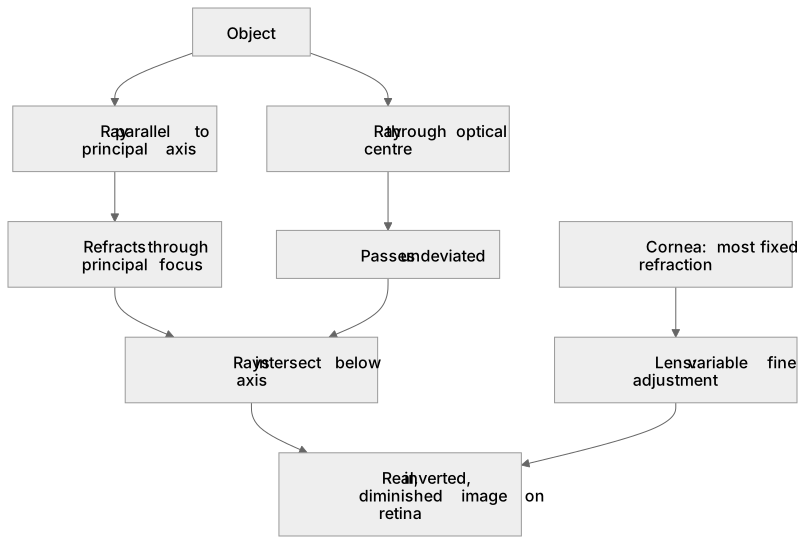
Key words
Say what each word means before you turn the card.
Accommodation
Try answering aloud or in your head before turning the card.
Real image
Try answering aloud or in your head before turning the card.
Cornea
Try answering aloud or in your head before turning the card.
Thin lens equation
Try answering aloud or in your head before turning the card.
See every definition
- Accommodation
- A change in lens focal length or power, with ciliary muscles relaxing for distant objects and contracting for near objects.
- Real image
- An inverted, diminished image formed on the retina, which acts as the fixed image plane.
- Cornea
- Provides most of the fixed refraction, contributing the greater fixed convergence, while the lens provides variable fine adjustment.
- Thin lens equation
- 1/f = 1/u + 1/v, used with v fixed near 2.5 cm to show how f must change as u changes.
Label the diagram
Some boxes have lost their names. Pick the right name for each number.
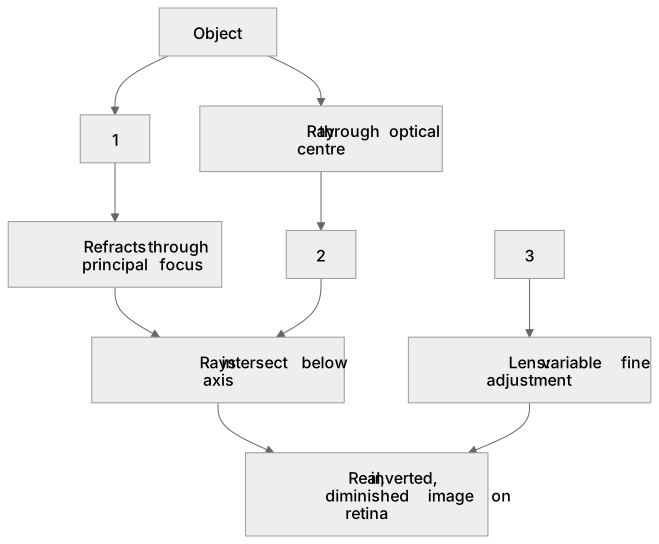
1Box 1
2Box 2
3Box 3
There is more to this lesson
The full lesson goes on to check your understanding and help you earn the marks. Create a free account to carry on, with your progress saved.
A week of Premium from your first lesson · Then the free plan continues · No card, no charge
Test your understanding of Physics of vision (A-level only): The eye as an optical refracting system, including ray diagrams of image formation.
Active recall beats re-reading. Take an instant quiz now to test what you’ve learned and lock it into long-term memory.
A week of Premium from your first lesson · Then the free plan continues · No card, no charge