AQA · A-Level · Physics
Course version: 7408 · Version from Sept 2016
The potential divider used to supply constant or variable potential…
Full specification wording
Potential divider: The potential divider used to supply constant or variable potential difference from a power supply.
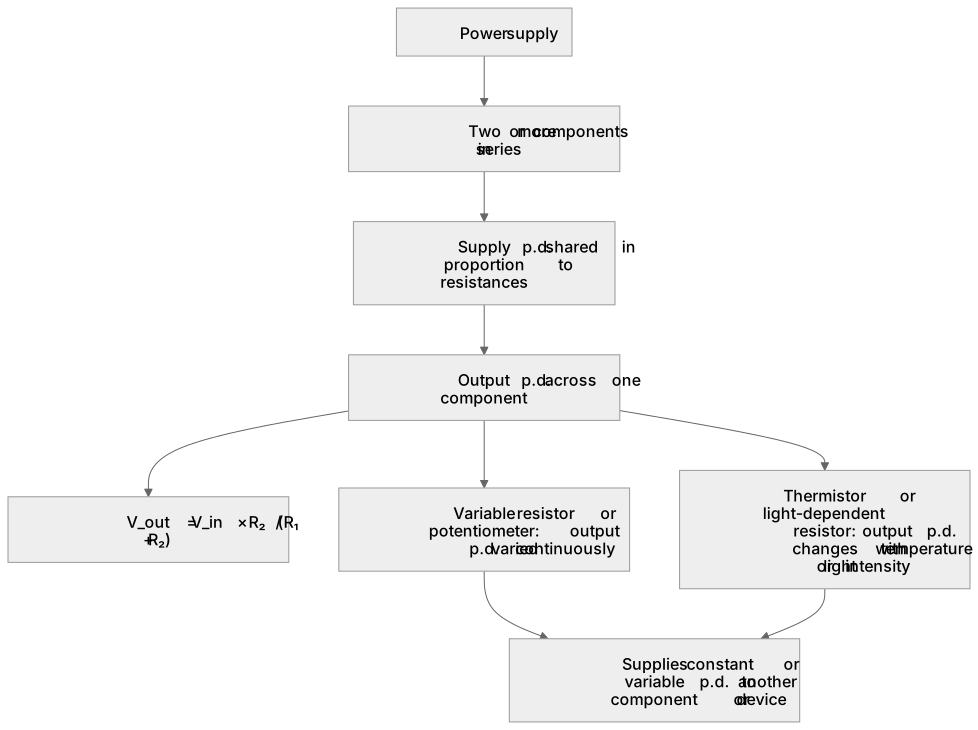
A potential divider consists of two or more components in series across a power supply.
Checked against the AQA 7408 specification (opens in a new tab) on .
- Point 1 of 2
- 4 key terms
Study notes
From the checked teaching notes for this specification point.
The idea
A potential divider consists of two or more components in series across a power supply. The supply p.d. is shared between the components in proportion to their resistances, so the output p.d. across one component can be set to a required value. For two resistors, V_out = V_in × R₂ / (R₁ + R₂). If one resistor is replaced by a variable resistor or a potentiometer, the output p.d. can be varied continuously. A thermistor or light-dependent resistor can also form part of a potential divider so that the output p.d. changes with temperature or light intensity. This makes the potential divider a key circuit for supplying a constant or variable p.d. to another component or device.
What earns the marks
- Describe a potential divider as two or more components connected in series across a power supply.
- State that the potential difference across each component is proportional to its resistance when the current is the same.
- Use the potential divider equation V_out = V_in × R₂ / (R₁ + R₂) to calculate an output p.d.
- Explain how replacing a fixed resistor with a variable resistor or using a potentiometer allows the output p.d. to be varied.
- Explain how a thermistor or light-dependent resistor in a potential divider produces an output p.d. that changes with temperature or light intensity.
- Design or interpret a potential divider circuit to supply a required constant or variable p.d. to a component.
Common mistakes and how to put them right
Assuming the output p.d. is always half the supply p.d.
Put it right: The output p.d. depends on the ratio of the resistances, so it is half only when the two resistances are equal.
Using the resistance of the component across which the output is not taken in the numerator of the potential divider equation.
Put it right: The numerator is the resistance across which the output p.d. is measured.
Ignoring the effect of connecting a load across the output.
Put it right: A load in parallel with the output resistor changes the effective resistance and therefore changes the output p.d.
Exam tips
- Sketch the circuit clearly and label the input p.d., output p.d. and component resistances before calculating.
- When using the potential divider equation, identify which resistor is R₂ by checking where the output p.d. is measured.
- For variable output questions, state how the resistance change affects the share of the supply p.d. and hence the output.
Try the lesson
The start of the Potential divider: The potential divider used to supply constant or variable potential difference from a power supply. lesson, made from checked teaching notes for this specification point.
Have a go first
A potential divider consists of two equal resistors in series across a 6.0 V supply. What is the potential difference across one of the resistors?
Listen
A potential divider consists of two or more components in series across a power supply. The supply p.d. is shared between the components in proportion to their resistances, so the output p.d. across one component can be set to a required value. For two resistors, V_out = V_in × R₂ / (R₁ + R₂). If one resistor is replaced by a variable resistor or a potentiometer, the output p.d. can be varied continuously. A thermistor or light-dependent resistor can also form part of a potential divider so that the output p.d. changes with temperature or light intensity. This makes the potential divider a key circuit for supplying a constant or variable p.d. to another component or device. A strong answer earns marks for these points. Describe a potential divider as two or more components connected in series across a power supply. State that the potential difference across each component is proportional to its resistance when the current is the same. Use the potential divider equation V_out = V_in × R₂ / (R₁ + R₂) to calculate an output p.d. Explain how replacing a fixed resistor with a variable resistor or using a potentiometer allows the output p.d. to be varied. A common slip: Assuming the output p.d. is always half the supply p.d. Instead, the output p.d. depends on the ratio of the resistances, so it is half only when the two resistances are equal. Exam tip: Sketch the circuit clearly and label the input p.d., output p.d. and component resistances before calculating.
See it
Key words
Say what each word means before you turn the card.
Potential divider
Try answering aloud or in your head before turning the card.
Resistance ratio and potential difference
Try answering aloud or in your head before turning the card.
Variable resistors and potentiometers
Try answering aloud or in your head before turning the card.
Sensors in potential divider circuits
Try answering aloud or in your head before turning the card.
See every definition
- Potential divider
- A circuit of two or more components in series across a power supply, used to supply a constant or variable potential difference from that supply.
- Resistance ratio and potential difference
- The supply p.d. is shared between the components in proportion to their resistances when the current is the same.
- Variable resistors and potentiometers
- Replacing a fixed resistor with one of these allows the output p.d. to be varied continuously.
- Sensors in potential divider circuits
- A thermistor or light-dependent resistor can form part of the circuit so that the output p.d. changes with temperature or light intensity.
Label the diagram
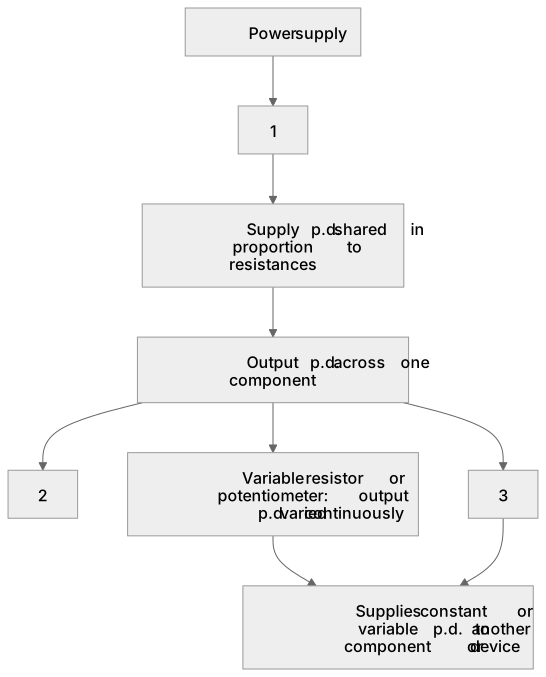
Some boxes have lost their names. Pick the right name for each number.
1Box 1
2Box 2
3Box 3
There is more to this lesson
The full lesson goes on to check your understanding and help you earn the marks. Create a free account to carry on, with your progress saved.
A week of Premium from your first lesson · Then the free plan continues · No card, no charge
Test your understanding of Potential divider: The potential divider used to supply constant or variable potential difference from a power supply.
Active recall beats re-reading. Take an instant quiz now to test what you’ve learned and lock it into long-term memory.
A week of Premium from your first lesson · Then the free plan continues · No card, no charge