AQA · A-Level · Physics
Course version: 7408 · Version from Sept 2016
Independent effect of motion in horizontal and vertical directions of a…
Full specification wording
Projectile motion: Independent effect of motion in horizontal and vertical directions of a uniform gravitational field.
In a uniform gravitational field, the only force on a projectile after launch is its weight, acting vertically downwards.
Checked against the AQA 7408 specification (opens in a new tab) on .
- Point 1 of 7
- 4 key terms
Study notes
From the checked teaching notes for this specification point.
The idea
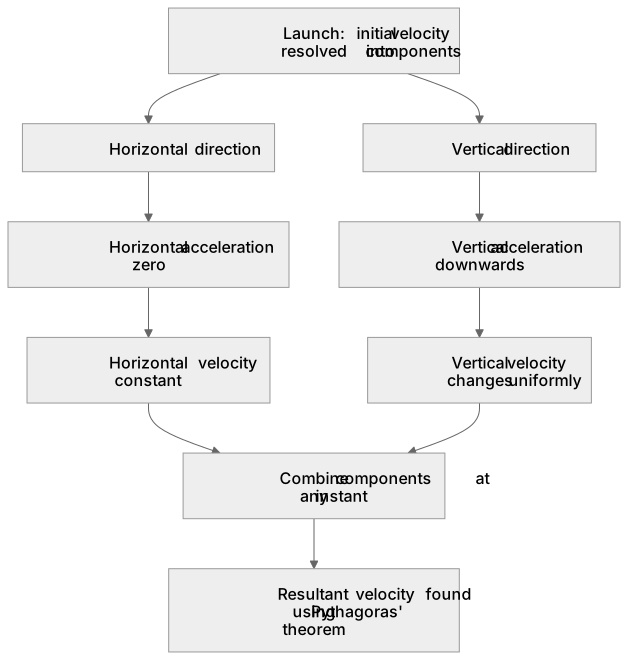
In a uniform gravitational field, the only force on a projectile after launch is its weight, acting vertically downwards. This produces a vertical acceleration of constant magnitude g, while the horizontal acceleration is zero. The two components of motion are therefore independent: the horizontal velocity stays constant, and the vertical velocity changes uniformly. A worked method is to resolve the initial velocity into horizontal and vertical components, treat each direction separately, then combine the components at any instant to find the resultant velocity. For example, a ball projected horizontally from a table has constant horizontal speed while falling with increasing vertical speed. Independence means the time to fall depends only on vertical quantities, not on the horizontal speed.
What earns the marks
- State that the only force acting after launch is weight, so the horizontal acceleration is zero and the vertical acceleration is g downwards.
- Resolve the initial velocity into perpendicular components using trigonometry, for example v cos θ horizontally and v sin θ vertically.
- Treat horizontal motion as uniform velocity and vertical motion as uniform acceleration, then link the two directions through the common time of flight.
- Explain that changing the horizontal component does not change the vertical time of flight, because the directions are independent.
- Combine perpendicular velocity components using Pythagoras' theorem to find the magnitude of the resultant velocity at a given instant.
Common mistakes and how to put them right
Treating the horizontal velocity as decreasing because of gravity.
Put it right by stating that gravity acts only vertically, so the horizontal velocity remains constant if air resistance is negligible.
Assuming a heavier projectile falls faster.
Put it right by noting that in a uniform field the vertical acceleration is g for all masses when air resistance is negligible.
Adding horizontal and vertical speeds directly as scalars.
Put it right by combining perpendicular components with Pythagoras' theorem.
Exam tips
- Always draw a diagram and mark the resolved components before substituting values into equations.
- Keep horizontal and vertical quantities in separate columns so that the common time of flight is used correctly.
- Check that each answer has a sensible direction as well as magnitude, especially for velocity at a particular instant.
Try the lesson
The start of the Projectile motion: Independent effect of motion in horizontal and vertical directions of a uniform gravitational field. lesson, made from checked teaching notes for this specification point.
Have a go first
A ball is projected horizontally from a cliff. Ignoring air resistance, what happens to the horizontal component of its velocity as it falls?
Listen
In a uniform gravitational field, the only force on a projectile after launch is its weight, acting vertically downwards. This produces a vertical acceleration of constant magnitude g, while the horizontal acceleration is zero. The two components of motion are therefore independent: the horizontal velocity stays constant, and the vertical velocity changes uniformly. A worked method is to resolve the initial velocity into horizontal and vertical components, treat each direction separately, then combine the components at any instant to find the resultant velocity. For example, a ball projected horizontally from a table has constant horizontal speed while falling with increasing vertical speed. Independence means the time to fall depends only on vertical quantities, not on the horizontal speed. A strong answer earns marks for these points. State that the only force acting after launch is weight, so the horizontal acceleration is zero and the vertical acceleration is g downwards. Resolve the initial velocity into perpendicular components using trigonometry, for example v cos θ horizontally and v sin θ vertically. Treat horizontal motion as uniform velocity and vertical motion as uniform acceleration, then link the two directions through the common time of flight. Explain that changing the horizontal component does not change the vertical time of flight, because the directions are independent. A common slip: Treating the horizontal velocity as decreasing because of gravity. Instead, stating that gravity acts only vertically, so the horizontal velocity remains constant if air resistance is negligible. Exam tip: Always draw a diagram and mark the resolved components before substituting values into equations.
See it
Key words
Say what each word means before you turn the card.
Independence of perpendicular motions
Try answering aloud or in your head before turning the card.
Uniform acceleration in a gravitational field
Try answering aloud or in your head before turning the card.
Resolution of vectors into perpendicular components
Try answering aloud or in your head before turning the card.
Combining components to find resultant velocity
Try answering aloud or in your head before turning the card.
See every definition
- Independence of perpendicular motions
- The horizontal velocity stays constant while the vertical velocity changes uniformly, so the two components of motion are independent.
- Uniform acceleration in a gravitational field
- The only force after launch is weight, producing a vertical acceleration of constant magnitude g, while the horizontal acceleration is zero.
- Resolution of vectors into perpendicular components
- The initial velocity is resolved into horizontal and vertical components, each direction treated separately.
- Combining components to find resultant velocity
- The components at any instant are combined to find the resultant velocity, using Pythagoras' theorem for the magnitude.
Label the diagram
Some boxes have lost their names. Pick the right name for each number.
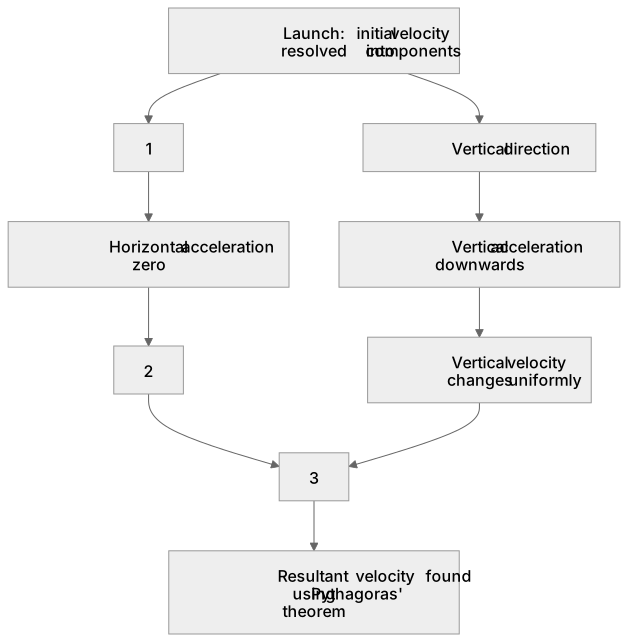
1Box 1
2Box 2
3Box 3
There is more to this lesson
The full lesson goes on to check your understanding and help you earn the marks. Create a free account to carry on, with your progress saved.
A week of Premium from your first lesson · Then the free plan continues · No card, no charge
Test your understanding of Projectile motion: Independent effect of motion in horizontal and vertical directions of a uniform gravitational field.
Active recall beats re-reading. Take an instant quiz now to test what you’ve learned and lock it into long-term memory.
A week of Premium from your first lesson · Then the free plan continues · No card, no charge