AQA · A-Level · Physics
Course version: 7408 · Version from Sept 2016
Projectile motion: Terminal speed.
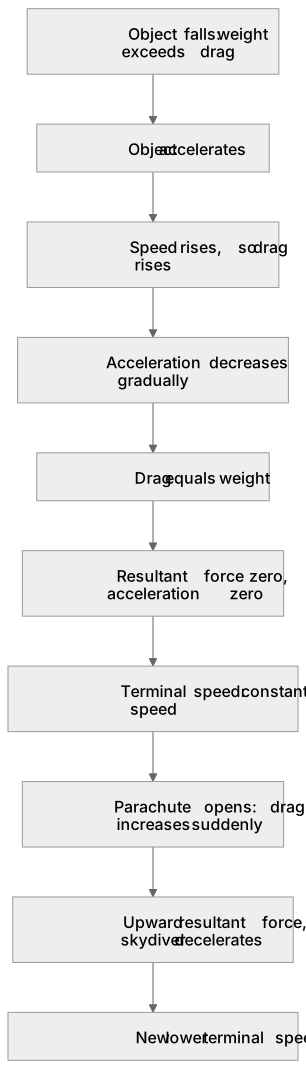
Terminal speed is reached when a falling object's drag force grows until it balances the object's weight, so the resultant force is zero and the acceleration is zero.
Checked against the AQA 7408 specification (opens in a new tab) on .
- Point 5 of 7
- 2 key terms
Study notes
From the checked teaching notes for this specification point.
The idea
Terminal speed is reached when a falling object's drag force grows until it balances the object's weight, so the resultant force is zero and the acceleration is zero. The object then falls at constant speed. As speed rises, drag rises; the acceleration therefore decreases gradually rather than switching off instantly. A skydiver provides a clear example: after jumping, weight exceeds drag, so the skydiver accelerates; as speed increases, drag increases until it equals weight and terminal speed is reached. Opening a parachute increases drag suddenly, so the skydiver decelerates to a new, lower terminal speed. The same reasoning applies to any object moving through a fluid under a driving force.
What earns the marks
- At terminal speed the drag force equals the weight for a falling object, so the resultant force is zero.
- Zero resultant force means zero acceleration, so the velocity is constant in magnitude and direction.
- Drag increases with speed, so the acceleration of a falling object decreases as it speeds up.
- Terminal speed is a dynamic balance, not a fixed property of the object alone; it depends on shape, mass and fluid.
- Changing the shape, for example by opening a parachute, increases drag and produces a new lower terminal speed.
Common mistakes and how to put them right
Saying there is no force at terminal speed.
Put it right by stating that weight and drag are equal and opposite, so the resultant force is zero.
Claiming the object stops accelerating only because it has reached a maximum possible speed.
Put it right by explaining that drag has grown until it balances weight.
Assuming terminal speed is the same for all objects of equal mass.
Put it right by noting that shape and area affect drag and therefore the terminal speed.
Exam tips
- Use the sequence weight greater than drag, then weight equals drag, and link each stage to the sign of the acceleration.
- State explicitly that zero resultant force gives zero acceleration and therefore constant velocity.
- When a parachute opens, describe the sudden increase in drag, the upward resultant force and the deceleration to a new lower terminal speed.
Try the lesson
The start of the Projectile motion: Terminal speed. lesson, made from checked teaching notes for this specification point.
Have a go first
A skydiver falls through the air and reaches terminal speed. What is the resultant force on the skydiver at terminal speed?
Listen
Terminal speed is reached when a falling object's drag force grows until it balances the object's weight, so the resultant force is zero and the acceleration is zero. The object then falls at constant speed. As speed rises, drag rises; the acceleration therefore decreases gradually rather than switching off instantly. A skydiver provides a clear example: after jumping, weight exceeds drag, so the skydiver accelerates; as speed increases, drag increases until it equals weight and terminal speed is reached. Opening a parachute increases drag suddenly, so the skydiver decelerates to a new, lower terminal speed. The same reasoning applies to any object moving through a fluid under a driving force. A strong answer earns marks for these points. At terminal speed the drag force equals the weight for a falling object, so the resultant force is zero. Zero resultant force means zero acceleration, so the velocity is constant in magnitude and direction. Drag increases with speed, so the acceleration of a falling object decreases as it speeds up. Terminal speed is a dynamic balance, not a fixed property of the object alone; it depends on shape, mass and fluid. A common slip: Saying there is no force at terminal speed. Instead, stating that weight and drag are equal and opposite, so the resultant force is zero. Exam tip: Use the sequence weight greater than drag, then weight equals drag, and link each stage to the sign of the acceleration.
See it
Key words
Say what each word means before you turn the card.
Terminal speed
Try answering aloud or in your head before turning the card.
Drag dependence on speed
Try answering aloud or in your head before turning the card.
See every definition
- Terminal speed
- Reached when a falling object's drag force grows until it balances the object's weight, so the resultant force and the acceleration are zero.
- Drag dependence on speed
- As speed rises, drag rises, so the acceleration of a falling object decreases gradually rather than switching off instantly.
Label the diagram
Some boxes have lost their names. Pick the right name for each number.
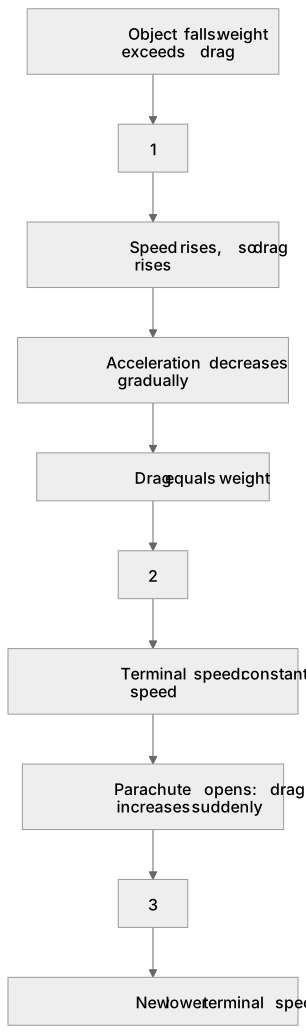
1Box 1
2Box 2
3Box 3
There is more to this lesson
The full lesson goes on to check your understanding and help you earn the marks. Create a free account to carry on, with your progress saved.
A week of Premium from your first lesson · Then the free plan continues · No card, no charge
Test your understanding of Projectile motion: Terminal speed.
Active recall beats re-reading. Take an instant quiz now to test what you’ve learned and lock it into long-term memory.
A week of Premium from your first lesson · Then the free plan continues · No card, no charge