AQA · A-Level · Physics
Course version: 7408 · Version from Sept 2016
Projectile motion: Qualitative treatment of lift and drag forces.
Lift and drag are contact forces exerted by a fluid on a body moving through it.
Checked against the AQA 7408 specification (opens in a new tab) on .
- Point 4 of 7
- 4 key terms
Study notes
From the checked teaching notes for this specification point.
The idea
Lift and drag are contact forces exerted by a fluid on a body moving through it. Drag acts opposite to the relative motion of the fluid and increases with speed, cross-sectional area and fluid density; it also depends on shape. Lift acts perpendicular to the relative flow and arises when a shape deflects fluid, so a wing generates upward lift as air is pushed downward. In projectile motion, drag reduces both the horizontal and vertical velocity components, so the path becomes asymmetric and the range and maximum height fall. Lift can matter for spinning or aerofoil-shaped projectiles. A useful method is to draw the velocity vector, then draw drag antiparallel to it and lift at 90° to it, before resolving.
What earns the marks
- Drag is a fluid resistance force acting in the direction opposite to the body's velocity relative to the fluid.
- Drag magnitude increases with speed, frontal area and fluid density, and depends on the object's shape.
- Lift acts perpendicular to the relative flow direction and is produced when a shape deflects the fluid.
- For a projectile, drag removes energy and reduces both velocity components, lowering range and maximum height.
- Lift can change the vertical motion of a spinning or aerofoil-shaped projectile, so the trajectory is not a simple parabola.
- A valid qualitative explanation links force directions to the resulting change in the velocity vector.
Common mistakes and how to put them right
Treating drag as always vertically upward.
Put it right by stating that drag is antiparallel to the relative velocity, so it tilts as the projectile moves.
Confusing lift with the upward normal force from a solid surface.
Put it right by defining lift as a fluid force perpendicular to the relative flow.
Assuming drag is constant during flight.
Put it right by explaining that drag falls as the projectile slows, so the deceleration is not uniform.
Exam tips
- Sketch the velocity vector first, then add drag opposite it and lift at 90° to it before writing any explanation.
- Use comparative language such as greater speed gives greater drag, and link each force to the change it causes in the velocity components.
- When asked about projectile motion with drag, state that the path is asymmetric and that range and maximum height are reduced compared with ideal projectile motion.
Try the lesson
The start of the Projectile motion: Qualitative treatment of lift and drag forces. lesson, made from checked teaching notes for this specification point.
Have a go first
A skydiver falls vertically downwards through the air. Which force is the primary upward aerodynamic force opposing the skydiver's downward motion?
Listen
Lift and drag are contact forces exerted by a fluid on a body moving through it. Drag acts opposite to the relative motion of the fluid and increases with speed, cross-sectional area and fluid density; it also depends on shape. Lift acts perpendicular to the relative flow and arises when a shape deflects fluid, so a wing generates upward lift as air is pushed downward. In projectile motion, drag reduces both the horizontal and vertical velocity components, so the path becomes asymmetric and the range and maximum height fall. Lift can matter for spinning or aerofoil-shaped projectiles. A useful method is to draw the velocity vector, then draw drag antiparallel to it and lift at 90° to it, before resolving. A strong answer earns marks for these points. Drag is a fluid resistance force acting in the direction opposite to the body's velocity relative to the fluid. Drag magnitude increases with speed, frontal area and fluid density, and depends on the object's shape. Lift acts perpendicular to the relative flow direction and is produced when a shape deflects the fluid. For a projectile, drag removes energy and reduces both velocity components, lowering range and maximum height. A common slip: Treating drag as always vertically upward. Instead, stating that drag is antiparallel to the relative velocity, so it tilts as the projectile moves. Exam tip: Sketch the velocity vector first, then add drag opposite it and lift at 90° to it before writing any explanation.
See it

Key words
Say what each word means before you turn the card.
Drag
Try answering aloud or in your head before turning the card.
Lift
Try answering aloud or in your head before turning the card.
Vector resolution of velocity and force
Try answering aloud or in your head before turning the card.
Effect of drag on projectile trajectories
Try answering aloud or in your head before turning the card.
See every definition
- Drag
- A contact force exerted by a fluid on a body moving through it, acting opposite to the relative motion of the fluid.
- Lift
- A contact force exerted by a fluid on a body moving through it, acting perpendicular to the relative flow and arising when a shape deflects fluid.
- Vector resolution of velocity and force
- A method of drawing the velocity vector, then drawing drag antiparallel to it and lift at 90° to it, before resolving.
- Effect of drag on projectile trajectories
- Drag reduces both the horizontal and vertical velocity components, so the path becomes asymmetric and the range and maximum height fall.
Label the diagram
Some boxes have lost their names. Pick the right name for each number.
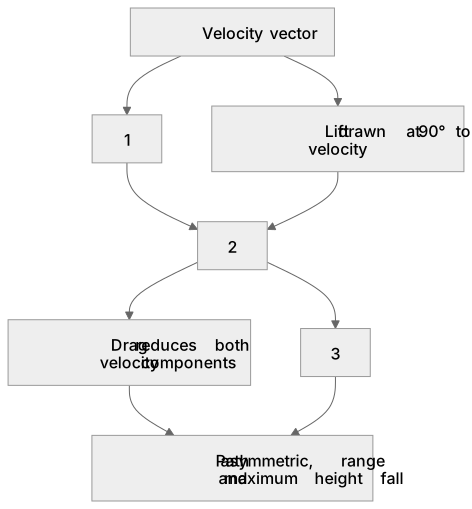
1Box 1
2Box 2
3Box 3
There is more to this lesson
The full lesson goes on to check your understanding and help you earn the marks. Create a free account to carry on, with your progress saved.
A week of Premium from your first lesson · Then the free plan continues · No card, no charge
Test your understanding of Projectile motion: Qualitative treatment of lift and drag forces.
Active recall beats re-reading. Take an instant quiz now to test what you’ve learned and lock it into long-term memory.
A week of Premium from your first lesson · Then the free plan continues · No card, no charge