AQA · A-Level · Physics
Course version: 7408 · Version from Sept 2016
Only knowledge of up (u), down (d) and strange (s) quarks and their…
Full specification wording
Quarks and antiquarks: Only knowledge of up (u), down (d) and strange (s) quarks and their antiquarks will be tested.
Quarks are fundamental particles that combine to form hadrons such as protons and neutrons.
Checked against the AQA 7408 specification (opens in a new tab) on .
- Point 3 of 4
- 4 key terms
Study notes
From the checked teaching notes for this specification point.
The idea
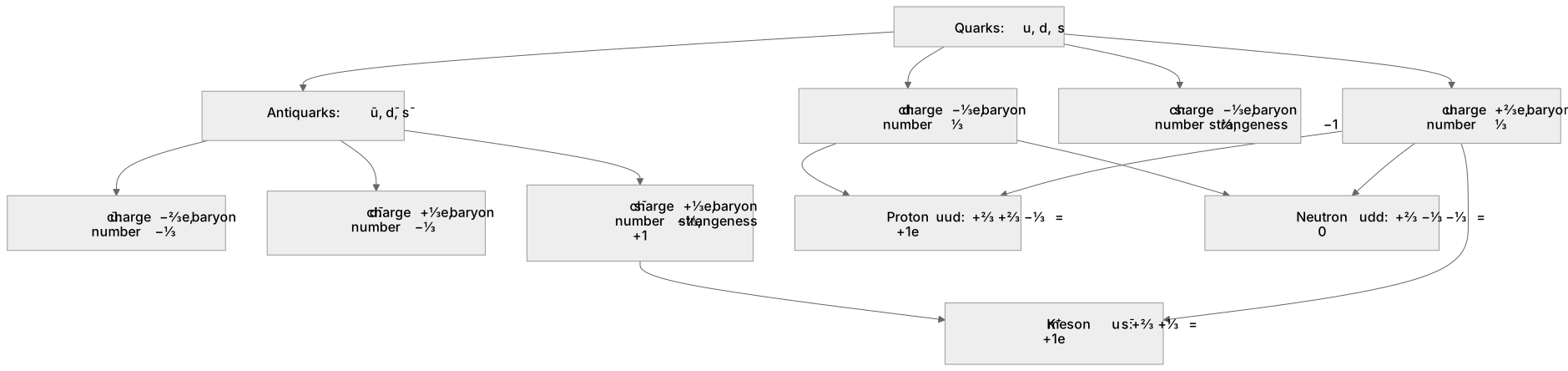
Quarks are fundamental particles that combine to form hadrons such as protons and neutrons. You need to know three quark flavours: up (u), down (d) and strange (s), together with their antiquarks. Each quark carries baryon number ⅓ and a fractional charge: u has charge +⅔e, d has charge −⅓e and s has charge −⅓e. Antiquarks have the opposite sign of every quantum number, so ū has charge −⅔e, d̄ has charge +⅓e and s̄ has charge +⅓e, each with baryon number −⅓. For example, a proton is uud, giving charge +⅔ +⅔ −⅓ = +1e, while a neutron is udd, giving +⅔ −⅓ −⅓ = 0. A strange particle such as the K⁺ meson is u s̄, giving +⅔ +⅓ = +1e. Questions may ask you to deduce the quark composition of a particle from its charge and strangeness, or to check whether a proposed composition is consistent.
What earns the marks
- States that up, down and strange are the only quark flavours required, with symbols u, d and s.
- Gives the charges: u = +⅔e, d = −⅓e, s = −⅓e, and antiquarks with opposite sign.
- States that each quark has baryon number ⅓ and each antiquark has baryon number −⅓.
- Explains that antiquarks have opposite values of charge, baryon number and strangeness to their corresponding quarks.
- Applies charge conservation to deduce or check a hadron composition, for example proton uud gives +1e.
- Uses strangeness values: s has strangeness −1, s̄ has strangeness +1, and u and d have strangeness 0.
Common mistakes and how to put them right
Writing the charge of the down quark as +⅓e instead of −⅓e.
Put it right by remembering that a neutron udd must have total charge zero.
Giving an antiquark the same charge sign as its quark.
Put it right by reversing the sign of every quantum number for an antiquark.
Forgetting that strange quarks carry strangeness −1 while strange antiquarks carry strangeness +1.
Put it right by treating strangeness as a quantum number that changes sign for antiparticles.
Exam tips
- Write the quark composition with charges underneath each symbol so charge conservation is visible in your working.
- When a question gives charge and strangeness, set up two simple equations and solve for the numbers of each quark.
- Check any proposed hadron by adding charges and baryon numbers; a valid baryon must have baryon number +1 and a valid meson must have baryon number 0.
Try the lesson
The start of the Quarks and antiquarks: Only knowledge of up (u), down (d) and strange (s) quarks and their antiquarks will be tested. lesson, made from checked teaching notes for this specification point.
Have a go first
Which of the following gives the electric charge of an up quark?
Listen
Quarks are fundamental particles that combine to form hadrons such as protons and neutrons. You need to know three quark flavours: up (u), down (d) and strange (s), together with their antiquarks. Each quark carries baryon number ⅓ and a fractional charge: u has charge +⅔e, d has charge −⅓e and s has charge −⅓e. Antiquarks have the opposite sign of every quantum number, so ū has charge −⅔e, d̄ has charge +⅓e and s̄ has charge +⅓e, each with baryon number −⅓. For example, a proton is uud, giving charge +⅔ +⅔ −⅓ = +1e, while a neutron is udd, giving +⅔ −⅓ −⅓ = 0. A strange particle such as the K⁺ meson is u s̄, giving +⅔ +⅓ = +1e. Questions may ask you to deduce the quark composition of a particle from its charge and strangeness, or to check whether a proposed composition is consistent. A strong answer earns marks for these points. States that up, down and strange are the only quark flavours required, with symbols u, d and s. Gives the charges: u = +⅔e, d = −⅓e, s = −⅓e, and antiquarks with opposite sign. States that each quark has baryon number ⅓ and each antiquark has baryon number −⅓. Explains that antiquarks have opposite values of charge, baryon number and strangeness to their corresponding quarks. A common slip: Writing the charge of the down quark as +⅓e instead of −⅓e. Instead, remembering that a neutron udd must have total charge zero. Exam tip: Write the quark composition with charges underneath each symbol so charge conservation is visible in your working.
See it
Key words
Say what each word means before you turn the card.
Quarks
Try answering aloud or in your head before turning the card.
Antiquarks
Try answering aloud or in your head before turning the card.
Baryon number
Try answering aloud or in your head before turning the card.
Strangeness
Try answering aloud or in your head before turning the card.
See every definition
- Quarks
- Fundamental particles that combine to form hadrons such as protons and neutrons, with flavours up (u), down (d) and strange (s).
- Antiquarks
- Particles that have the opposite sign of every quantum number, so ū has charge −⅔e, d̄ has charge +⅓e and s̄ has charge +⅓e, each with baryon number −⅓.
- Baryon number
- Each quark carries baryon number ⅓ and each antiquark has baryon number −⅓.
- Strangeness
- A quantum number where s has strangeness −1, s̄ has strangeness +1, and u and d have strangeness 0.
Label the diagram
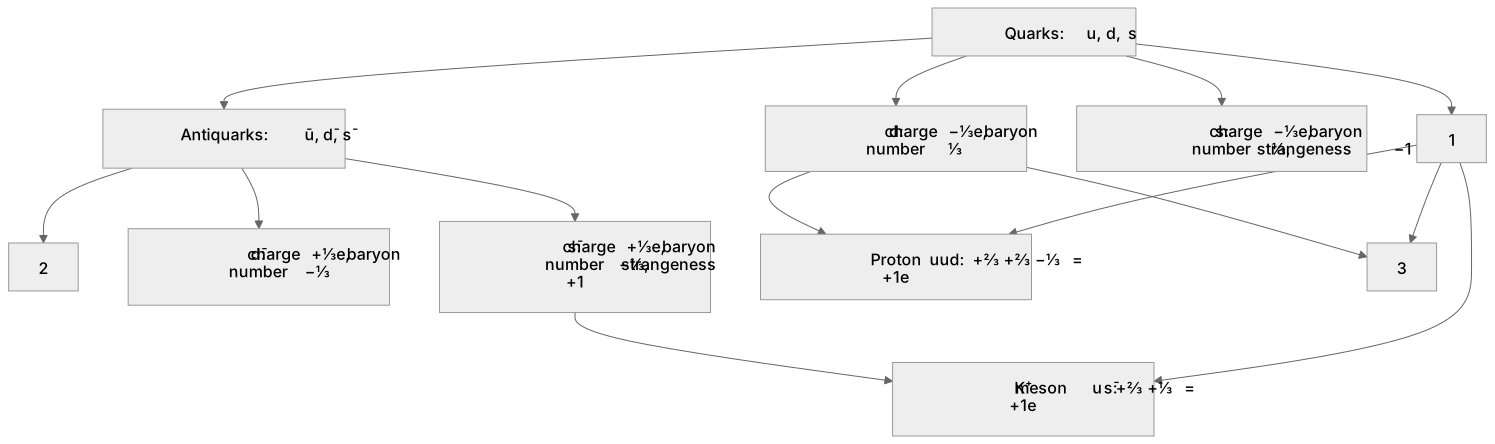
Some boxes have lost their names. Pick the right name for each number.
1Box 1
2Box 2
3Box 3
There is more to this lesson
The full lesson goes on to check your understanding and help you earn the marks. Create a free account to carry on, with your progress saved.
A week of Premium from your first lesson · Then the free plan continues · No card, no charge
Test your understanding of Quarks and antiquarks: Only knowledge of up (u), down (d) and strange (s) quarks and their antiquarks will be tested.
Active recall beats re-reading. Take an instant quiz now to test what you’ve learned and lock it into long-term memory.
A week of Premium from your first lesson · Then the free plan continues · No card, no charge