AQA · A-Level · Physics
Course version: 7408 · Version from Sept 2016
Quarks and antiquarks: The decay of the neutron should be known.
A free neutron is unstable and undergoes beta-minus decay.
Checked against the AQA 7408 specification (opens in a new tab) on .
- Point 4 of 4
- 4 key terms
Study notes
From the checked teaching notes for this specification point.
The idea
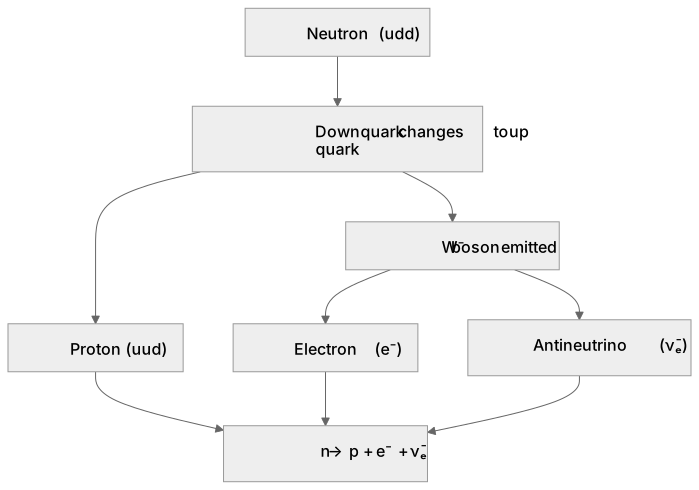
A free neutron is unstable and undergoes beta-minus decay. In quark terms, one down quark changes into an up quark, so the neutron (udd) becomes a proton (uud). The change d → u is accompanied by the emission of a W⁻ boson, which then decays into an electron and an antineutrino. The overall equation is n → p + e⁻ + ν̄ₑ. Charge is conserved: the neutron has charge 0, and the products have +1e, −1e and 0. Baryon number is conserved: the neutron and proton each have baryon number +1, while the electron and antineutrino have baryon number 0. Lepton number is also conserved, with the electron having lepton number +1 and the antineutrino having lepton number −1. You should be able to write the equation, identify the quark-level change and explain the role of the W⁻ boson.
What earns the marks
- Writes the decay equation n → p + e⁻ + ν̄ₑ with correct symbols and charges.
- States that a down quark changes into an up quark, so udd becomes uud.
- Identifies the W⁻ boson as the exchange particle mediating the weak interaction.
- Checks conservation of charge: 0 → +1 − 1 + 0.
- Checks conservation of baryon number: +1 → +1 + 0 + 0.
- Explains that the electron and antineutrino are leptons produced when the W⁻ boson decays.
Common mistakes and how to put them right
Writing an electron neutrino instead of an electron antineutrino.
Put it right by using ν̄ₑ because lepton number must be conserved.
Omitting the antineutrino from the equation.
Put it right by including all three products so charge and lepton number balance.
Stating that an up quark changes into a down quark.
Put it right by noting that the neutron's down quark changes into an up quark, converting udd to uud.
Exam tips
- Write the full equation first, then annotate each particle with its charge and baryon number to show conservation.
- Use the quark-level change d → u to explain why the neutron becomes a proton rather than simply quoting the nucleon equation.
- Remember that beta-minus decay involves a W⁻ boson, while beta-plus decay involves a W⁺ boson.
Try the lesson
The start of the Quarks and antiquarks: The decay of the neutron should be known. lesson, made from checked teaching notes for this specification point.
Have a go first
Into which particles does a free neutron decay?
Listen
A free neutron is unstable and undergoes beta-minus decay. In quark terms, one down quark changes into an up quark, so the neutron (udd) becomes a proton (uud). The change d → u is accompanied by the emission of a W⁻ boson, which then decays into an electron and an antineutrino. The overall equation is n → p + e⁻ + ν̄ₑ. Charge is conserved: the neutron has charge 0, and the products have +1e, −1e and 0. Baryon number is conserved: the neutron and proton each have baryon number +1, while the electron and antineutrino have baryon number 0. Lepton number is also conserved, with the electron having lepton number +1 and the antineutrino having lepton number −1. You should be able to write the equation, identify the quark-level change and explain the role of the W⁻ boson. A strong answer earns marks for these points. Writes the decay equation n → p + e⁻ + ν̄ₑ with correct symbols and charges. States that a down quark changes into an up quark, so udd becomes uud. Identifies the W⁻ boson as the exchange particle mediating the weak interaction. Checks conservation of charge: 0 → +1 − 1 + 0. A common slip: Writing an electron neutrino instead of an electron antineutrino. Instead, using ν̄ₑ because lepton number must be conserved. Exam tip: Write the full equation first, then annotate each particle with its charge and baryon number to show conservation.
See it
Key words
Say what each word means before you turn the card.
Weak interaction and beta decay
Try answering aloud or in your head before turning the card.
Quark transformation and hadron change
Try answering aloud or in your head before turning the card.
Conservation laws in particle decays
Try answering aloud or in your head before turning the card.
Exchange particles and Feynman diagrams
Try answering aloud or in your head before turning the card.
See every definition
- Weak interaction and beta decay
- A free neutron is unstable and undergoes beta-minus decay, in which a down quark changes into an up quark and a W⁻ boson is emitted.
- Quark transformation and hadron change
- One down quark changes into an up quark, so the neutron (udd) becomes a proton (uud).
- Conservation laws in particle decays
- Charge, baryon number and lepton number are each conserved, with the electron having lepton number +1 and the antineutrino having lepton number −1.
- Exchange particles and Feynman diagrams
- The W⁻ boson is the exchange particle mediating the weak interaction, and it then decays into an electron and an antineutrino.
Label the diagram
Some boxes have lost their names. Pick the right name for each number.
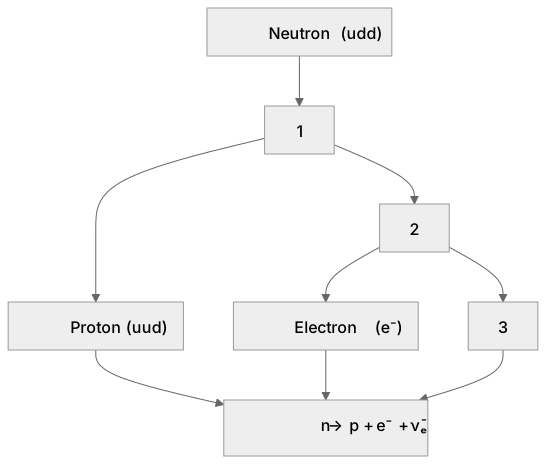
1Box 1
2Box 2
3Box 3
There is more to this lesson
The full lesson goes on to check your understanding and help you earn the marks. Create a free account to carry on, with your progress saved.
A week of Premium from your first lesson · Then the free plan continues · No card, no charge
Test your understanding of Quarks and antiquarks: The decay of the neutron should be known.
Active recall beats re-reading. Take an instant quiz now to test what you’ve learned and lock it into long-term memory.
A week of Premium from your first lesson · Then the free plan continues · No card, no charge