AQA · A-Level · Physics
Course version: 7408 · Version from Sept 2016
Quasars (A-level only): Discovery of quasars as bright radio sources.
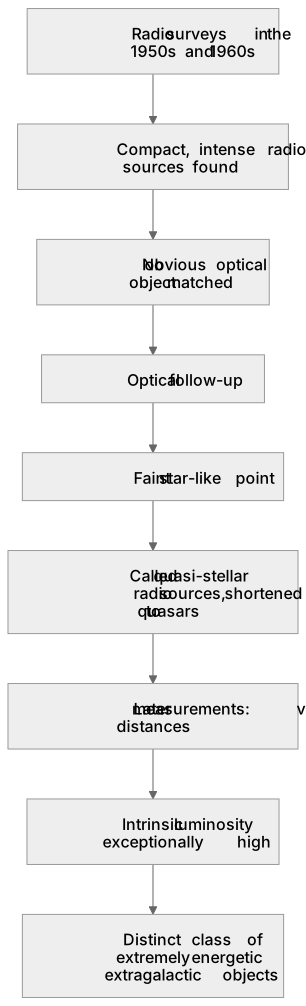
Quasars were first identified when radio surveys in the 1950s and 1960s found compact, intense radio sources that did not match any obvious optical object.
Checked against the AQA 7408 specification (opens in a new tab) on .
- Point 2 of 4
- 4 key terms
Study notes
From the checked teaching notes for this specification point.
The idea
Quasars were first identified when radio surveys in the 1950s and 1960s found compact, intense radio sources that did not match any obvious optical object. Optical follow-up showed faint star-like points, so they were called quasi-stellar radio sources, shortened to quasars. Their radio power is enormous, often far exceeding a normal galaxy, yet the optical image is point-like. Later measurements showed they lie at vast distances, so their intrinsic luminosity must be exceptionally high. A useful method is to compare a quasar's radio flux with that of a nearby galaxy: even when the quasar appears faint optically, its radio emission can dominate. This established quasars as a distinct class of extremely energetic extragalactic objects, not nearby stars.
What earns the marks
- Quasars were discovered through radio astronomy surveys that detected strong, compact radio sources before their optical counterparts were recognised.
- Early optical identification showed a faint, star-like point rather than an extended galaxy, leading to the name quasi-stellar radio source.
- The radio emission from a quasar can be far more powerful than that of a normal galaxy, indicating an exceptionally energetic source.
- Quasars are extragalactic: their faint optical appearance combined with large distances implies very high intrinsic power output.
- The discovery required combining radio positions with optical telescopes to match a radio source to a specific point-like object.
- Quasar radio emission is often variable and compact, distinguishing it from extended radio lobes associated with many galaxies.
Common mistakes and how to put them right
Treating quasars as nearby stars because their optical images are point-like.
Put it right: Their red shifts and distances show they are extremely remote extragalactic objects.
Assuming the first quasars were found by optical telescopes alone.
Put it right: They were initially detected as strong radio sources, with optical identification following.
Confusing quasars with pulsars or normal radio galaxies.
Put it right: Quasars are compact, optically star-like sources with huge power outputs, unlike pulsars in our Galaxy or extended radio galaxies.
Exam tips
- Link the name quasar to its origin: quasi-stellar radio source, and explain why the optical image looked star-like.
- When describing discovery, sequence the evidence: radio detection first, then optical identification, then distance measurement.
- Use comparative language about power output, such as far greater than a normal galaxy, rather than vague words like very big.
Try the lesson
The start of the Quasars (A-level only): Discovery of quasars as bright radio sources. lesson, made from checked teaching notes for this specification point.
Have a go first
Quasars were first identified as which type of bright source?
Listen
Quasars were first identified when radio surveys in the 1950s and 1960s found compact, intense radio sources that did not match any obvious optical object. Optical follow-up showed faint star-like points, so they were called quasi-stellar radio sources, shortened to quasars. Their radio power is enormous, often far exceeding a normal galaxy, yet the optical image is point-like. Later measurements showed they lie at vast distances, so their intrinsic luminosity must be exceptionally high. A useful method is to compare a quasar's radio flux with that of a nearby galaxy: even when the quasar appears faint optically, its radio emission can dominate. This established quasars as a distinct class of extremely energetic extragalactic objects, not nearby stars. A strong answer earns marks for these points. Quasars were discovered through radio astronomy surveys that detected strong, compact radio sources before their optical counterparts were recognised. Early optical identification showed a faint, star-like point rather than an extended galaxy, leading to the name quasi-stellar radio source. The radio emission from a quasar can be far more powerful than that of a normal galaxy, indicating an exceptionally energetic source. Quasars are extragalactic: their faint optical appearance combined with large distances implies very high intrinsic power output. A common slip: Treating quasars as nearby stars because their optical images are point-like. Instead, their red shifts and distances show they are extremely remote extragalactic objects. Exam tip: Link the name quasar to its origin: quasi-stellar radio source, and explain why the optical image looked star-like.
See it
Key words
Say what each word means before you turn the card.
Quasars
Try answering aloud or in your head before turning the card.
Quasi-stellar radio sources
Try answering aloud or in your head before turning the card.
Radio astronomy surveys
Try answering aloud or in your head before turning the card.
Extragalactic
Try answering aloud or in your head before turning the card.
See every definition
- Quasars
- Compact, intense radio sources with faint star-like optical images, later shown to lie at vast distances with exceptionally high intrinsic luminosity.
- Quasi-stellar radio sources
- The original name for quasars, given because optical follow-up showed faint star-like points rather than extended galaxies.
- Radio astronomy surveys
- Surveys in the 1950s and 1960s that detected strong, compact radio sources before their optical counterparts were recognised.
- Extragalactic
- Lying beyond our Galaxy, as quasars do, being extremely remote objects rather than nearby stars.
Label the diagram
Some boxes have lost their names. Pick the right name for each number.
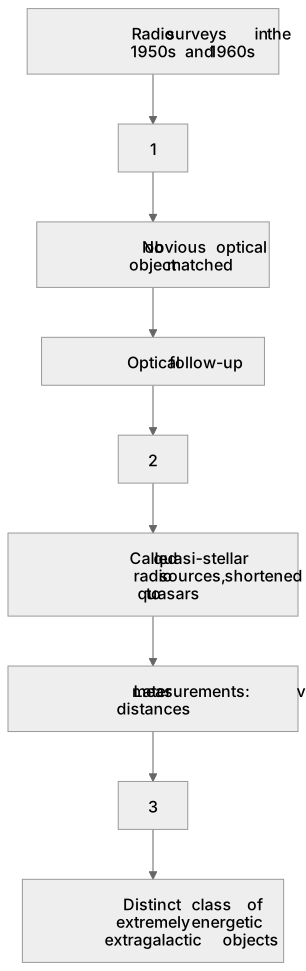
1Box 1
2Box 2
3Box 3
There is more to this lesson
The full lesson goes on to check your understanding and help you earn the marks. Create a free account to carry on, with your progress saved.
A week of Premium from your first lesson · Then the free plan continues · No card, no charge
Test your understanding of Quasars (A-level only): Discovery of quasars as bright radio sources.
Active recall beats re-reading. Take an instant quiz now to test what you’ve learned and lock it into long-term memory.
A week of Premium from your first lesson · Then the free plan continues · No card, no charge