AQA · A-Level · Physics
Course version: 7408 · Version from Sept 2016
Quasars show large optical red shifts; estimation involving distance and…
Full specification wording
Quasars (A-level only): Quasars show large optical red shifts; estimation involving distance and power output.
Optical spectra of quasars show emission lines shifted to much longer wavelengths than in laboratory sources.
Checked against the AQA 7408 specification (opens in a new tab) on .
- Point 3 of 4
- 4 key terms
Study notes
From the checked teaching notes for this specification point.
The idea
Optical spectra of quasars show emission lines shifted to much longer wavelengths than in laboratory sources. The red shift z is defined by z = (λ_observed − λ_rest) / λ_rest, and for cosmological red shifts it indicates recession and distance through Hubble's law, v = H₀d, with v = zc for small z. A large z therefore implies a very distant quasar. Because apparent brightness falls with distance squared, a quasar that still appears bright at huge distance must have an enormous power output. Estimation typically involves reading a spectrum to find z, using v = zc and d = v / H₀ to estimate distance, then comparing apparent flux with a known standard to estimate luminosity. Uncertainties in H₀ and in flux calibration make such estimates approximate.
What earns the marks
- The red shift z is calculated from observed and rest wavelengths using z = (λ_observed − λ_rest) / λ_rest.
- For small cosmological red shifts, recession speed is estimated as v = zc, where c is the speed of light.
- Distance is estimated from Hubble's law, v = H₀d, so d = v / H₀, using an accepted value of the Hubble constant.
- Apparent brightness decreases with distance squared, so a quasar visible at large distance must have a very large intrinsic power output.
- Power output can be estimated by comparing the quasar's measured flux with that of a standard source of known luminosity at a known distance.
- Large red shifts in quasar spectra provided early evidence that quasars are extragalactic and extremely luminous.
Common mistakes and how to put them right
Using z = λ_observed / λ_rest instead of the fractional change.
Put it right: z = (λ_observed − λ_rest) / λ_rest.
Applying v = zc without checking that the red shift is small enough for this approximation.
Put it right: State the approximation and note that relativistic or cosmological corrections are needed at large z.
Forgetting to square the distance ratio when comparing brightness.
Put it right: Apparent flux follows an inverse-square relation, so distance changes affect brightness by the square of the distance ratio.
Exam tips
- Show the rearrangement explicitly: from z to v, then from v to d using d = v / H₀.
- Keep units consistent, converting wavelengths to the same unit before calculating z.
- Comment on the reliability of the estimate, mentioning uncertainty in H₀ and in measuring flux or distance.
Try the lesson
The start of the Quasars (A-level only): Quasars show large optical red shifts; estimation involving distance and power output. lesson, made from checked teaching notes for this specification point.
Have a go first
What does a large optical red shift in a quasar's spectrum indicate?
Listen
Optical spectra of quasars show emission lines shifted to much longer wavelengths than in laboratory sources. The red shift z is defined by z = (λ_observed − λ_rest) / λ_rest, and for cosmological red shifts it indicates recession and distance through Hubble's law, v = H₀d, with v = zc for small z. A large z therefore implies a very distant quasar. Because apparent brightness falls with distance squared, a quasar that still appears bright at huge distance must have an enormous power output. Estimation typically involves reading a spectrum to find z, using v = zc and d = v / H₀ to estimate distance, then comparing apparent flux with a known standard to estimate luminosity. Uncertainties in H₀ and in flux calibration make such estimates approximate. A strong answer earns marks for these points. The red shift z is calculated from observed and rest wavelengths using z = (λ_observed − λ_rest) / λ_rest. For small cosmological red shifts, recession speed is estimated as v = zc, where c is the speed of light. Distance is estimated from Hubble's law, v = H₀d, so d = v / H₀, using an accepted value of the Hubble constant. Apparent brightness decreases with distance squared, so a quasar visible at large distance must have a very large intrinsic power output. A common slip: Using z = λ_observed / λ_rest instead of the fractional change. Instead, z = (λ_observed − λ_rest) / λ_rest. Exam tip: Show the rearrangement explicitly: from z to v, then from v to d using d = v / H₀.
See it
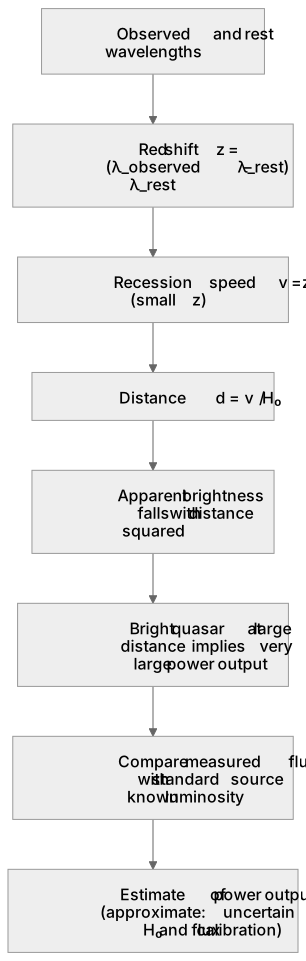
Put it in order
Put these steps in the order they happen.
- 1. Apparent brightness falls with distance squared
- 2. Estimate of power output (approximate: uncertain H₀ and flux calibration)
- 3. Bright quasar at large distance implies very large power output
- 4. Observed and rest wavelengths
- 5. Red shift z = (λ_observed − λ_rest) / λ_rest
- 6. Compare measured flux with standard source of known luminosity
- 7. Recession speed v = zc (small z)
- 8. Distance d = v / H₀
Key words
Say what each word means before you turn the card.
red shift
Try answering aloud or in your head before turning the card.
Hubble's law
Try answering aloud or in your head before turning the card.
inverse-square law
Try answering aloud or in your head before turning the card.
estimation
Try answering aloud or in your head before turning the card.
See every definition
- red shift
- Calculated from observed and rest wavelengths using z = (λ_observed − λ_rest) / λ_rest, and for cosmological red shifts it indicates recession and distance.
- Hubble's law
- Distance is estimated from v = H₀d, so d = v / H₀, using an accepted value of the Hubble constant.
- inverse-square law
- Apparent brightness decreases with distance squared, so a quasar visible at large distance must have a very large intrinsic power output.
- estimation
- Typically involves reading a spectrum to find z, using v = zc and d = v / H₀ to estimate distance, then comparing apparent flux with a known standard to estimate luminosity.
Label the diagram
Some boxes have lost their names. Pick the right name for each number.
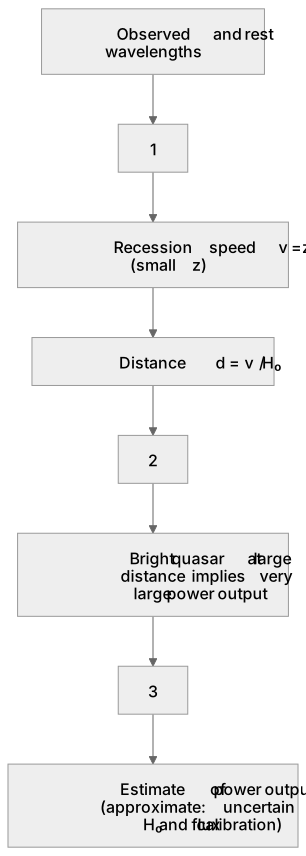
1Box 1
2Box 2
3Box 3
There is more to this lesson
The full lesson goes on to check your understanding and help you earn the marks. Create a free account to carry on, with your progress saved.
A week of Premium from your first lesson · Then the free plan continues · No card, no charge
Test your understanding of Quasars (A-level only): Quasars show large optical red shifts; estimation involving distance and power output.
Active recall beats re-reading. Take an instant quiz now to test what you’ve learned and lock it into long-term memory.
A week of Premium from your first lesson · Then the free plan continues · No card, no charge