AQA · A-Level · Physics
Course version: 7408 · Version from Sept 2016
Formation of quasars from active supermassive black holes.
Full specification wording
Quasars (A-level only): Formation of quasars from active supermassive black holes.
A quasar is the extremely luminous core of a distant galaxy powered by a supermassive black hole.
Checked against the AQA 7408 specification (opens in a new tab) on .
- Point 4 of 4
- 4 key terms
Study notes
From the checked teaching notes for this specification point.
The idea
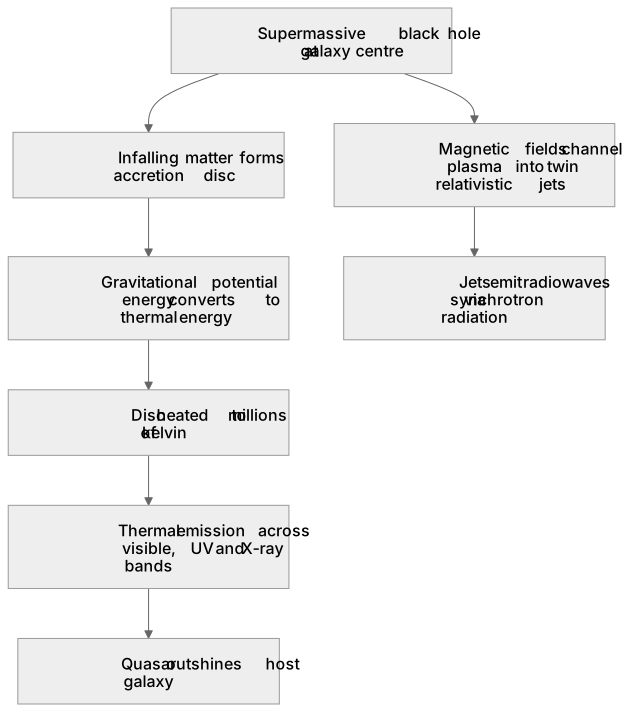
A quasar is the extremely luminous core of a distant galaxy powered by a supermassive black hole. Matter in the surrounding accretion disc spirals inward; gravitational potential energy converts to thermal energy, heating the disc to millions of kelvin so it radiates strongly across the electromagnetic spectrum, particularly in visible, UV and X-ray bands. Magnetic fields channel plasma into twin relativistic jets that emit radio waves via synchrotron radiation. The black hole mass is typically 10⁶ to 10¹⁰ solar masses, and the quasar can outshine its entire host galaxy. Quasars are observed at great distances, so their light was emitted when the universe was younger, showing these active black holes formed early in galactic history.
What earns the marks
- A quasar is powered by accretion onto a supermassive black hole at the centre of a galaxy, not by nuclear fusion.
- Infalling matter forms an accretion disc; gravitational potential energy transfers to thermal energy, heating the disc to millions of kelvin.
- The hot accretion disc radiates thermal emission across visible, UV and X-ray bands, outshining the host galaxy.
- Magnetic fields produce collimated relativistic jets that emit radio waves via synchrotron radiation.
- High observed redshifts indicate quasars are distant and were active when the universe was much younger.
- Supermassive black holes of roughly 10⁶ to 10¹⁰ solar masses are required to release the observed luminosities.
Common mistakes and how to put them right
Thinking a quasar shines because of fusion.
Put it right by explaining energy comes from gravitational potential energy released as matter accretes onto a supermassive black hole.
Attributing radio emission to the accretion disc.
Put it right by stating radio waves are produced by synchrotron radiation from the relativistic jets.
Confusing the accretion disc with the event horizon.
Put it right by stating the disc lies outside the event horizon and is the luminous region.
Exam tips
- Link each stage of the energy chain explicitly: infalling matter, accretion disc thermal radiation, and jet synchrotron radio emission.
- Use comparative data such as black hole mass or luminosity to show why a quasar can outshine its host galaxy.
Try the lesson
The start of the Quasars (A-level only): Formation of quasars from active supermassive black holes. lesson, made from checked teaching notes for this specification point.
Have a go first
A quasar is powered by matter falling onto which object at the centre of a galaxy?
Listen
A quasar is the extremely luminous core of a distant galaxy powered by a supermassive black hole. Matter in the surrounding accretion disc spirals inward; gravitational potential energy converts to thermal energy, heating the disc to millions of kelvin so it radiates strongly across the electromagnetic spectrum, particularly in visible, UV and X-ray bands. Magnetic fields channel plasma into twin relativistic jets that emit radio waves via synchrotron radiation. The black hole mass is typically 10⁶ to 10¹⁰ solar masses, and the quasar can outshine its entire host galaxy. Quasars are observed at great distances, so their light was emitted when the universe was younger, showing these active black holes formed early in galactic history. A strong answer earns marks for these points. A quasar is powered by accretion onto a supermassive black hole at the centre of a galaxy, not by nuclear fusion. Infalling matter forms an accretion disc; gravitational potential energy transfers to thermal energy, heating the disc to millions of kelvin. The hot accretion disc radiates thermal emission across visible, UV and X-ray bands, outshining the host galaxy. Magnetic fields produce collimated relativistic jets that emit radio waves via synchrotron radiation. A common slip: Thinking a quasar shines because of fusion. Instead, explaining energy comes from gravitational potential energy released as matter accretes onto a supermassive black hole. Exam tip: Link each stage of the energy chain explicitly: infalling matter, accretion disc thermal radiation, and jet synchrotron radio emission.
See it
Key words
Say what each word means before you turn the card.
Gravitational potential energy conversion
Try answering aloud or in your head before turning the card.
Accretion discs and black hole mass
Try answering aloud or in your head before turning the card.
Synchrotron and thermal radiation
Try answering aloud or in your head before turning the card.
Relativistic jets and magnetic fields
Try answering aloud or in your head before turning the card.
See every definition
- Gravitational potential energy conversion
- Infalling matter forms an accretion disc, and gravitational potential energy transfers to thermal energy, heating the disc to millions of kelvin.
- Accretion discs and black hole mass
- A quasar is powered by accretion onto a supermassive black hole of roughly 10⁶ to 10¹⁰ solar masses at the centre of a galaxy.
- Synchrotron and thermal radiation
- The hot accretion disc radiates thermal emission across visible, UV and X-ray bands, while magnetic fields produce relativistic jets that emit radio waves via synchrotron radiation.
- Relativistic jets and magnetic fields
- Magnetic fields produce collimated relativistic jets that emit radio waves via synchrotron radiation.
Label the diagram
Some boxes have lost their names. Pick the right name for each number.
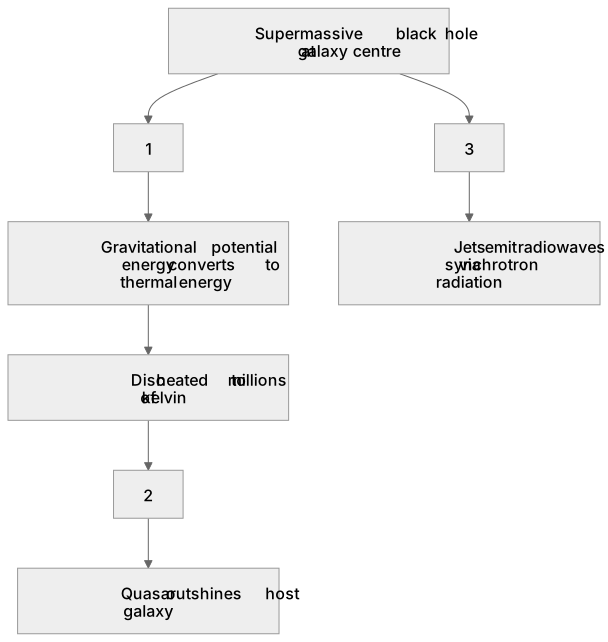
1Box 1
2Box 2
3Box 3
There is more to this lesson
The full lesson goes on to check your understanding and help you earn the marks. Create a free account to carry on, with your progress saved.
A week of Premium from your first lesson · Then the free plan continues · No card, no charge
Test your understanding of Quasars (A-level only): Formation of quasars from active supermassive black holes.
Active recall beats re-reading. Take an instant quiz now to test what you’ve learned and lock it into long-term memory.
A week of Premium from your first lesson · Then the free plan continues · No card, no charge