AQA · A-Level · Physics
Course version: 7408 · Version from Sept 2016
Applications of superconductors to include the production of strong…
Full specification wording
Resistivity: Applications of superconductors to include the production of strong magnetic fields and the reduction of energy loss in transmission of electric power.
Two applications follow directly from zero resistivity.
Checked against the AQA 7408 specification (opens in a new tab) on .
- Point 5 of 6
- 4 key terms
Study notes
From the checked teaching notes for this specification point.
The idea
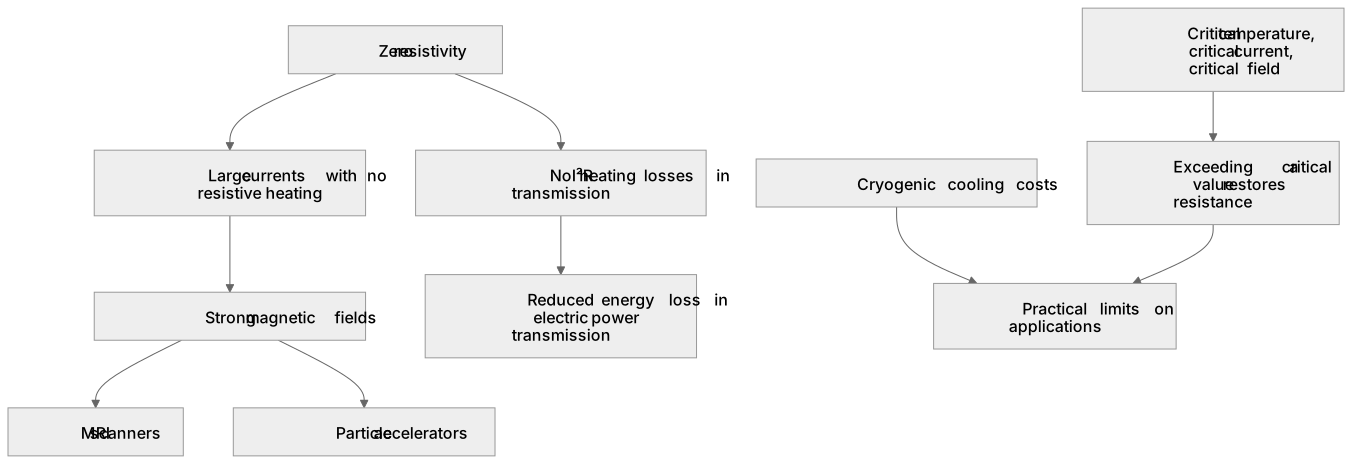
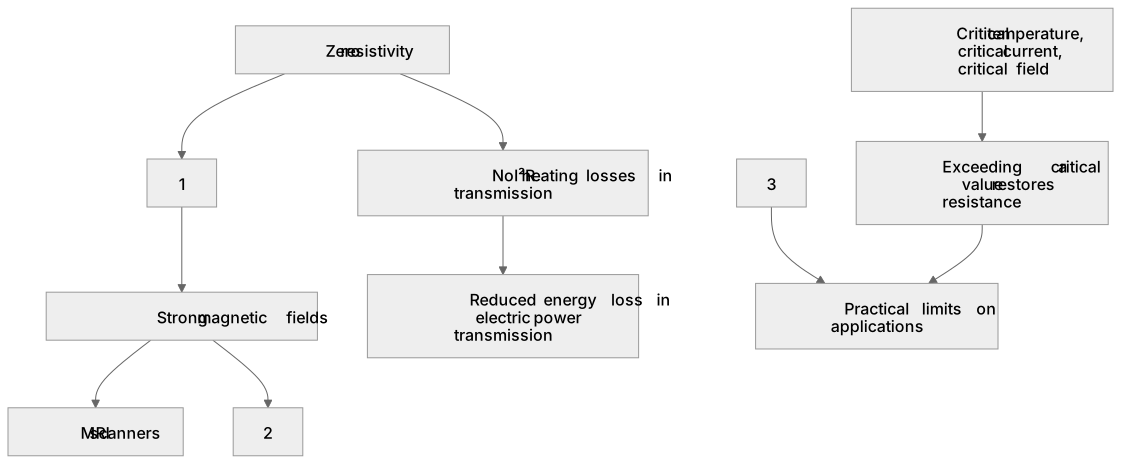
Two applications follow directly from zero resistivity. First, strong magnetic fields: a superconductor can carry large currents with no resistive heating, so electromagnets for MRI scanners and particle accelerators reach fields ordinary copper coils cannot sustain. Second, power transmission: zero-resistance cables would remove I²R heating losses, raising efficiency. In practice both are limited by critical temperature, critical current and critical field, and by the cost and cooling of cryogenic systems. A superconductor above any critical value reverts to normal resistance, so engineering must keep it inside all three limits.
What earns the marks
- Explains that zero resistance allows large currents without resistive heating, enabling strong electromagnets.
- Names a context such as MRI scanners, maglev or particle accelerators where strong fields are needed.
- Explains that zero-resistance transmission cables would eliminate I²R heating losses in the grid.
- Recognises practical limits: critical temperature, critical current, critical field and cryogenic cooling costs.
- Compares superconductor cables with copper cables in terms of energy loss and cooling demand.
- States that exceeding a critical value destroys superconductivity and restores resistance.
Common mistakes and how to put them right
Claiming superconductors remove all energy costs.
Put it right by noting refrigeration still consumes energy.
Saying superconductors can carry unlimited current.
Put it right by referring to the critical current.
Assuming any material becomes superconducting when cooled.
Put it right by noting only certain materials have a critical temperature.
Exam tips
- Link each application to zero resistivity rather than listing applications without physics.
- Use I²R heating to quantify the energy saved in transmission.
- Mention at least one critical limit when discussing why applications are not universal.
Try the lesson
The start of the Resistivity: Applications of superconductors to include the production of strong magnetic fields and the reduction of energy loss in transmission of electric power. lesson, made from checked teaching notes for this specification point.
Have a go first
Which application makes direct use of the zero resistivity of a superconductor?
Listen
Two applications follow directly from zero resistivity. First, strong magnetic fields: a superconductor can carry large currents with no resistive heating, so electromagnets for MRI scanners and particle accelerators reach fields ordinary copper coils cannot sustain. Second, power transmission: zero-resistance cables would remove I²R heating losses, raising efficiency. In practice both are limited by critical temperature, critical current and critical field, and by the cost and cooling of cryogenic systems. A superconductor above any critical value reverts to normal resistance, so engineering must keep it inside all three limits. A strong answer earns marks for these points. Explains that zero resistance allows large currents without resistive heating, enabling strong electromagnets. Names a context such as MRI scanners, maglev or particle accelerators where strong fields are needed. Explains that zero-resistance transmission cables would eliminate I²R heating losses in the grid. Recognises practical limits: critical temperature, critical current, critical field and cryogenic cooling costs. A common slip: Claiming superconductors remove all energy costs. Instead, noting refrigeration still consumes energy. Exam tip: Link each application to zero resistivity rather than listing applications without physics.
See it
Key words
Say what each word means before you turn the card.
Applications of superconductivity
Try answering aloud or in your head before turning the card.
Energy efficiency in power transmission
Try answering aloud or in your head before turning the card.
Magnetic field generation
Try answering aloud or in your head before turning the card.
Materials and critical limits
Try answering aloud or in your head before turning the card.
See every definition
- Applications of superconductivity
- Include the production of strong magnetic fields and the reduction of energy loss in transmission of electric power.
- Energy efficiency in power transmission
- Zero-resistance cables would remove I²R heating losses, raising efficiency, though refrigeration still consumes energy.
- Magnetic field generation
- A superconductor can carry large currents with no resistive heating, so electromagnets reach fields ordinary copper coils cannot sustain.
- Materials and critical limits
- Critical temperature, critical current and critical field limit applications; above any critical value the material reverts to normal resistance.
Label the diagram
Some boxes have lost their names. Pick the right name for each number.
1Box 1
2Box 2
3Box 3
There is more to this lesson
The full lesson goes on to check your understanding and help you earn the marks. Create a free account to carry on, with your progress saved.
A week of Premium from your first lesson · Then the free plan continues · No card, no charge
Test your understanding of Resistivity: Applications of superconductors to include the production of strong magnetic fields and the reduction of energy loss in transmission of electric power.
Active recall beats re-reading. Take an instant quiz now to test what you’ve learned and lock it into long-term memory.
A week of Premium from your first lesson · Then the free plan continues · No card, no charge