AQA · A-Level · Physics
Course version: 7408 · Version from Sept 2016
Superconductivity as a property of certain materials which have zero…
Full specification wording
Resistivity: Superconductivity as a property of certain materials which have zero resistivity at and below a critical temperature which depends on the material.
Superconductivity is a state, not a coating: below a material-specific critical temperature T_c, certain materials lose all resistance to current.
Checked against the AQA 7408 specification (opens in a new tab) on .
- Point 4 of 6
- 3 key terms
Study notes
From the checked teaching notes for this specification point.
The idea
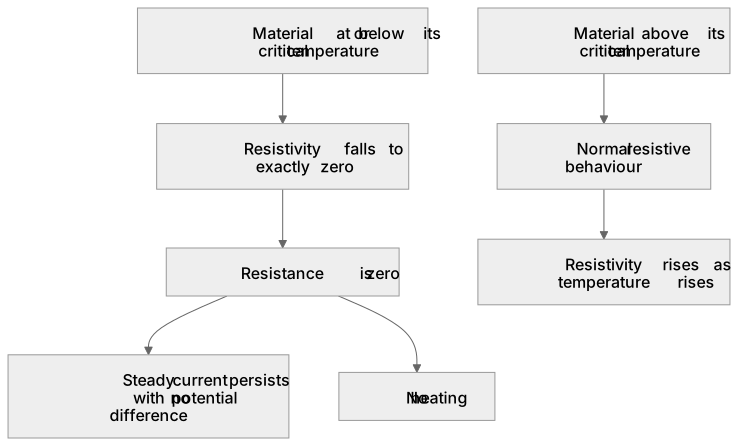
Superconductivity is a state, not a coating: below a material-specific critical temperature T_c, certain materials lose all resistance to current. Resistivity ρ falls to exactly zero, so a steady current persists with no potential difference and no heating. Above T_c the same sample behaves normally, with ρ rising as temperature rises. T_c is fixed for a given material: mercury near 4.2 K, niobium alloys far higher, ceramic cuprates above 77 K. Because ρ = 0, R = 0, so V = IR gives zero volts across the superconductor for any current. Current is limited by a critical current and critical field, not by resistance.
What earns the marks
- Defines superconductivity as zero resistivity at and below a critical temperature, not merely very low resistivity.
- States that the critical temperature is a fixed property of each material and differs between materials.
- Links zero resistivity to zero resistance, so no potential difference is needed to maintain a steady current.
- Explains that above the critical temperature the material reverts to normal resistive behaviour.
- Uses ρ = 0 with R = ρL/A to show a sample of any length or area has zero resistance.
- Applies V = IR to show zero volts across a superconductor carrying a steady current.
Common mistakes and how to put them right
Saying resistivity becomes very small rather than exactly zero.
Put it right by stating ρ = 0 at and below T_c.
Treating T_c as a universal constant such as 0 K.
Put it right by naming a material and its own T_c.
Confusing resistance with resistivity.
Put it right by noting resistivity is a material property while resistance also depends on length and cross-sectional area.
Exam tips
- Quote the definition with both conditions: zero resistivity and at or below the critical temperature.
- When comparing materials, name each material and its own T_c rather than giving one value for all.
- Use ρ = 0 and V = IR to justify statements about zero potential difference and no heating.
Try the lesson
The start of the Resistivity: Superconductivity as a property of certain materials which have zero resistivity at and below a critical temperature which depends on the material. lesson, made from checked teaching notes for this specification point.
Have a go first
Which statement describes the resistivity of a superconducting material when its temperature is at or below its critical temperature?
Listen
Superconductivity is a state, not a coating: below a material-specific critical temperature T_c, certain materials lose all resistance to current. Resistivity ρ falls to exactly zero, so a steady current persists with no potential difference and no heating. Above T_c the same sample behaves normally, with ρ rising as temperature rises. T_c is fixed for a given material: mercury near 4.2 K, niobium alloys far higher, ceramic cuprates above 77 K. Because ρ = 0, R = 0, so V = IR gives zero volts across the superconductor for any current. Current is limited by a critical current and critical field, not by resistance. A strong answer earns marks for these points. Defines superconductivity as zero resistivity at and below a critical temperature, not merely very low resistivity. States that the critical temperature is a fixed property of each material and differs between materials. Links zero resistivity to zero resistance, so no potential difference is needed to maintain a steady current. Explains that above the critical temperature the material reverts to normal resistive behaviour. A common slip: Saying resistivity becomes very small rather than exactly zero. Instead, stating ρ = 0 at and below T_c. Exam tip: Quote the definition with both conditions: zero resistivity and at or below the critical temperature.
See it
Key words
Say what each word means before you turn the card.
Superconductivity
Try answering aloud or in your head before turning the card.
Critical temperature
Try answering aloud or in your head before turning the card.
Resistivity
Try answering aloud or in your head before turning the card.
See every definition
- Superconductivity
- A property of certain materials which have zero resistivity at and below a critical temperature which depends on the material.
- Critical temperature
- A temperature which depends on the material, at and below which certain materials have zero resistivity.
- Resistivity
- A material property which falls to exactly zero at and below the critical temperature in certain materials.
Label the diagram
Some boxes have lost their names. Pick the right name for each number.
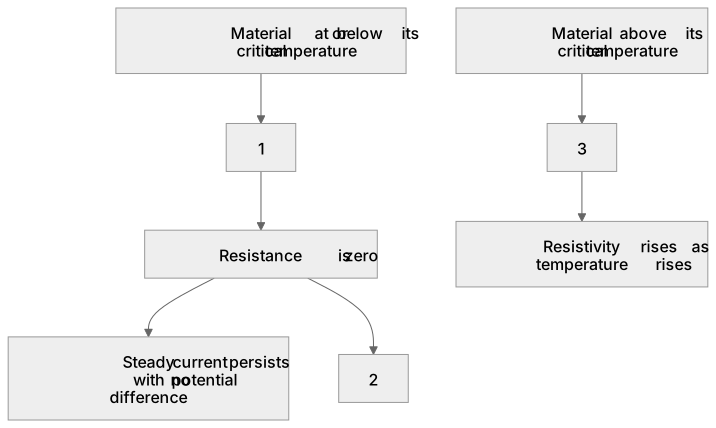
1Box 1
2Box 2
3Box 3
There is more to this lesson
The full lesson goes on to check your understanding and help you earn the marks. Create a free account to carry on, with your progress saved.
A week of Premium from your first lesson · Then the free plan continues · No card, no charge
Test your understanding of Resistivity: Superconductivity as a property of certain materials which have zero resistivity at and below a critical temperature which depends on the material.
Active recall beats re-reading. Take an instant quiz now to test what you’ve learned and lock it into long-term memory.
A week of Premium from your first lesson · Then the free plan continues · No card, no charge