AQA · A-Level · Physics
Course version: 7408 · Version from Sept 2016
Use of flywheels for smoothing torque and speed, and for storing energy in…
Full specification wording
Rotational kinetic energy (A-level only): Use of flywheels for smoothing torque and speed, and for storing energy in vehicles, and in machines used for production processes.
A flywheel is a rotating mass that stores rotational kinetic energy, Eₖ = ½Iω².
Checked against the AQA 7408 specification (opens in a new tab) on .
- Point 2 of 2
- 4 key terms
Study notes
From the checked teaching notes for this specification point.
The idea
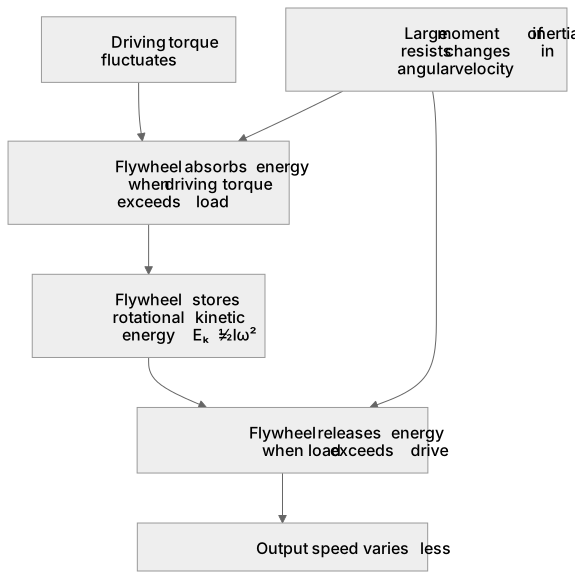
A flywheel is a rotating mass that stores rotational kinetic energy, Eₖ = ½Iω². Because its angular momentum resists rapid change, it smooths torque and speed: when a machine's driving torque fluctuates, the flywheel absorbs energy during surplus and releases it during deficit, so output speed varies less. In vehicles, a flywheel can store energy recovered during braking and return it during acceleration, reducing fuel use; in production machines such as presses, it supplies a large short burst of energy from a smaller continuous motor. Its effectiveness depends on moment of inertia I and angular speed ω, so mass distribution and safe maximum speed matter.
What earns the marks
- A flywheel stores rotational kinetic energy given by Eₖ = ½Iω², so energy storage increases with moment of inertia and with the square of angular speed.
- Smoothing occurs because the flywheel's large moment of inertia resists changes in angular velocity; it absorbs energy when the driving torque exceeds the load and releases it when the load exceeds the drive.
- In a vehicle, a flywheel can store energy during braking and return it during acceleration, reducing the demand on the engine and improving efficiency.
- In production machinery such as a punch press, the flywheel supplies a large energy burst for each stroke while the motor provides a smaller, steadier average power.
- The moment of inertia depends on mass and how that mass is distributed about the axis, so a rim-weighted flywheel stores more energy for the same total mass.
- Practical limits include material strength at high angular speed, bearing friction and the need to keep angular speed within a safe range.
Common mistakes and how to put them right
Treating a flywheel as a source of energy rather than a store.
Put it right: It stores rotational kinetic energy and must be spun up by an external torque before it can return energy.
Assuming doubling angular speed doubles stored energy.
Put it right: Eₖ ∝ ω², so doubling ω quadruples the stored energy for unchanged I.
Confusing torque smoothing with speed smoothing.
Put it right: The flywheel reduces fluctuations in both by exchanging energy, but it does not eliminate the average torque or power requirement.
Exam tips
- Link each context to the same physics: identify where energy enters the flywheel and where it leaves, then relate this to ½Iω².
- When comparing flywheels, state clearly whether I, ω or both change, and calculate the resulting energy ratio rather than guessing.
- Use correct units and notation, for example J for energy, rad s⁻¹ for angular speed and kg m² for moment of inertia.
Try the lesson
The start of the Rotational kinetic energy (A-level only): Use of flywheels for smoothing torque and speed, and for storing energy in vehicles, and in machines used for production processes. lesson, made from checked teaching notes for this specification point.
Have a go first
A flywheel is used in a production machine to smooth out fluctuations in rotational speed when the load varies. Which statement explains how the flywheel achieves this?
Listen
A flywheel is a rotating mass that stores rotational kinetic energy, Eₖ = ½Iω². Because its angular momentum resists rapid change, it smooths torque and speed: when a machine's driving torque fluctuates, the flywheel absorbs energy during surplus and releases it during deficit, so output speed varies less. In vehicles, a flywheel can store energy recovered during braking and return it during acceleration, reducing fuel use; in production machines such as presses, it supplies a large short burst of energy from a smaller continuous motor. Its effectiveness depends on moment of inertia I and angular speed ω, so mass distribution and safe maximum speed matter. A strong answer earns marks for these points. A flywheel stores rotational kinetic energy given by Eₖ = ½Iω², so energy storage increases with moment of inertia and with the square of angular speed. Smoothing occurs because the flywheel's large moment of inertia resists changes in angular velocity; it absorbs energy when the driving torque exceeds the load and releases it when the load exceeds the drive. In a vehicle, a flywheel can store energy during braking and return it during acceleration, reducing the demand on the engine and improving efficiency. In production machinery such as a punch press, the flywheel supplies a large energy burst for each stroke while the motor provides a smaller, steadier average power. A common slip: Treating a flywheel as a source of energy rather than a store. Instead, it stores rotational kinetic energy and must be spun up by an external torque before it can return energy. Exam tip: Link each context to the same physics: identify where energy enters the flywheel and where it leaves, then relate this to ½Iω².
See it
Key words
Say what each word means before you turn the card.
Flywheel
Try answering aloud or in your head before turning the card.
Rotational kinetic energy
Try answering aloud or in your head before turning the card.
Moment of inertia
Try answering aloud or in your head before turning the card.
Smoothing
Try answering aloud or in your head before turning the card.
See every definition
- Flywheel
- A rotating mass that stores rotational kinetic energy, with angular momentum that resists rapid change so it smooths torque and speed.
- Rotational kinetic energy
- Energy stored by a rotating mass, given by Eₖ = ½Iω², so storage increases with moment of inertia and with the square of angular speed.
- Moment of inertia
- A quantity depending on mass and how that mass is distributed about the axis, so a rim-weighted flywheel stores more energy for the same total mass.
- Smoothing
- Absorbing energy when the driving torque exceeds the load and releasing it when the load exceeds the drive, so output speed varies less.
Label the diagram
Some boxes have lost their names. Pick the right name for each number.
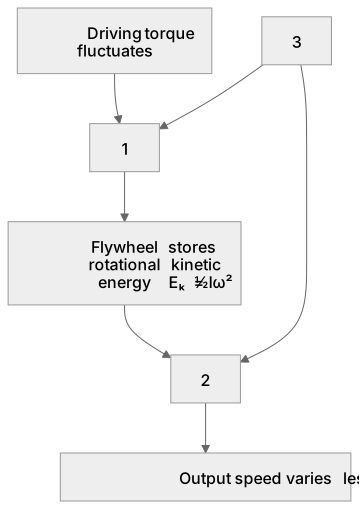
1Box 1
2Box 2
3Box 3
There is more to this lesson
The full lesson goes on to check your understanding and help you earn the marks. Create a free account to carry on, with your progress saved.
A week of Premium from your first lesson · Then the free plan continues · No card, no charge
Test your understanding of Rotational kinetic energy (A-level only): Use of flywheels for smoothing torque and speed, and for storing energy in vehicles, and in machines used for production processes.
Active recall beats re-reading. Take an instant quiz now to test what you’ve learned and lock it into long-term memory.
A week of Premium from your first lesson · Then the free plan continues · No card, no charge