AQA · A-Level · Physics
Course version: 7408 · Version from Sept 2016
Rotational kinetic energy (A-level only): Use of flywheels in machines.
A flywheel is a rotating mass used to store rotational kinetic energy, E = ½Iω², where I is its moment of inertia and ω its angular velocity.
Checked against the AQA 7408 specification (opens in a new tab) on .
- Point 1 of 2
- 4 key terms
Study notes
From the checked teaching notes for this specification point.
The idea
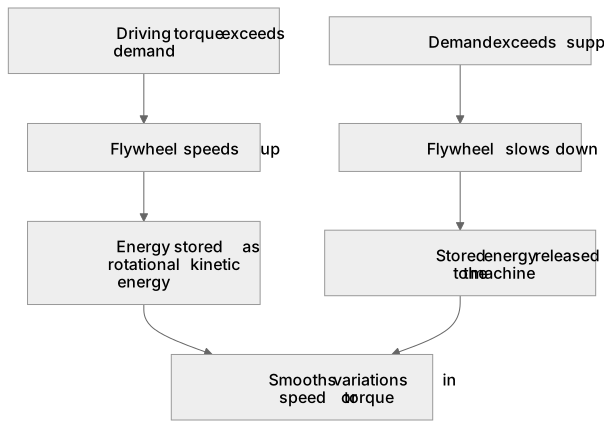
A flywheel is a rotating mass used to store rotational kinetic energy, E = ½Iω², where I is its moment of inertia and ω its angular velocity. Because a large I and high ω store substantial energy, a flywheel can smooth the output of an engine or machine: it absorbs energy when the driving torque exceeds demand and releases it when demand exceeds supply. In a vehicle, a heavy flywheel keeps the crankshaft turning between power strokes; in a press or wind turbine, it reduces speed fluctuations during each cycle. Energy stored depends on both I and ω², so doubling ω quadruples the stored energy. A flywheel of I = 0.50 kg m² spinning at 60 rad s⁻¹ stores ½ × 0.50 × 60² = 900 J.
What earns the marks
- Describe a flywheel as a rotating mass that stores rotational kinetic energy given by ½Iω².
- Explain that energy is stored when the flywheel speeds up and released when it slows down, smoothing variations in speed or torque.
- Link a large moment of inertia and high angular velocity to a large stored energy, noting the ω² dependence.
- Apply the conservation idea that energy transferred from the drive is stored and later returned to the machine.
- Calculate rotational kinetic energy or angular velocity using E = ½Iω² with consistent SI units.
Common mistakes and how to put them right
Using linear kinetic energy.
Put it right: Use ½Iω² with moment of inertia and angular velocity.
Confusing ω with frequency.
Put it right: Convert to rad s⁻¹ using ω = 2πf.
Assuming a flywheel creates energy.
Put it right: Describe it as storing and returning energy already supplied by the drive.
Exam tips
- State clearly whether the flywheel is storing or releasing energy at the point described in the question.
- Show the substitution into E = ½Iω² with units, especially converting rpm to rad s⁻¹.
- When explaining smoothing, refer to energy transfer during acceleration and deceleration of the flywheel.
Try the lesson
The start of the Rotational kinetic energy (A-level only): Use of flywheels in machines. lesson, made from checked teaching notes for this specification point.
Have a go first
Why is a flywheel often incorporated into the design of a mechanical punch press?
Listen
A flywheel is a rotating mass used to store rotational kinetic energy, E = ½Iω², where I is its moment of inertia and ω its angular velocity. Because a large I and high ω store substantial energy, a flywheel can smooth the output of an engine or machine: it absorbs energy when the driving torque exceeds demand and releases it when demand exceeds supply. In a vehicle, a heavy flywheel keeps the crankshaft turning between power strokes; in a press or wind turbine, it reduces speed fluctuations during each cycle. Energy stored depends on both I and ω², so doubling ω quadruples the stored energy. A flywheel of I = 0.50 kg m² spinning at 60 rad s⁻¹ stores ½ × 0.50 × 60² = 900 J. A strong answer earns marks for these points. Describe a flywheel as a rotating mass that stores rotational kinetic energy given by ½Iω². Explain that energy is stored when the flywheel speeds up and released when it slows down, smoothing variations in speed or torque. Link a large moment of inertia and high angular velocity to a large stored energy, noting the ω² dependence. Apply the conservation idea that energy transferred from the drive is stored and later returned to the machine. A common slip: Using linear kinetic energy: the error is applying ½mv² to a rotating flywheel. Instead, use ½Iω² with moment of inertia and angular velocity. Exam tip: State clearly whether the flywheel is storing or releasing energy at the point described in the question.
See it
Key words
Say what each word means before you turn the card.
Energy storage
Try answering aloud or in your head before turning the card.
Rotational kinetic energy
Try answering aloud or in your head before turning the card.
Smoothing of motion
Try answering aloud or in your head before turning the card.
Engineering applications
Try answering aloud or in your head before turning the card.
See every definition
- Energy storage
- A flywheel absorbs energy when the driving torque exceeds demand and releases it when demand exceeds supply.
- Rotational kinetic energy
- A rotating mass stores this, given by E = ½Iω², where I is its moment of inertia and ω its angular velocity.
- Smoothing of motion
- A flywheel reduces speed fluctuations during each cycle, keeping the crankshaft turning between power strokes in a vehicle.
- Engineering applications
- Flywheels are used in machines such as a vehicle, a press or a wind turbine.
Label the diagram
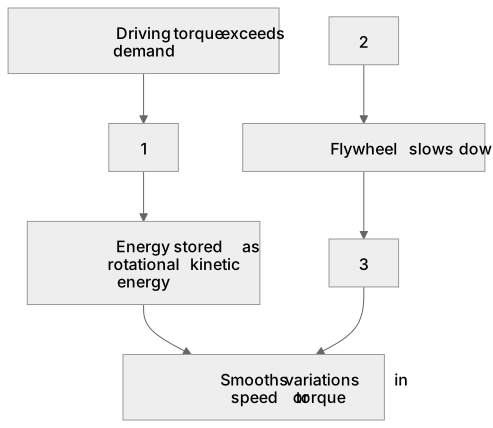
Some boxes have lost their names. Pick the right name for each number.
1Box 1
2Box 2
3Box 3
There is more to this lesson
The full lesson goes on to check your understanding and help you earn the marks. Create a free account to carry on, with your progress saved.
A week of Premium from your first lesson · Then the free plan continues · No card, no charge
Test your understanding of Rotational kinetic energy (A-level only): Use of flywheels in machines.
Active recall beats re-reading. Take an instant quiz now to test what you’ve learned and lock it into long-term memory.
A week of Premium from your first lesson · Then the free plan continues · No card, no charge