AQA · A-Level · Physics
Course version: 7408 · Version from Sept 2016
Required practical 12: Investigation of the inverse- square law for gamma…
Full specification wording
Rutherford scattering (A-level only): Required practical 12: Investigation of the inverse- square law for gamma radiation.
This practical tests whether gamma intensity follows an inverse-square relationship with distance from a point source.
Checked against the AQA 7408 specification (opens in a new tab) on .
- Point 8 of 8
- 4 key terms
Study notes
From the checked teaching notes for this specification point.
The idea
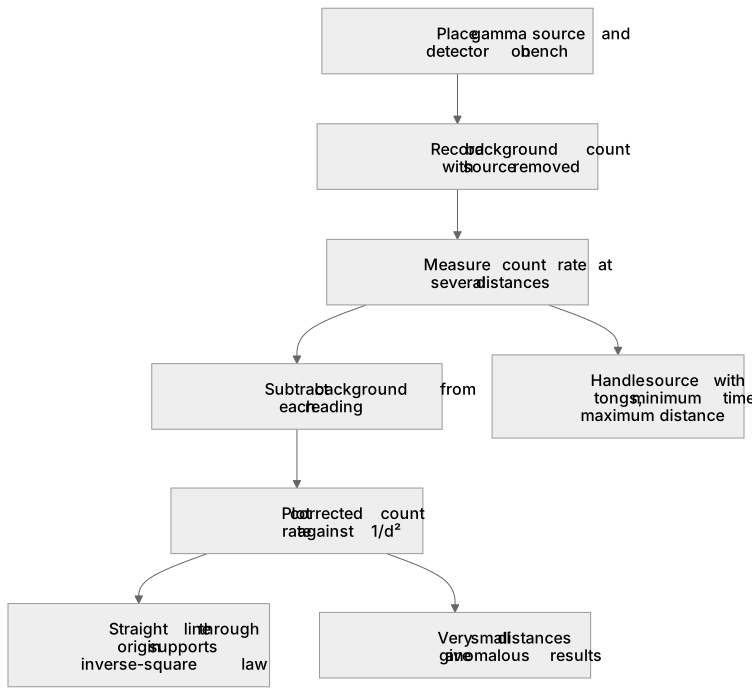
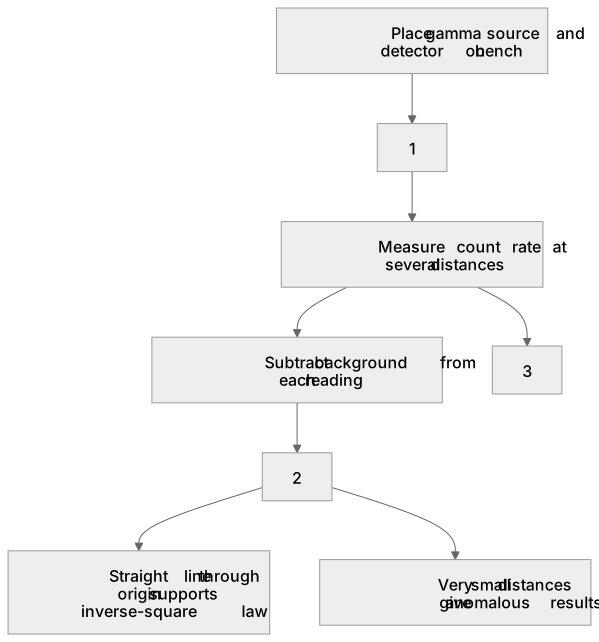
This practical tests whether gamma intensity follows an inverse-square relationship with distance from a point source. A gamma source and detector are placed on a bench, and count rate is measured at several distances. Background radiation is always present, so a background count is recorded with the source removed, then subtracted from each reading. Corrected count rate is plotted against 1/d²; a straight line through the origin supports the inverse-square law. The source must be handled with tongs and kept away from the body, as gamma radiation is highly penetrating. The investigation also reveals that the detector has a finite size and the source is not a true point, so very small distances give anomalous results.
What earns the marks
- Measures background count rate with the source removed or shielded and subtracts it from each reading.
- Records distance from the source to a fixed reference point on the detector, keeping the detector and source aligned.
- Plots corrected count rate against 1/d² and interprets a straight line through the origin as evidence for the inverse-square law.
- Controls variables such as source activity, detector settings and measurement time, and repeats readings to reduce random uncertainty.
- Uses safe handling: tongs, minimum time, maximum distance, shielding and secure storage of the source.
Common mistakes and how to put them right
Forgetting to subtract background count rate.
Put it right: Measure background separately and subtract it from every reading before plotting.
Measuring distance from the source to the bench end rather than to the detector.
Put it right: Define and use a consistent source-to-detector distance.
Plotting count rate against distance and expecting a straight line.
Put it right: Plot against 1/d² or to check that count rate falls by a factor of four when distance doubles.
Exam tips
- State the background correction explicitly and show one worked subtraction.
- Use a log or ratio check, such as doubling distance should quarter the corrected count rate, to test the law.
- Comment on why very small distances may not fit the inverse-square law, referring to source and detector size.
Try the lesson
The start of the Rutherford scattering (A-level only): Required practical 12: Investigation of the inverse- square law for gamma radiation. lesson, made from checked teaching notes for this specification point.
Have a go first
In an experiment to test the inverse-square law for gamma radiation, a detector measures the count rate at different distances from a gamma source. What is the independent variable in this investigation?
Listen
This practical tests whether gamma intensity follows an inverse-square relationship with distance from a point source. A gamma source and detector are placed on a bench, and count rate is measured at several distances. Background radiation is always present, so a background count is recorded with the source removed, then subtracted from each reading. Corrected count rate is plotted against 1/d²; a straight line through the origin supports the inverse-square law. The source must be handled with tongs and kept away from the body, as gamma radiation is highly penetrating. The investigation also reveals that the detector has a finite size and the source is not a true point, so very small distances give anomalous results. A strong answer earns marks for these points. Measures background count rate with the source removed or shielded and subtracts it from each reading. Records distance from the source to a fixed reference point on the detector, keeping the detector and source aligned. Plots corrected count rate against 1/d² and interprets a straight line through the origin as evidence for the inverse-square law. Controls variables such as source activity, detector settings and measurement time, and repeats readings to reduce random uncertainty. A common slip: Forgetting to subtract background count rate. Instead, measure background separately and subtract it from every reading before plotting. Exam tip: State the background correction explicitly and show one worked subtraction.
See it
Key words
Say what each word means before you turn the card.
Inverse-square law for point sources
Try answering aloud or in your head before turning the card.
Background radiation and correction
Try answering aloud or in your head before turning the card.
Experimental design and uncertainty
Try answering aloud or in your head before turning the card.
Radiation safety and source handling
Try answering aloud or in your head before turning the card.
See every definition
- Inverse-square law for point sources
- The relationship tested by plotting corrected count rate against 1/d², where a straight line through the origin supports it.
- Background radiation and correction
- Radiation always present, so a background count is recorded with the source removed and then subtracted from each reading.
- Experimental design and uncertainty
- Controlling variables such as source activity, detector settings and measurement time, and repeating readings to reduce random uncertainty.
- Radiation safety and source handling
- The source must be handled with tongs and kept away from the body, as gamma radiation is highly penetrating.
Label the diagram
Some boxes have lost their names. Pick the right name for each number.
1Box 1
2Box 2
3Box 3
There is more to this lesson
The full lesson goes on to check your understanding and help you earn the marks. Create a free account to carry on, with your progress saved.
A week of Premium from your first lesson · Then the free plan continues · No card, no charge
Test your understanding of Rutherford scattering (A-level only): Required practical 12: Investigation of the inverse- square law for gamma radiation.
Active recall beats re-reading. Take an instant quiz now to test what you’ve learned and lock it into long-term memory.
A week of Premium from your first lesson · Then the free plan continues · No card, no charge