AQA · A-Level · Physics
Course version: 7408 · Version from Sept 2016
Appreciation of balance between risk and benefits in the uses of radiation…
Full specification wording
Rutherford scattering (A-level only): Appreciation of balance between risk and benefits in the uses of radiation in medicine.
Medical physics uses ionising radiation for diagnosis and therapy, trading harm against benefit.
Checked against the AQA 7408 specification (opens in a new tab) on .
- Point 7 of 8
- 4 key terms
Study notes
From the checked teaching notes for this specification point.
The idea
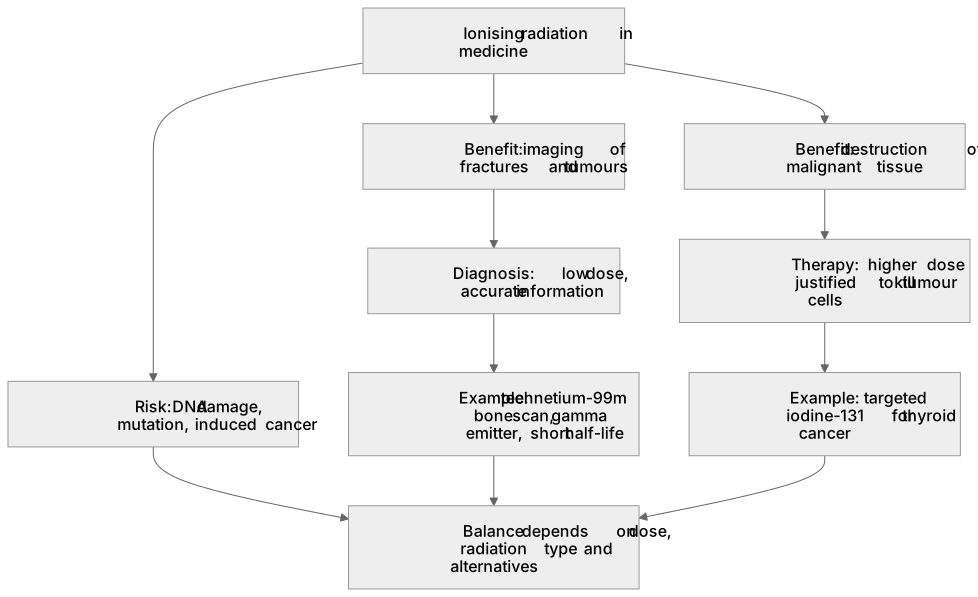
Medical physics uses ionising radiation for diagnosis and therapy, trading harm against benefit. Ionising radiation can damage DNA, raising cancer risk; yet it enables imaging of fractures and tumours, and can destroy malignant tissue. The balance depends on dose, type of radiation, and alternative options. For diagnosis, benefit is accurate information gained at low dose, for example a technetium-99m bone scan using a gamma emitter with a short half-life. For therapy, higher doses are justified because the aim is to kill tumour cells, for example targeted iodine-131 for thyroid cancer. Assessment asks you to compare risk and benefit for a named use, rather than declaring radiation simply good or bad.
What earns the marks
- Identifies the benefit of a named medical use, such as diagnosis of disease or destruction of tumour tissue.
- Identifies the risk, such as ionising damage to DNA, cell mutation or induced cancer.
- Compares risk and benefit for the specific patient group and procedure rather than in general terms.
- Uses physics ideas such as absorbed dose, equivalent dose, half-life, penetrating power or source type to support the comparison.
- Recognises that benefit may justify higher risk in therapy than in diagnosis, and that alternatives and patient factors matter.
Common mistakes and how to put them right
Treating radiation as either wholly safe or wholly harmful.
Put it right: Weigh the specific benefit against the specific risk for that procedure.
Confusing the risk to the patient with the risk to the radiographer.
Put it right: State which person receives which dose and why shielding, distance and time reduce staff dose.
Assuming all medical radiation is gamma.
Put it right: Match the radiation type to the use, for example beta emitters for therapy and gamma emitters for imaging.
Exam tips
- Name the procedure and the radionuclide or radiation type before discussing risk and benefit.
- Use comparative language such as greater than, lower than or justified because to show balance.
- Link each risk or benefit to a physics quantity, such as dose in sieverts or half-life in hours, rather than asserting it.
Try the lesson
The start of the Rutherford scattering (A-level only): Appreciation of balance between risk and benefits in the uses of radiation in medicine. lesson, made from checked teaching notes for this specification point.
Have a go first
A patient is injected with a radioactive tracer for a diagnostic scan. How is the balance between risk and benefit optimised in this medical procedure?
Listen
Medical physics uses ionising radiation for diagnosis and therapy, trading harm against benefit. Ionising radiation can damage DNA, raising cancer risk; yet it enables imaging of fractures and tumours, and can destroy malignant tissue. The balance depends on dose, type of radiation, and alternative options. For diagnosis, benefit is accurate information gained at low dose, for example a technetium-99m bone scan using a gamma emitter with a short half-life. For therapy, higher doses are justified because the aim is to kill tumour cells, for example targeted iodine-131 for thyroid cancer. Assessment asks you to compare risk and benefit for a named use, rather than declaring radiation simply good or bad. A strong answer earns marks for these points. Identifies the benefit of a named medical use, such as diagnosis of disease or destruction of tumour tissue. Identifies the risk, such as ionising damage to DNA, cell mutation or induced cancer. Compares risk and benefit for the specific patient group and procedure rather than in general terms. Uses physics ideas such as absorbed dose, equivalent dose, half-life, penetrating power or source type to support the comparison. A common slip: Treating radiation as either wholly safe or wholly harmful. Instead, weigh the specific benefit against the specific risk for that procedure. Exam tip: Name the procedure and the radionuclide or radiation type before discussing risk and benefit.
See it
Key words
Say what each word means before you turn the card.
Ionising radiation and biological harm
Try answering aloud or in your head before turning the card.
Diagnostic imaging and therapeutic treatment
Try answering aloud or in your head before turning the card.
Dose, half-life and penetrating power
Try answering aloud or in your head before turning the card.
Risk–benefit reasoning in applied physics
Try answering aloud or in your head before turning the card.
See every definition
- Ionising radiation and biological harm
- Ionising radiation can damage DNA, raising cancer risk, so its medical use trades this harm against benefit.
- Diagnostic imaging and therapeutic treatment
- Imaging of fractures and tumours gains accurate information at low dose, while therapy uses higher doses to kill tumour cells.
- Dose, half-life and penetrating power
- The balance between risk and benefit depends on dose, type of radiation and alternative options.
- Risk–benefit reasoning in applied physics
- Assessment compares risk and benefit for a named use rather than declaring radiation simply good or bad.
Label the diagram
Some boxes have lost their names. Pick the right name for each number.
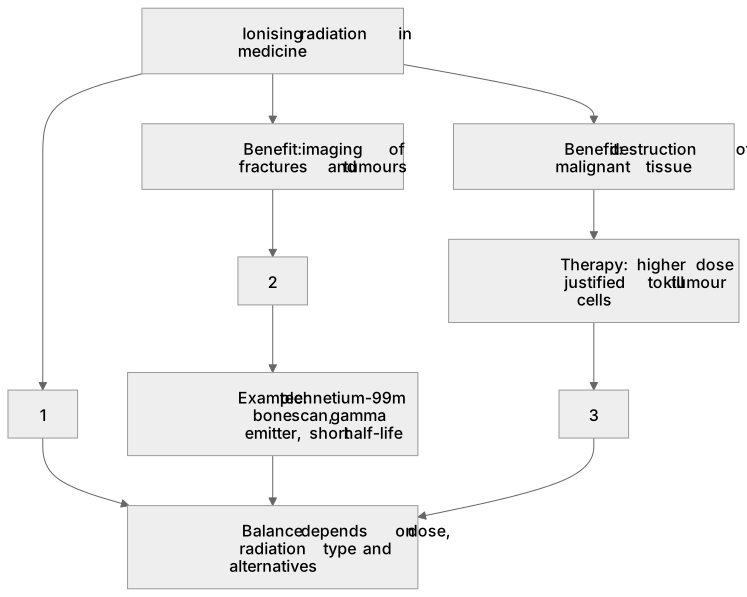
1Box 1
2Box 2
3Box 3
There is more to this lesson
The full lesson goes on to check your understanding and help you earn the marks. Create a free account to carry on, with your progress saved.
A week of Premium from your first lesson · Then the free plan continues · No card, no charge
Test your understanding of Rutherford scattering (A-level only): Appreciation of balance between risk and benefits in the uses of radiation in medicine.
Active recall beats re-reading. Take an instant quiz now to test what you’ve learned and lock it into long-term memory.
A week of Premium from your first lesson · Then the free plan continues · No card, no charge