AQA · A-Level · Physics
Course version: 7408 · Version from Sept 2016
Their properties and experimental identification using simple absorption…
Full specification wording
Rutherford scattering (A-level only): Their properties and experimental identification using simple absorption experiments; applications eg to relative hazards of exposure to humans.
Alpha, beta and gamma radiations differ in charge, mass, ionising power and penetrating ability.
Checked against the AQA 7408 specification (opens in a new tab) on .
- Point 3 of 8
- 4 key terms
Study notes
From the checked teaching notes for this specification point.
The idea
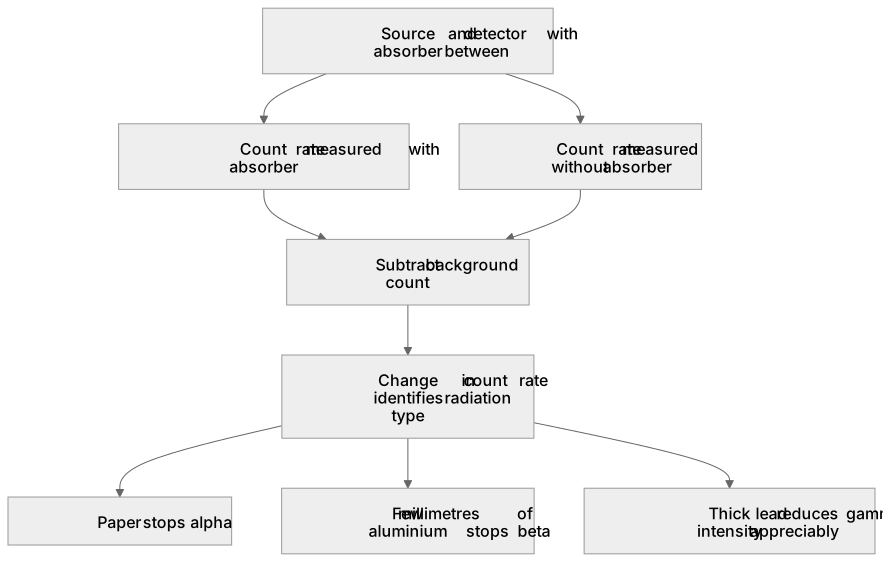
Alpha, beta and gamma radiations differ in charge, mass, ionising power and penetrating ability. In a simple absorption experiment, a source is placed near a detector with an absorber between them; counts are recorded with and without the absorber, and the background count is subtracted. Paper stops alpha, a few millimetres of aluminium stops beta, but gamma needs thick lead to reduce intensity appreciably. These properties explain relative hazards: alpha is dangerous if inhaled or ingested because it ionises densely over a short range, beta harms skin and eyes and can penetrate a little, while gamma is highly penetrating and needs dense shielding. Distance, time and shielding reduce exposure.
What earns the marks
- Alpha particles are helium nuclei with charge 2⁺ and are strongly ionising but have a short range in air, so they are stopped by paper or skin.
- Beta particles are fast electrons with charge 1⁻; they are less ionising than alpha but more penetrating, and are absorbed by a few millimetres of aluminium.
- Gamma radiation is electromagnetic radiation with no charge and no mass; it is weakly ionising but highly penetrating, so thick lead or concrete reduces its intensity.
- In an absorption experiment, count rate is measured with and without the absorber, background count is subtracted, and the change identifies the radiation type.
- Practical safety measures include minimising exposure time, increasing distance and using appropriate shielding.
Common mistakes and how to put them right
Treating beta as more ionising than alpha.
Put it right: Alpha is the most ionising because it is heavily charged and slow-moving, while beta is less ionising.
Forgetting to subtract background count.
Put it right: The corrected count rate is the measured rate minus the background rate, otherwise absorption conclusions are unreliable.
Assuming all gamma is stopped by a thin aluminium sheet.
Put it right: Aluminium absorbs beta, but gamma requires much thicker, denser shielding such as lead.
Exam tips
- When describing an absorption test, state the absorber used, the measurement taken and the conclusion drawn for each radiation type.
- Link hazard to the route of exposure: external exposure, inhalation or ingestion changes which radiation is most dangerous.
- Use comparative language such as more ionising, less penetrating and stopped by, rather than absolute statements.
Try the lesson
The start of the Rutherford scattering (A-level only): Their properties and experimental identification using simple absorption experiments; applications eg to relative hazards of exposure to humans. lesson, made from checked teaching notes for this specification point.
Have a go first
In a simple absorption experiment, a source is placed near a detector and readings are taken with no absorber, then with a sheet of paper between source and detector. The count rate falls almost to background. Which type of radiation is being emitted?
Listen
Alpha, beta and gamma radiations differ in charge, mass, ionising power and penetrating ability. In a simple absorption experiment, a source is placed near a detector with an absorber between them; counts are recorded with and without the absorber, and the background count is subtracted. Paper stops alpha, a few millimetres of aluminium stops beta, but gamma needs thick lead to reduce intensity appreciably. These properties explain relative hazards: alpha is dangerous if inhaled or ingested because it ionises densely over a short range, beta harms skin and eyes and can penetrate a little, while gamma is highly penetrating and needs dense shielding. Distance, time and shielding reduce exposure. A strong answer earns marks for these points. Alpha particles are helium nuclei with charge 2⁺ and are strongly ionising but have a short range in air, so they are stopped by paper or skin. Beta particles are fast electrons with charge 1⁻; they are less ionising than alpha but more penetrating, and are absorbed by a few millimetres of aluminium. Gamma radiation is electromagnetic radiation with no charge and no mass; it is weakly ionising but highly penetrating, so thick lead or concrete reduces its intensity. In an absorption experiment, count rate is measured with and without the absorber, background count is subtracted, and the change identifies the radiation type. Exam tip: When describing an absorption test, state the absorber used, the measurement taken and the conclusion drawn for each radiation type.
See it
Key words
Say what each word means before you turn the card.
Ionising power
Try answering aloud or in your head before turning the card.
Penetrating ability
Try answering aloud or in your head before turning the card.
Absorption experiment
Try answering aloud or in your head before turning the card.
Relative hazard
Try answering aloud or in your head before turning the card.
See every definition
- Ionising power
- Alpha is strongly ionising, beta is less ionising than alpha, and gamma is weakly ionising.
- Penetrating ability
- Paper stops alpha, a few millimetres of aluminium stops beta, but gamma needs thick lead to reduce intensity appreciably.
- Absorption experiment
- A source is placed near a detector with an absorber between them; counts are recorded with and without the absorber, and the background count is subtracted.
- Relative hazard
- Alpha is dangerous if inhaled or ingested because it ionises densely over a short range, beta harms skin and eyes, and gamma is highly penetrating and needs dense shielding.
Label the diagram
Some boxes have lost their names. Pick the right name for each number.
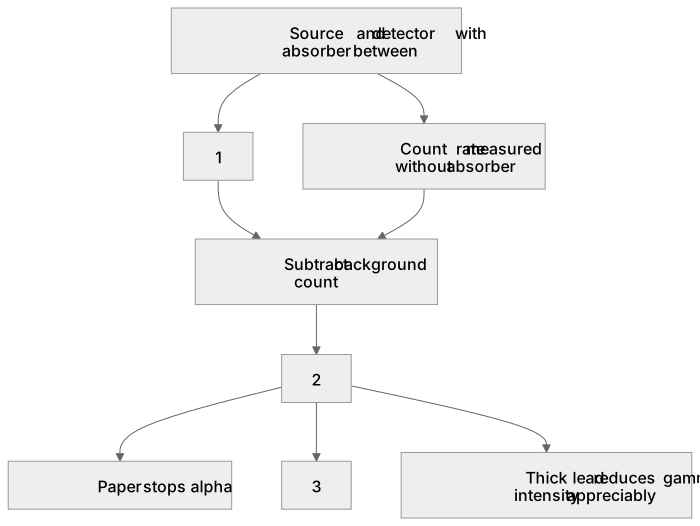
1Box 1
2Box 2
3Box 3
There is more to this lesson
The full lesson goes on to check your understanding and help you earn the marks. Create a free account to carry on, with your progress saved.
A week of Premium from your first lesson · Then the free plan continues · No card, no charge
Test your understanding of Rutherford scattering (A-level only): Their properties and experimental identification using simple absorption experiments; applications eg to relative hazards of exposure to humans.
Active recall beats re-reading. Take an instant quiz now to test what you’ve learned and lock it into long-term memory.
A week of Premium from your first lesson · Then the free plan continues · No card, no charge