AQA · A-Level · Physics
Course version: 7408 · Version from Sept 2016
Applications also include thickness measurements of aluminium foil paper…
Full specification wording
Rutherford scattering (A-level only): Applications also include thickness measurements of aluminium foil paper and steel.
Absorption of radiation can monitor the thickness of moving sheets in manufacture.
Checked against the AQA 7408 specification (opens in a new tab) on .
- Point 4 of 8
- 4 key terms
Study notes
From the checked teaching notes for this specification point.
The idea
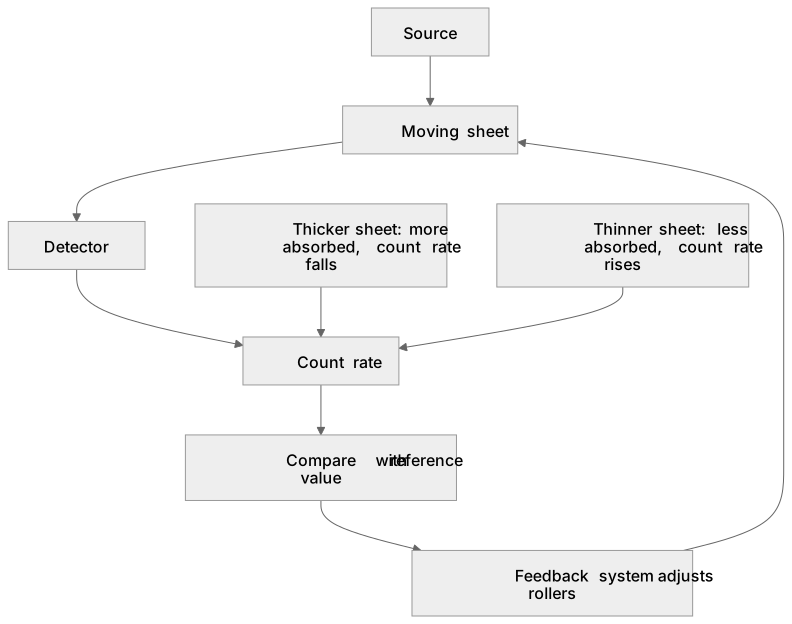
Absorption of radiation can monitor the thickness of moving sheets in manufacture. A source and detector are placed on opposite sides of the material, and the detected count rate depends on how much material the radiation passes through. Alpha is unsuitable for most industrial foils because it is stopped by air and thin layers, so beta from a suitable source is used for thin sheets such as paper and aluminium foil, while gamma is used for thicker or denser steel. If the sheet becomes thicker, more radiation is absorbed and the count rate falls; if it becomes thinner, the count rate rises. A control system compares the count rate with a set value and adjusts rollers to keep thickness constant.
What earns the marks
- A radioactive source and detector are placed on opposite sides of the moving sheet, and the count rate indicates the thickness of material between them.
- Beta radiation is suitable for measuring thin materials such as paper and aluminium foil because beta is partly absorbed by small thicknesses.
- Gamma radiation is suitable for measuring thicker or denser materials such as steel because gamma is highly penetrating and is not completely stopped by thin sheets.
- A fall in count rate indicates increased thickness, while a rise indicates reduced thickness, because more material absorbs more radiation.
- The count rate is compared with a reference value and a feedback system adjusts the rollers to maintain the required thickness.
- The method is non-contact and can operate continuously on a moving production line.
Common mistakes and how to put them right
Choosing alpha for thickness measurement.
Put it right: Alpha is stopped by air and by very thin layers, so it cannot penetrate the sheet reliably.
Saying that a higher count rate means a thicker sheet.
Put it right: Greater thickness absorbs more radiation, so the count rate falls.
Ignoring background count: background must be subtracted before comparing the measured count rate with the reference value.
Exam tips
- Name the radiation and the material together, for example beta for paper and gamma for steel, and justify the choice by penetration.
- Describe the sequence: source, material, detector, count rate, comparison, adjustment.
- State the relationship between thickness and count rate clearly, using falls and rises correctly.
Try the lesson
The start of the Rutherford scattering (A-level only): Applications also include thickness measurements of aluminium foil paper and steel. lesson, made from checked teaching notes for this specification point.
Have a go first
In a factory, a radioactive source and detector are placed on opposite sides of a moving sheet of paper. The detector reading is used to monitor the thickness of the paper. Which type of radiation is most suitable for this measurement?
Listen
Absorption of radiation can monitor the thickness of moving sheets in manufacture. A source and detector are placed on opposite sides of the material, and the detected count rate depends on how much material the radiation passes through. Alpha is unsuitable for most industrial foils because it is stopped by air and thin layers, so beta from a suitable source is used for thin sheets such as paper and aluminium foil, while gamma is used for thicker or denser steel. If the sheet becomes thicker, more radiation is absorbed and the count rate falls; if it becomes thinner, the count rate rises. A control system compares the count rate with a set value and adjusts rollers to keep thickness constant. A strong answer earns marks for these points. A radioactive source and detector are placed on opposite sides of the moving sheet, and the count rate indicates the thickness of material between them. Beta radiation is suitable for measuring thin materials such as paper and aluminium foil because beta is partly absorbed by small thicknesses. Gamma radiation is suitable for measuring thicker or denser materials such as steel because gamma is highly penetrating and is not completely stopped by thin sheets. A fall in count rate indicates increased thickness, while a rise indicates reduced thickness, because more material absorbs more radiation. Exam tip: Name the radiation and the material together, for example beta for paper and gamma for steel, and justify the choice by penetration.
See it
Key words
Say what each word means before you turn the card.
Absorption of radiation
Try answering aloud or in your head before turning the card.
Choice of radiation source
Try answering aloud or in your head before turning the card.
Feedback control
Try answering aloud or in your head before turning the card.
Industrial measurement
Try answering aloud or in your head before turning the card.
See every definition
- Absorption of radiation
- Process in which the detected count rate depends on how much material the radiation passes through, so more material absorbs more radiation.
- Choice of radiation source
- Beta from a suitable source is used for thin sheets such as paper and aluminium foil, while gamma is used for thicker or denser steel.
- Feedback control
- A control system compares the count rate with a set value and adjusts rollers to keep thickness constant.
- Industrial measurement
- Thickness measurements of aluminium foil, paper and steel, with a source and detector placed on opposite sides of the material.
Label the diagram
Some boxes have lost their names. Pick the right name for each number.
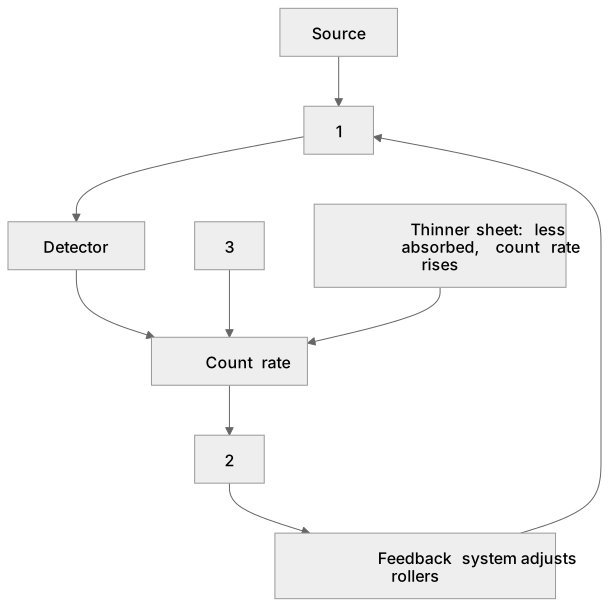
1Box 1
2Box 2
3Box 3
There is more to this lesson
The full lesson goes on to check your understanding and help you earn the marks. Create a free account to carry on, with your progress saved.
A week of Premium from your first lesson · Then the free plan continues · No card, no charge
Test your understanding of Rutherford scattering (A-level only): Applications also include thickness measurements of aluminium foil paper and steel.
Active recall beats re-reading. Take an instant quiz now to test what you’ve learned and lock it into long-term memory.
A week of Premium from your first lesson · Then the free plan continues · No card, no charge