AQA · A-Level · Physics
Course version: 7408 · Version from Sept 2016
Examples should include: velocity/speed, mass, force/weight, acceleration,…
Full specification wording
Scalars and vectors: Examples should include: velocity/speed, mass, force/weight, acceleration, displacement/distance.
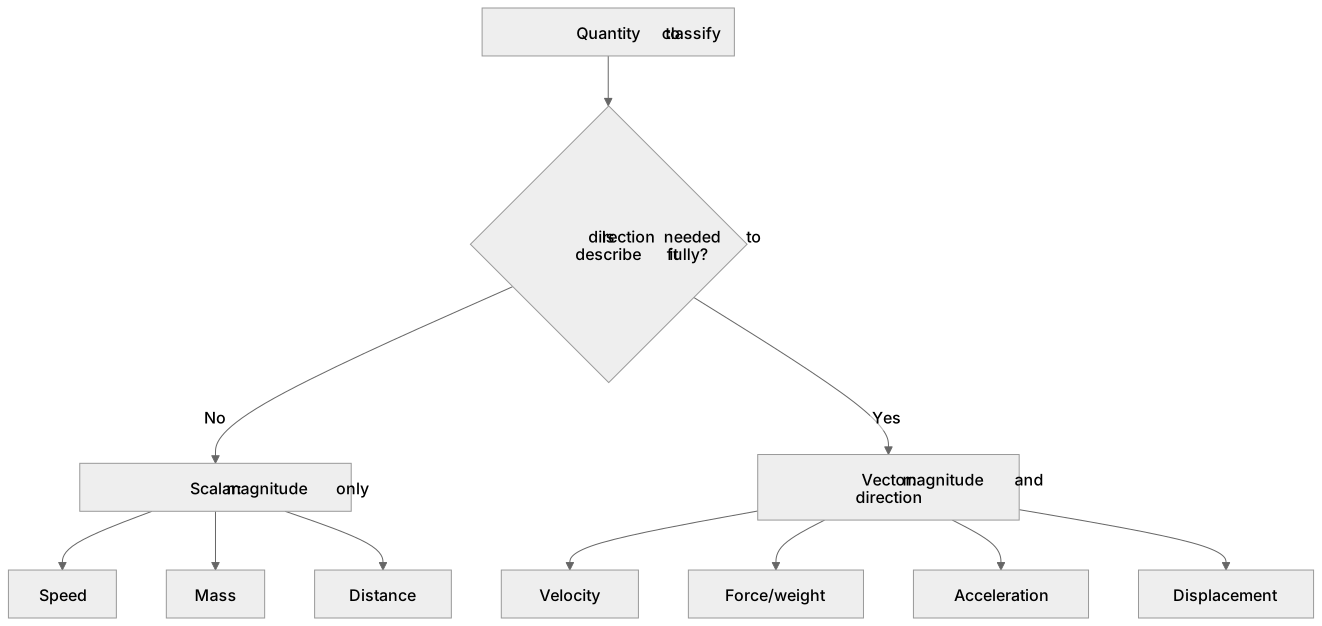
A scalar has magnitude only; a vector has magnitude and direction.
Checked against the AQA 7408 specification (opens in a new tab) on .
- Point 2 of 10
- 4 key terms
Study notes
From the checked teaching notes for this specification point.
The idea
A scalar has magnitude only; a vector has magnitude and direction. Speed is how fast something moves; velocity is speed in a stated direction, so a car at 20 m s⁻¹ north has a different velocity from one at 20 m s⁻¹ south. Mass is the quantity of matter in kg; weight is the gravitational force on it in N, W = mg, acting downwards. Distance is the total path length; displacement is the straight-line change in position with direction. Acceleration is the rate of change of velocity, a vector, so slowing down or turning changes it. Force is a push or pull with direction. Classify each quantity by asking whether direction is needed to describe it fully.
What earns the marks
- States that a scalar has magnitude only, while a vector has both magnitude and direction.
- Classifies speed, mass and distance as scalars, and velocity, force/weight, acceleration and displacement as vectors.
- Explains that velocity is speed in a stated direction, so direction must be given.
- Distinguishes mass in kg from weight in N, linking weight to W = mg acting downwards.
- Distinguishes distance as total path length from displacement as straight-line change in position with direction.
- Describes acceleration as the rate of change of velocity, so it is a vector even when speed is constant but direction changes.
Common mistakes and how to put them right
Treating speed and velocity as interchangeable.
Put it right by stating that velocity requires a direction, for example 15 m s⁻¹ east.
Calling weight a scalar because it is measured in newtons.
Put it right by noting weight is a force and therefore has direction, acting towards the centre of the Earth.
Saying displacement is the same as distance travelled.
Put it right by defining displacement as the straight-line distance and direction from start to finish.
Exam tips
- When asked to classify a quantity, write scalar or vector and justify it by referring to whether direction is needed.
- Use correct units and directions in answers, such as 9.81 m s⁻² downwards for acceleration of free fall.
- If a question gives a speed without direction, state that it is a scalar and that velocity cannot be fully stated without a direction.
Try the lesson
The start of the Scalars and vectors: Examples should include: velocity/speed, mass, force/weight, acceleration, displacement/distance. lesson, made from checked teaching notes for this specification point.
Have a go first
Which of the following lists contains only vector quantities?
Listen
A scalar has magnitude only; a vector has magnitude and direction. Speed is how fast something moves; velocity is speed in a stated direction, so a car at 20 m s⁻¹ north has a different velocity from one at 20 m s⁻¹ south. Mass is the quantity of matter in kg; weight is the gravitational force on it in N, W = mg, acting downwards. Distance is the total path length; displacement is the straight-line change in position with direction. Acceleration is the rate of change of velocity, a vector, so slowing down or turning changes it. Force is a push or pull with direction. Classify each quantity by asking whether direction is needed to describe it fully. A strong answer earns marks for these points. States that a scalar has magnitude only, while a vector has both magnitude and direction. Classifies speed, mass and distance as scalars, and velocity, force/weight, acceleration and displacement as vectors. Explains that velocity is speed in a stated direction, so direction must be given. Distinguishes mass in kg from weight in N, linking weight to W = mg acting downwards. A common slip: Treating speed and velocity as interchangeable. Instead, stating that velocity requires a direction, for example 15 m s⁻¹ east. Exam tip: When asked to classify a quantity, write scalar or vector and justify it by referring to whether direction is needed.
See it
Key words
Say what each word means before you turn the card.
Scalar
Try answering aloud or in your head before turning the card.
Vector
Try answering aloud or in your head before turning the card.
Velocity
Try answering aloud or in your head before turning the card.
Displacement
Try answering aloud or in your head before turning the card.
See every definition
- Scalar
- A quantity that has magnitude only, so direction is not needed to describe it fully.
- Vector
- A quantity that has both magnitude and direction.
- Velocity
- Speed in a stated direction, so direction must be given.
- Displacement
- The straight-line change in position with direction.
There is more to this lesson
The full lesson goes on to check your understanding and help you earn the marks. Create a free account to carry on, with your progress saved.
A week of Premium from your first lesson · Then the free plan continues · No card, no charge
Test your understanding of Scalars and vectors: Examples should include: velocity/speed, mass, force/weight, acceleration, displacement/distance.
Active recall beats re-reading. Take an instant quiz now to test what you’ve learned and lock it into long-term memory.
A week of Premium from your first lesson · Then the free plan continues · No card, no charge