AQA · A-Level · Physics
Course version: 7408 · Version from Sept 2016
Scalars and vectors: Addition of vectors by calculation or scale drawing.
To add vectors, account for direction.
Checked against the AQA 7408 specification (opens in a new tab) on .
- Point 3 of 10
- 4 key terms
Study notes
From the checked teaching notes for this specification point.
The idea
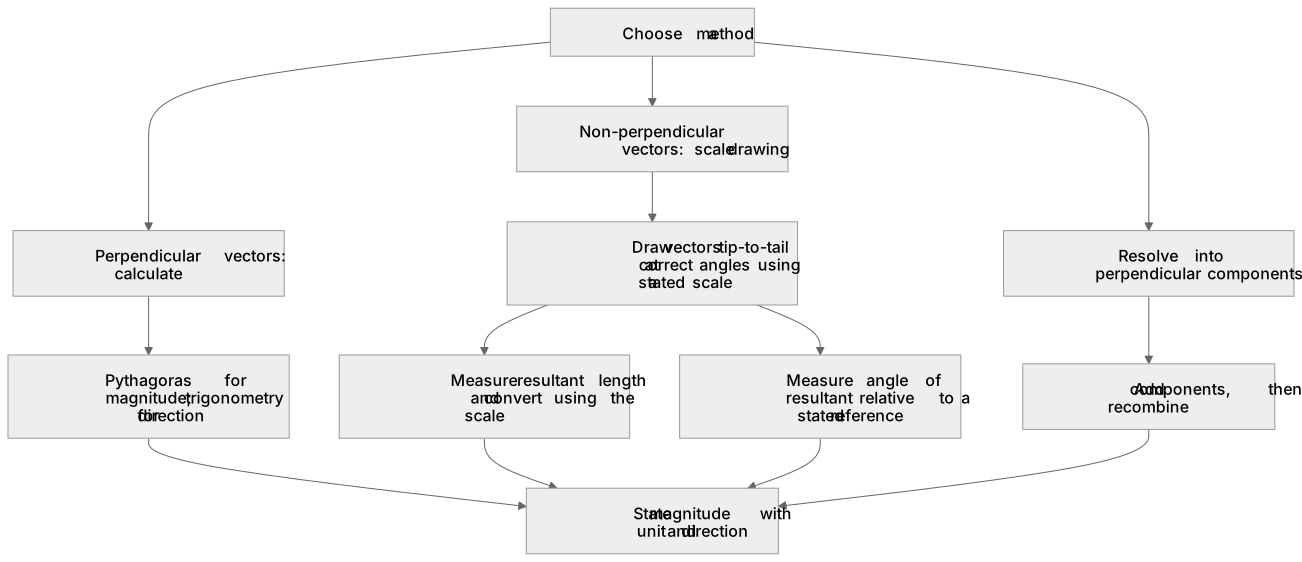
To add vectors, account for direction. For perpendicular vectors, resolve into components and use Pythagoras: a 3 N force east plus a 4 N force north gives a resultant of 5 N at an angle found from tan θ = 4/3. For non-perpendicular vectors, use a scale drawing: choose a scale, draw each vector tip-to-tail at the correct angle, then measure the resultant length and direction. Alternatively resolve each vector into perpendicular components, add components, then recombine. The resultant is a single vector with the same effect as the original vectors. Always state magnitude with unit and direction relative to a stated reference.
What earns the marks
- Draws vectors tip-to-tail at the correct angles using a stated scale.
- Measures the resultant length and converts it using the scale to find magnitude.
- Measures the angle of the resultant relative to a stated reference direction.
- Uses Pythagoras for perpendicular vectors and trigonometry to find the resultant direction.
- Resolves vectors into perpendicular components, adds components, then recombines to find the resultant.
- States the final answer as a magnitude with unit and a direction, for example 5.0 N at 53° north of east.
Common mistakes and how to put them right
Drawing vectors tail-to-tail and measuring between the tails.
Put it right by drawing them tip-to-tail so the resultant runs from the start of the first vector to the tip of the last.
Forgetting to convert a measured drawing length back using the scale.
Put it right by multiplying the measured length by the scale factor.
Giving only a magnitude for a vector sum.
Put it right: Also stating the direction relative to a clear reference line.
Exam tips
- Choose a scale that makes the drawing large enough to measure angles accurately, and state the scale clearly.
- Show the tip-to-tail construction and label the resultant with its direction; examiners can then follow your method.
- For perpendicular vectors, calculate rather than draw, and check the resultant is larger than either component but smaller than their sum.
Try the lesson
The start of the Scalars and vectors: Addition of vectors by calculation or scale drawing. lesson, made from checked teaching notes for this specification point.
Have a go first
Two forces act at right angles to each other: 3 N to the right and 4 N upwards. What is the magnitude of the resultant force?
Listen
To add vectors, account for direction. For perpendicular vectors, resolve into components and use Pythagoras: a 3 N force east plus a 4 N force north gives a resultant of 5 N at an angle found from tan θ = 4/3. For non-perpendicular vectors, use a scale drawing: choose a scale, draw each vector tip-to-tail at the correct angle, then measure the resultant length and direction. Alternatively resolve each vector into perpendicular components, add components, then recombine. The resultant is a single vector with the same effect as the original vectors. Always state magnitude with unit and direction relative to a stated reference. A strong answer earns marks for these points. Draws vectors tip-to-tail at the correct angles using a stated scale. Measures the resultant length and converts it using the scale to find magnitude. Measures the angle of the resultant relative to a stated reference direction. Uses Pythagoras for perpendicular vectors and trigonometry to find the resultant direction. A common slip: Drawing vectors tail-to-tail and measuring between the tails. Instead, drawing them tip-to-tail so the resultant runs from the start of the first vector to the tip of the last. Exam tip: Choose a scale that makes the drawing large enough to measure angles accurately, and state the scale clearly.
See it
Key words
Say what each word means before you turn the card.
Scale drawing
Try answering aloud or in your head before turning the card.
Resolving components
Try answering aloud or in your head before turning the card.
Resultant magnitude and direction
Try answering aloud or in your head before turning the card.
Vector addition
Try answering aloud or in your head before turning the card.
See every definition
- Scale drawing
- A method for non-perpendicular vectors: choose a scale, draw each vector tip-to-tail at the correct angle, then measure the resultant length and direction.
- Resolving components
- Resolve each vector into perpendicular components, add components, then recombine to find the resultant.
- Resultant magnitude and direction
- A single vector with the same effect as the original vectors, stated as a magnitude with unit and a direction relative to a stated reference.
- Vector addition
- Done by calculation or scale drawing, accounting for direction; for perpendicular vectors, resolve into components and use Pythagoras.
Label the diagram
Some boxes have lost their names. Pick the right name for each number.

1Box 1
2Box 2
3Box 3
There is more to this lesson
The full lesson goes on to check your understanding and help you earn the marks. Create a free account to carry on, with your progress saved.
A week of Premium from your first lesson · Then the free plan continues · No card, no charge
Test your understanding of Scalars and vectors: Addition of vectors by calculation or scale drawing.
Active recall beats re-reading. Take an instant quiz now to test what you’ve learned and lock it into long-term memory.
A week of Premium from your first lesson · Then the free plan continues · No card, no charge