AQA · A-Level · Physics
Course version: 7408 · Version from Sept 2016
Second Law of Thermodynamics expressed as the need for a heat engine to…
Full specification wording
Second Law and engines (A-level only): Second Law of Thermodynamics expressed as the need for a heat engine to operate between a source and a sink.
A heat engine converts thermal energy into useful work, but only if thermal energy flows from a hot source to a cold sink.
Checked against the AQA 7408 specification (opens in a new tab) on .
- Point 2 of 2
- 4 key terms
Study notes
From the checked teaching notes for this specification point.
The idea
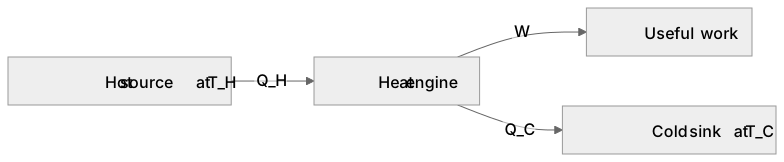
A heat engine converts thermal energy into useful work, but only if thermal energy flows from a hot source to a cold sink. The source supplies energy Q_H at temperature T_H; the engine extracts work W; the sink receives Q_C at lower temperature T_C. The Second Law forbids a device that converts a single thermal reservoir entirely into work with no sink, so efficiency is always below 1.
For example: A steam turbine takes energy from steam at about 800 K and rejects energy to cooling water at about 300 K. The maximum theoretical efficiency is 1 − T_C/T_H, showing that a larger temperature difference gives greater efficiency.
What earns the marks
- State that a heat engine absorbs thermal energy from a hot source and rejects some thermal energy to a cold sink.
- Explain that the Second Law requires a temperature difference between source and sink for continuous conversion of thermal energy into work.
- Apply the energy balance W = Q_H − Q_C to a heat engine operating between a source and a sink.
- Use the Kelvin temperatures of source and sink to compare maximum theoretical efficiencies of different engines.
- Recognise that no real engine can be 100% efficient because some energy must be rejected to the sink.
Common mistakes and how to put them right
Thinking that a heat engine can convert all absorbed thermal energy into work.
Put it right by stating that some energy must be rejected to a cold sink.
Using Celsius temperatures in efficiency calculations.
Put it right by converting all temperatures to kelvin first.
Confusing the source with the sink.
Put it right by identifying the source as the hot reservoir that supplies energy and the sink as the cold reservoir that receives rejected energy.
Exam tips
- Sketch a simple energy flow diagram labelling source, engine, work output and sink before calculating.
- When comparing engines, calculate the maximum theoretical efficiency for each using source and sink temperatures in kelvin.
- Explain the Second Law in terms of the direction of spontaneous energy transfer from hot to cold, not just energy conservation.
Try the lesson
The start of the Second Law and engines (A-level only): Second Law of Thermodynamics expressed as the need for a heat engine to operate between a source and a sink. lesson, made from checked teaching notes for this specification point.
Have a go first
A heat engine takes in energy from a hot source and delivers some of it as useful work. According to the Second Law of Thermodynamics, what must the engine also have in order to keep operating?
Listen
A heat engine converts thermal energy into useful work, but only if thermal energy flows from a hot source to a cold sink. The source supplies energy Q_H at temperature T_H; the engine extracts work W; the sink receives Q_C at lower temperature T_C. The Second Law forbids a device that converts a single thermal reservoir entirely into work with no sink, so efficiency is always below 1. For example, a steam turbine takes energy from steam at about 800 K and rejects energy to cooling water at about 300 K. The maximum theoretical efficiency is 1 − T_C/T_H, showing that a larger temperature difference gives greater efficiency. A strong answer earns marks for these points. State that a heat engine absorbs thermal energy from a hot source and rejects some thermal energy to a cold sink. Explain that the Second Law requires a temperature difference between source and sink for continuous conversion of thermal energy into work. Apply the energy balance W = Q_H − Q_C to a heat engine operating between a source and a sink. Use the Kelvin temperatures of source and sink to compare maximum theoretical efficiencies of different engines. A common slip: Thinking that a heat engine can convert all absorbed thermal energy into work. Instead, stating that some energy must be rejected to a cold sink. Exam tip: Sketch a simple energy flow diagram labelling source, engine, work output and sink before calculating.
See it
Key words
Say what each word means before you turn the card.
Second Law of Thermodynamics
Try answering aloud or in your head before turning the card.
Heat engine
Try answering aloud or in your head before turning the card.
Source
Try answering aloud or in your head before turning the card.
Sink
Try answering aloud or in your head before turning the card.
See every definition
- Second Law of Thermodynamics
- It forbids a device that converts a single thermal reservoir entirely into work with no sink, so efficiency is always below 1.
- Heat engine
- It converts thermal energy into useful work, but only if thermal energy flows from a hot source to a cold sink.
- Source
- The hot reservoir that supplies energy Q_H at temperature T_H to the engine.
- Sink
- The cold reservoir that receives rejected energy Q_C at lower temperature T_C.
Label the diagram
Some boxes have lost their names. Pick the right name for each number.
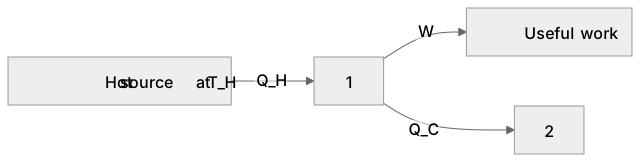
1Box 1
2Box 2
There is more to this lesson
The full lesson goes on to check your understanding and help you earn the marks. Create a free account to carry on, with your progress saved.
A week of Premium from your first lesson · Then the free plan continues · No card, no charge
Test your understanding of Second Law and engines (A-level only): Second Law of Thermodynamics expressed as the need for a heat engine to operate between a source and a sink.
Active recall beats re-reading. Take an instant quiz now to test what you’ve learned and lock it into long-term memory.
A week of Premium from your first lesson · Then the free plan continues · No card, no charge