AQA · A-Level · Physics
Course version: 7408 · Version from Sept 2016
Simple harmonic systems (A-level only): Effects of damping on oscillations.
Damping removes energy from an oscillating system, usually transferring it to the surroundings by doing work against resistive forces such as friction or air resistance.
Checked against the AQA 7408 specification (opens in a new tab) on .
- Point 1 of 2
- 4 key terms
Study notes
From the checked teaching notes for this specification point.
The idea
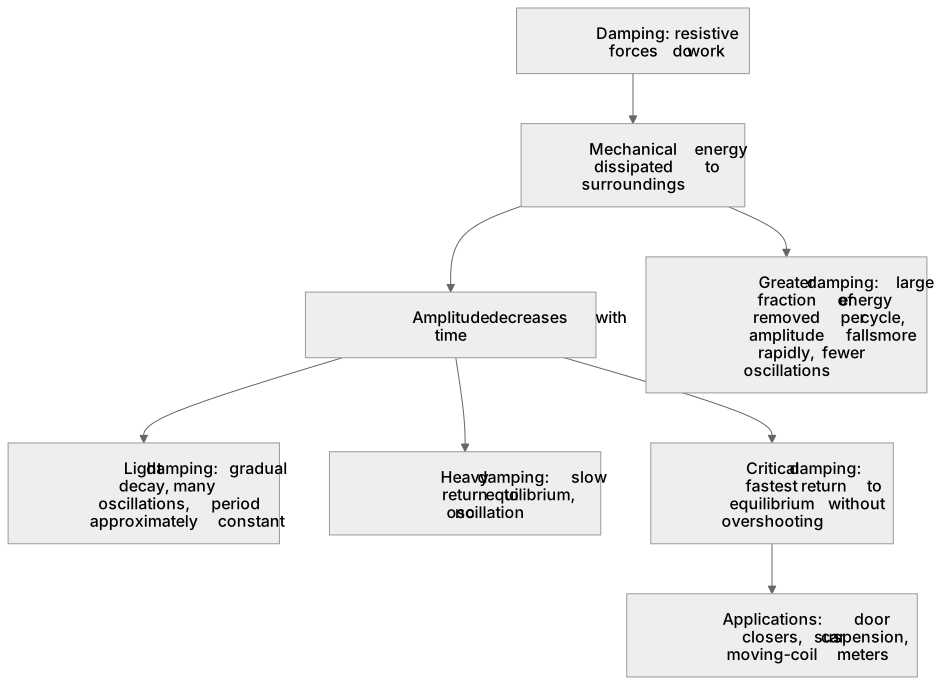
Damping removes energy from an oscillating system, usually transferring it to the surroundings by doing work against resistive forces such as friction or air resistance. The amplitude therefore decreases over time, while the period is only slightly affected for light damping. In light damping, the amplitude decays gradually and the oscillations remain approximately simple harmonic. In heavy damping, the system returns slowly to equilibrium without oscillating. In critical damping, the system returns to equilibrium in the shortest possible time without overshooting, which is useful in door closers and moving-coil meters. Greater damping reduces the number of visible oscillations and increases the rate of energy loss.
What earns the marks
- State that damping is caused by resistive forces doing work on the oscillator, so mechanical energy is dissipated to the surroundings and the amplitude decreases with time.
- Describe light damping as a gradual exponential-like decrease in amplitude with the oscillator still completing many oscillations and the period remaining approximately constant.
- Describe heavy damping as a slow return to equilibrium with no oscillation, and critical damping as the fastest return to equilibrium without overshooting.
- Explain practical consequences, such as critical damping in door closers, car suspension or moving-coil meters, where overshoot or prolonged oscillation is undesirable.
- Compare energy loss: greater damping removes a larger fraction of energy per cycle, so the amplitude falls more rapidly and fewer oscillations are observed.
Common mistakes and how to put them right
Thinking damping always changes the period dramatically.
Put it right: For light damping the period is almost unchanged; the main observable effect is a decrease in amplitude.
Confusing heavy damping with critical damping.
Put it right: Heavy damping returns to equilibrium slowly without oscillating, whereas critical damping returns in the shortest time without overshooting.
Believing that damping stops the oscillator instantly.
Put it right: Damping gradually removes energy, so the amplitude decays over many cycles in the lightly damped case.
Exam tips
- Sketch displacement–time curves for light, heavy and critical damping on the same axes, labelling the equilibrium line and showing that only the lightly damped curve crosses it repeatedly.
- Use the phrase 'returns to equilibrium in the shortest time without overshooting' when defining critical damping, and give one named application to show understanding.
- When explaining energy transfer, refer to work done against resistive forces and the resulting decrease in amplitude rather than saying that energy is simply 'lost'.
Try the lesson
The start of the Simple harmonic systems (A-level only): Effects of damping on oscillations. lesson, made from checked teaching notes for this specification point.
Have a go first
What happens to the amplitude of a damped oscillation over time?
Listen
Damping removes energy from an oscillating system, usually transferring it to the surroundings by doing work against resistive forces such as friction or air resistance. The amplitude therefore decreases over time, while the period is only slightly affected for light damping. In light damping, the amplitude decays gradually and the oscillations remain approximately simple harmonic. In heavy damping, the system returns slowly to equilibrium without oscillating. In critical damping, the system returns to equilibrium in the shortest possible time without overshooting, which is useful in door closers and moving-coil meters. Greater damping reduces the number of visible oscillations and increases the rate of energy loss. A strong answer earns marks for these points. State that damping is caused by resistive forces doing work on the oscillator, so mechanical energy is dissipated to the surroundings and the amplitude decreases with time. Describe light damping as a gradual exponential-like decrease in amplitude with the oscillator still completing many oscillations and the period remaining approximately constant. Describe heavy damping as a slow return to equilibrium with no oscillation, and critical damping as the fastest return to equilibrium without overshooting. Explain practical consequences, such as critical damping in door closers, car suspension or moving-coil meters, where overshoot or prolonged oscillation is undesirable. A common slip: Thinking damping always changes the period dramatically. Instead, for light damping the period is almost unchanged; the main observable effect is a decrease in amplitude. Exam tip: Sketch displacement–time curves for light, heavy and critical damping on the same axes, labelling the equilibrium line and showing that only the lightly damped curve crosses it repeatedly.
See it
Key words
Say what each word means before you turn the card.
Damping
Try answering aloud or in your head before turning the card.
Light damping
Try answering aloud or in your head before turning the card.
Heavy damping
Try answering aloud or in your head before turning the card.
Critical damping
Try answering aloud or in your head before turning the card.
See every definition
- Damping
- Resistive forces do work on the oscillator, so mechanical energy is dissipated to the surroundings and the amplitude decreases with time.
- Light damping
- A gradual exponential-like decrease in amplitude with the oscillator still completing many oscillations and the period remaining approximately constant.
- Heavy damping
- A slow return to equilibrium with no oscillation.
- Critical damping
- The fastest return to equilibrium without overshooting, useful in door closers and moving-coil meters.
Label the diagram
Some boxes have lost their names. Pick the right name for each number.
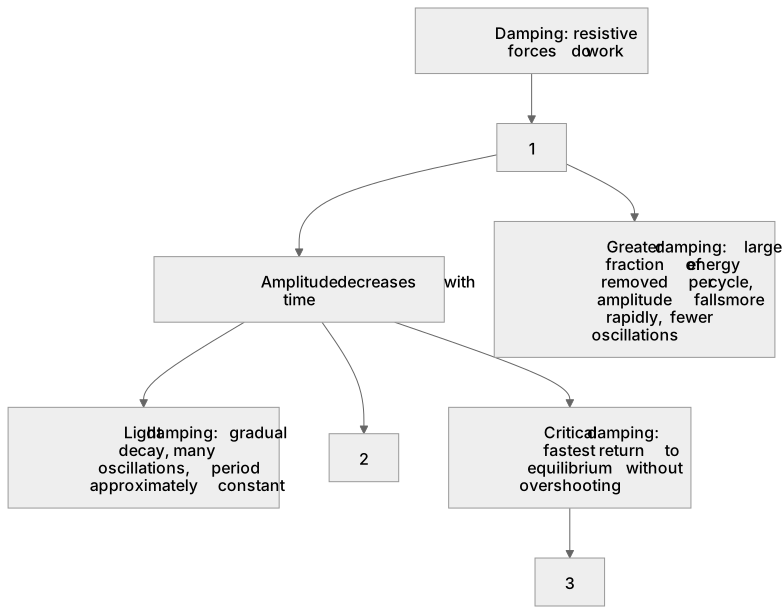
1Box 1
2Box 2
3Box 3
There is more to this lesson
The full lesson goes on to check your understanding and help you earn the marks. Create a free account to carry on, with your progress saved.
A week of Premium from your first lesson · Then the free plan continues · No card, no charge
Test your understanding of Simple harmonic systems (A-level only): Effects of damping on oscillations.
Active recall beats re-reading. Take an instant quiz now to test what you’ve learned and lock it into long-term memory.
A week of Premium from your first lesson · Then the free plan continues · No card, no charge