AQA · A-Level · Physics
Course version: 7408 · Version from Sept 2016
Required practical 7: Investigation into simple harmonic motion using a…
Full specification wording
Simple harmonic systems (A-level only): Required practical 7: Investigation into simple harmonic motion using a mass–spring system and a simple pendulum.
You investigate two oscillators that approximate simple harmonic motion.
Checked against the AQA 7408 specification (opens in a new tab) on .
- Point 2 of 2
- 2 key terms
Study notes
From the checked teaching notes for this specification point.
The idea
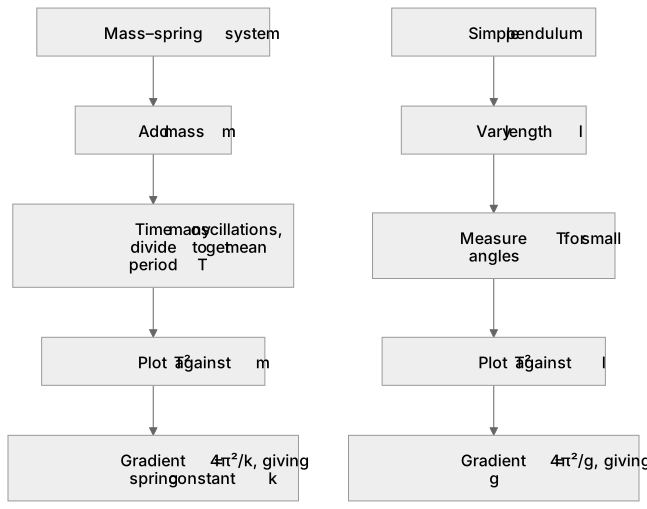
You investigate two oscillators that approximate simple harmonic motion. For the mass–spring system, time many oscillations for each added mass to find the period T, then plot T² against mass m; the gradient is 4π²/k, giving the spring constant k. For the pendulum, vary the length l, measure T for small angles, and plot T² against l; the gradient is 4π²/g, giving g. In both cases, repeat readings, use a fiducial marker at the equilibrium position, and start timing as the bob or mass passes it. Keep amplitudes small so the motion stays close to SHM, and identify the equilibrium position carefully.
What earns the marks
- Times a large number of oscillations and divides by that number to obtain a mean period, reducing the effect of human reaction time.
- Uses a fiducial marker at the equilibrium position and starts timing as the oscillator passes it, so each timing begins from the same phase.
- For the mass–spring system, plots T² against m and uses gradient = 4π²/k to determine the spring constant k.
- For the pendulum, plots T² against l and uses gradient = 4π²/g to determine g.
- Keeps the amplitude small so the small-angle approximation holds and the motion remains close to simple harmonic.
- Repeats measurements and calculates a mean, and considers uncertainties in length, time and mass.
Common mistakes and how to put them right
Timing only one oscillation, which makes reaction time a large fraction of the measured period.
Put it right by timing many oscillations and dividing.
Measuring the pendulum length to the top of the bob rather than to its centre, which gives a systematic error in l.
Put it right by measuring to the centre of the bob.
Using a large amplitude for the pendulum, so the motion is not simple harmonic.
Put it right by keeping the amplitude small.
Exam tips
- State clearly how you reduce timing uncertainty, for example by timing 20 oscillations and dividing by 20.
- When describing a graph, name the axes and explain how the gradient gives the required constant.
- Mention at least one control variable, such as keeping the amplitude small or using the same spring.
Try the lesson
The start of the Simple harmonic systems (A-level only): Required practical 7: Investigation into simple harmonic motion using a mass–spring system and a simple pendulum. lesson, made from checked teaching notes for this specification point.
Have a go first
In Required practical 7, a student times 20 complete oscillations of a simple pendulum and records a total time of 36.0 s. What is the period of the pendulum?
Listen
You investigate two oscillators that approximate simple harmonic motion. For the mass–spring system, time many oscillations for each added mass to find the period T, then plot T² against mass m; the gradient is 4π²/k, giving the spring constant k. For the pendulum, vary the length l, measure T for small angles, and plot T² against l; the gradient is 4π²/g, giving g. In both cases, repeat readings, use a fiducial marker at the equilibrium position, and start timing as the bob or mass passes it. Keep amplitudes small so the motion stays close to SHM, and identify the equilibrium position carefully. A strong answer earns marks for these points. Times a large number of oscillations and divides by that number to obtain a mean period, reducing the effect of human reaction time. Uses a fiducial marker at the equilibrium position and starts timing as the oscillator passes it, so each timing begins from the same phase. For the mass–spring system, plots T² against m and uses gradient = 4π²/k to determine the spring constant k. For the pendulum, plots T² against l and uses gradient = 4π²/g to determine g. A common slip: Timing only one oscillation, which makes reaction time a large fraction of the measured period. Instead, timing many oscillations and dividing. Exam tip: State clearly how you reduce timing uncertainty, for example by timing 20 oscillations and dividing by 20.
See it
Key words
Say what each word means before you turn the card.
Experimental measurement and uncertainty
Try answering aloud or in your head before turning the card.
Graphical analysis
Try answering aloud or in your head before turning the card.
See every definition
- Experimental measurement and uncertainty
- Repeating measurements and calculating a mean, and considering uncertainties in length, time and mass, improves reliability.
- Graphical analysis
- Plotting T² against mass m gives a gradient of 4π²/k, and plotting T² against length l gives a gradient of 4π²/g.
Label the diagram
Some boxes have lost their names. Pick the right name for each number.
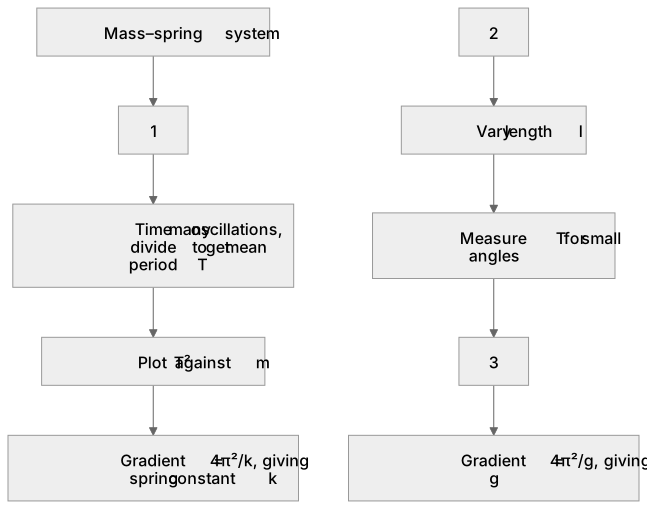
1Box 1
2Box 2
3Box 3
There is more to this lesson
The full lesson goes on to check your understanding and help you earn the marks. Create a free account to carry on, with your progress saved.
A week of Premium from your first lesson · Then the free plan continues · No card, no charge
Test your understanding of Simple harmonic systems (A-level only): Required practical 7: Investigation into simple harmonic motion using a mass–spring system and a simple pendulum.
Active recall beats re-reading. Take an instant quiz now to test what you’ve learned and lock it into long-term memory.
A week of Premium from your first lesson · Then the free plan continues · No card, no charge