AQA · A-Level · Physics
Course version: 7408 · Version from Sept 2016
Defining properties: rapid increase in absolute magnitude of supernovae;…
Full specification wording
Supernovae, neutron stars and black holes (A-level only): Defining properties: rapid increase in absolute magnitude of supernovae; composition and density of neutron stars; escape velocity > c for black holes.
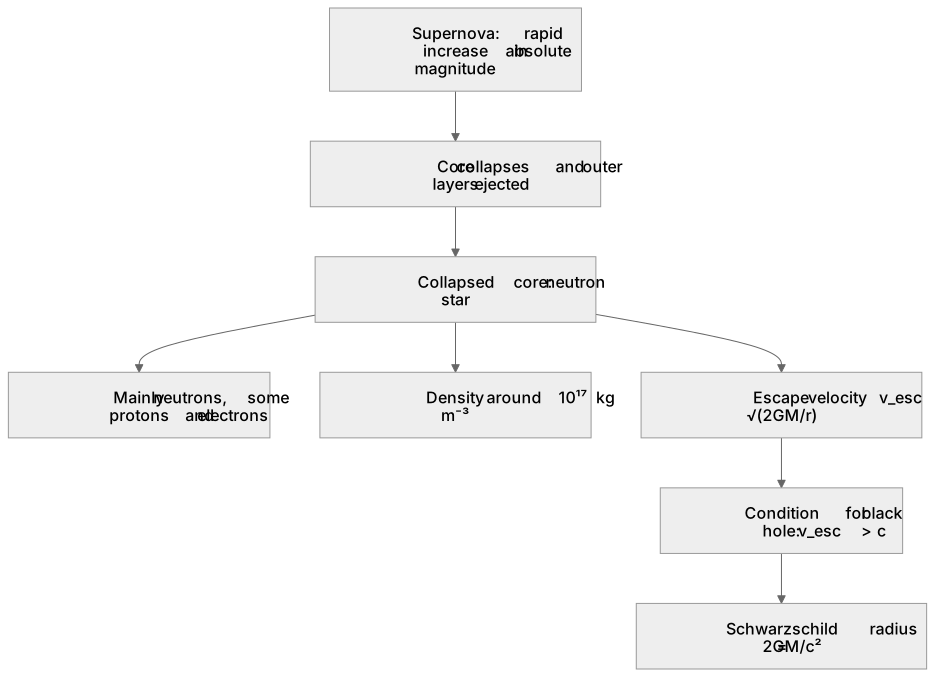
A supernova is identified by a rapid increase in absolute magnitude, meaning its intrinsic brightness rises sharply as the star's core collapses and the outer layers are ejected.
Checked against the AQA 7408 specification (opens in a new tab) on .
- Point 1 of 6
- 4 key terms
Study notes
From the checked teaching notes for this specification point.
The idea
A supernova is identified by a rapid increase in absolute magnitude, meaning its intrinsic brightness rises sharply as the star's core collapses and the outer layers are ejected. The absolute magnitude becomes much more negative over days, so the event can outshine a galaxy. A neutron star is the collapsed core, composed mainly of neutrons with some protons and electrons, with a density comparable to an atomic nucleus, around 10¹⁷ kg m⁻³. A black hole forms when the escape velocity from the collapsed core exceeds the speed of light c, so even light cannot escape. The escape velocity is v_esc = √(2GM/r); setting v_esc > c gives a Schwarzschild radius r_s = 2GM/c². For a 10 M☉ black hole, r_s is about 30 km.
What earns the marks
- State that a supernova shows a rapid increase in absolute magnitude, meaning the absolute magnitude becomes more negative over a short time.
- Explain that the rapid brightening is caused by the collapse of the core and the resulting ejection of outer layers, producing a huge increase in luminosity.
- Describe a neutron star as composed mainly of neutrons, with some protons and electrons, at nuclear density around 10¹⁷ kg m⁻³.
- Derive or use v_esc = √(2GM/r) and set v_esc > c to define a black hole.
- Rearrange to r_s = 2GM/c² and interpret r_s as the Schwarzschild radius or event horizon.
- Compare densities: a neutron star is about 10¹⁷ kg m⁻³, whereas a black hole's mass is concentrated within its event horizon.
Common mistakes and how to put them right
Confusing absolute magnitude with apparent magnitude.
Put it right by defining absolute magnitude as the brightness the star would have at 10 pc.
Thinking a neutron star is made only of neutrons.
Put it right by stating the composition includes neutrons, protons and electrons.
Using v_esc = c as the condition for a black hole instead of v_esc > c.
Put it right by writing v_esc > c and then r_s = 2GM/c².
Forgetting to square c in r_s = 2GM/c².
Put it right by writing c² in the denominator.
Exam tips
- When defining a supernova, link the rapid increase in absolute magnitude to the collapse and ejection process, not just to a brightening.
- For neutron stars, quote a typical density such as 10¹⁷ kg m⁻³ and state the main composition.
- For black holes, start from the escape velocity equation and show the inequality v_esc > c before rearranging to r_s = 2GM/c².
- Use consistent units: G = 6.67 × 10⁻¹¹ N m² kg⁻², c = 3.00 × 10⁸ m s⁻¹, and masses in kg.
Try the lesson
The start of the Supernovae, neutron stars and black holes (A-level only): Defining properties: rapid increase in absolute magnitude of supernovae; composition and density of neutron stars; escape velocity > c for black holes. lesson, made from checked teaching notes for this specification point.
Have a go first
Which change in a star's absolute magnitude defines a supernova?
Listen
A supernova is identified by a rapid increase in absolute magnitude, meaning its intrinsic brightness rises sharply as the star's core collapses and the outer layers are ejected. The absolute magnitude becomes much more negative over days, so the event can outshine a galaxy. A neutron star is the collapsed core, composed mainly of neutrons with some protons and electrons, with a density comparable to an atomic nucleus, around 10¹⁷ kg m⁻³. A black hole forms when the escape velocity from the collapsed core exceeds the speed of light c, so even light cannot escape. The escape velocity is v_esc = √(2GM/r); setting v_esc > c gives a Schwarzschild radius r_s = 2GM/c². For a 10 M☉ black hole, r_s is about 30 km. A strong answer earns marks for these points. State that a supernova shows a rapid increase in absolute magnitude, meaning the absolute magnitude becomes more negative over a short time. Explain that the rapid brightening is caused by the collapse of the core and the resulting ejection of outer layers, producing a huge increase in luminosity. Describe a neutron star as composed mainly of neutrons, with some protons and electrons, at nuclear density around 10¹⁷ kg m⁻³. Derive or use v_esc = √(2GM/r) and set v_esc > c to define a black hole. A common slip: Confusing absolute magnitude with apparent magnitude: absolute magnitude is the intrinsic brightness at a standard distance, while apparent magnitude depends on distance. Instead, defining absolute magnitude as the brightness the star would have at 10 pc. Exam tip: When defining a supernova, link the rapid increase in absolute magnitude to the collapse and ejection process, not just to a brightening.
See it
Key words
Say what each word means before you turn the card.
Supernova
Try answering aloud or in your head before turning the card.
Neutron star
Try answering aloud or in your head before turning the card.
Black hole
Try answering aloud or in your head before turning the card.
Schwarzschild radius
Try answering aloud or in your head before turning the card.
See every definition
- Supernova
- An event showing a rapid increase in absolute magnitude, meaning the absolute magnitude becomes more negative over a short time.
- Neutron star
- A collapsed core composed mainly of neutrons, with some protons and electrons, at nuclear density around 10¹⁷ kg m⁻³.
- Black hole
- A collapsed core from which the escape velocity exceeds the speed of light c, so even light cannot escape.
- Schwarzschild radius
- The radius r_s = 2GM/c² obtained by setting the escape velocity greater than c, also called the event horizon.
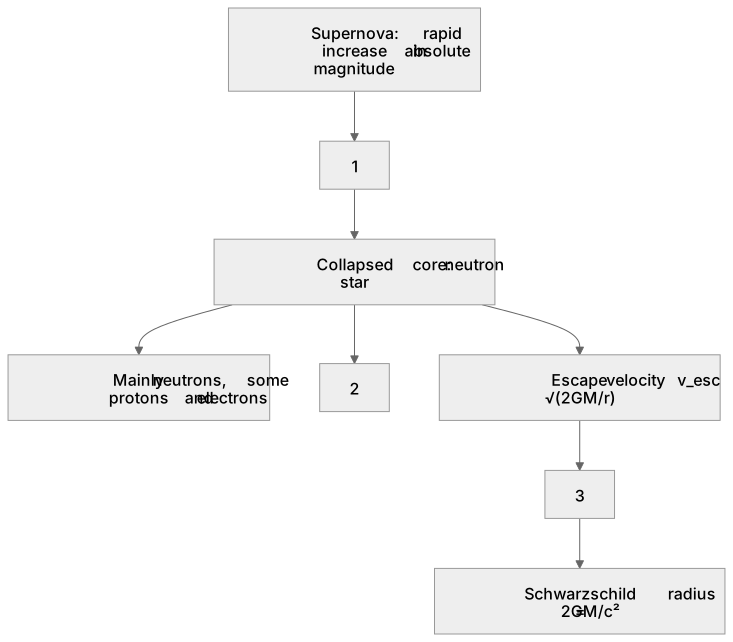
Label the diagram
Some boxes have lost their names. Pick the right name for each number.
1Box 1
2Box 2
3Box 3
There is more to this lesson
The full lesson goes on to check your understanding and help you earn the marks. Create a free account to carry on, with your progress saved.
A week of Premium from your first lesson · Then the free plan continues · No card, no charge
Test your understanding of Supernovae, neutron stars and black holes (A-level only): Defining properties: rapid increase in absolute magnitude of supernovae; composition and density of neutron stars; escape velocity > c for black holes.
Active recall beats re-reading. Take an instant quiz now to test what you’ve learned and lock it into long-term memory.
A week of Premium from your first lesson · Then the free plan continues · No card, no charge