AQA · A-Level · Physics
Course version: 7408 · Version from Sept 2016
Gamma ray bursts due to the collapse of supergiant stars to form neutron…
Full specification wording
Supernovae, neutron stars and black holes (A-level only): Gamma ray bursts due to the collapse of supergiant stars to form neutron stars or black holes.
Gamma ray bursts (GRBs) are extremely energetic flashes of gamma radiation.
Checked against the AQA 7408 specification (opens in a new tab) on .
- Point 2 of 6
- 4 key terms
Study notes
From the checked teaching notes for this specification point.
The idea
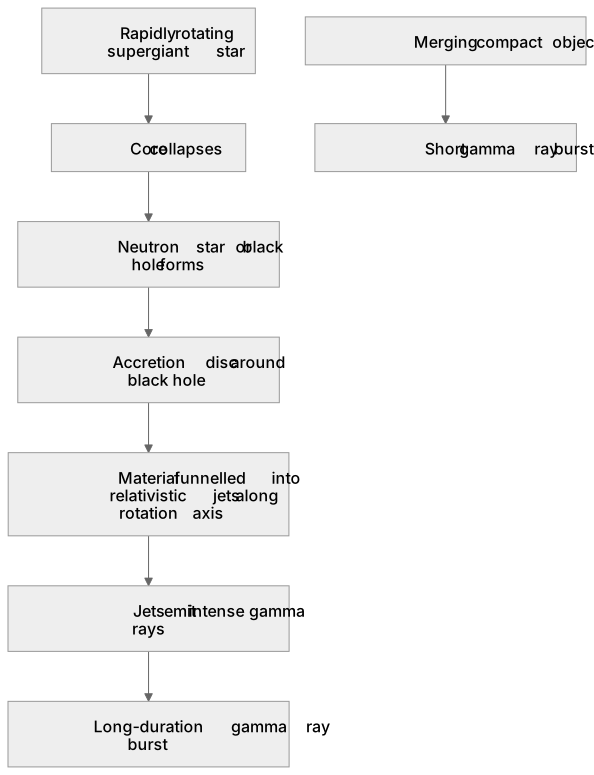
Gamma ray bursts (GRBs) are extremely energetic flashes of gamma radiation. A long-duration GRB can occur when a rapidly rotating supergiant star collapses at the end of its life. The core collapses to form a neutron star or a black hole. If the collapse produces a black hole, material from the surrounding accretion disc can be funnelled into relativistic jets along the rotation axis. These jets emit intense gamma rays. The burst is therefore linked to the collapse of a supergiant star and the formation of a neutron star or black hole. The event is brief but can release more energy than the Sun will emit in its entire lifetime. Observations show that long GRBs are associated with supernovae in distant galaxies.
What earns the marks
- State that a gamma ray burst is a brief, intense emission of gamma rays.
- Link the burst to the collapse of a supergiant star.
- Identify the collapsed core as a neutron star or a black hole.
- Explain that jets or beams of particles moving at relativistic speeds produce the gamma rays.
- Note that the collapse must involve rapid rotation to produce the jets.
- Distinguish long GRBs from short GRBs, which are associated with merging compact objects rather than supergiant collapse.
Common mistakes and how to put them right
Saying gamma ray bursts come from the supernova explosion itself rather than from the collapse to a neutron star or black hole and the resulting jets.
Put it right by linking the burst to the collapse and jet formation.
Confusing gamma ray bursts with supernovae.
Put it right by stating that a GRB is a distinct phenomenon often associated with some supernovae.
Thinking all gamma ray bursts come from supergiant stars.
Put it right by specifying that long GRBs are due to supergiant collapse.
Ignoring the role of rotation.
Put it right by mentioning rapid rotation of the collapsing star.
Exam tips
- Use the term 'relativistic jets' when describing the emission mechanism.
- State clearly that the collapse forms a neutron star or black hole, not just a supernova.
- If asked to compare, mention that long GRBs are linked to supergiant collapse, while short GRBs are linked to compact object mergers.
- Remember that gamma rays are electromagnetic radiation of very high photon energy.
Try the lesson
The start of the Supernovae, neutron stars and black holes (A-level only): Gamma ray bursts due to the collapse of supergiant stars to form neutron stars or black holes. lesson, made from checked teaching notes for this specification point.
Have a go first
Which of the following stellar events is a known cause of gamma ray bursts?
Listen
Gamma ray bursts (GRBs) are extremely energetic flashes of gamma radiation. A long-duration GRB can occur when a rapidly rotating supergiant star collapses at the end of its life. The core collapses to form a neutron star or a black hole. If the collapse produces a black hole, material from the surrounding accretion disc can be funnelled into relativistic jets along the rotation axis. These jets emit intense gamma rays. The burst is therefore linked to the collapse of a supergiant star and the formation of a neutron star or black hole. The event is brief but can release more energy than the Sun will emit in its entire lifetime. Observations show that long GRBs are associated with supernovae in distant galaxies. A strong answer earns marks for these points. State that a gamma ray burst is a brief, intense emission of gamma rays. Link the burst to the collapse of a supergiant star. Identify the collapsed core as a neutron star or a black hole. Explain that jets or beams of particles moving at relativistic speeds produce the gamma rays. A common slip: Saying gamma ray bursts come from the supernova explosion itself rather than from the collapse to a neutron star or black hole and the resulting jets. Instead, linking the burst to the collapse and jet formation. Exam tip: Use the term 'relativistic jets' when describing the emission mechanism.
See it
Key words
Say what each word means before you turn the card.
Gamma ray burst
Try answering aloud or in your head before turning the card.
Relativistic jets
Try answering aloud or in your head before turning the card.
Long-duration GRB
Try answering aloud or in your head before turning the card.
Short GRBs
Try answering aloud or in your head before turning the card.
See every definition
- Gamma ray burst
- A brief, intense emission of gamma rays, extremely energetic flashes of gamma radiation.
- Relativistic jets
- Jets along the rotation axis into which material from the surrounding accretion disc can be funnelled, emitting intense gamma rays.
- Long-duration GRB
- A burst that can occur when a rapidly rotating supergiant star collapses at the end of its life, associated with supernovae in distant galaxies.
- Short GRBs
- Bursts associated with merging compact objects rather than supergiant collapse.
Label the diagram
Some boxes have lost their names. Pick the right name for each number.
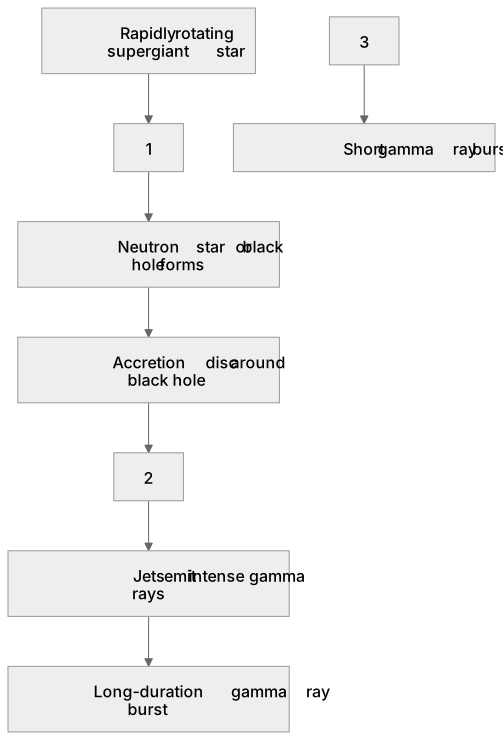
1Box 1
2Box 2
3Box 3
There is more to this lesson
The full lesson goes on to check your understanding and help you earn the marks. Create a free account to carry on, with your progress saved.
A week of Premium from your first lesson · Then the free plan continues · No card, no charge
Test your understanding of Supernovae, neutron stars and black holes (A-level only): Gamma ray bursts due to the collapse of supergiant stars to form neutron stars or black holes.
Active recall beats re-reading. Take an instant quiz now to test what you’ve learned and lock it into long-term memory.
A week of Premium from your first lesson · Then the free plan continues · No card, no charge