AQA · A-Level · Physics
Course version: 7408 · Version from Sept 2016
Supermassive black holes at the centre of galaxies.
Full specification wording
Supernovae, neutron stars and black holes (A-level only): Supermassive black holes at the centre of galaxies.
Supermassive black holes have masses of millions to billions of solar masses and reside at the centres of most large galaxies, including the Milky Way, where Sagittarius A* has a mass of about 4…
Checked against the AQA 7408 specification (opens in a new tab) on .
- Point 6 of 6
- 4 key terms
Study notes
From the checked teaching notes for this specification point.
The idea
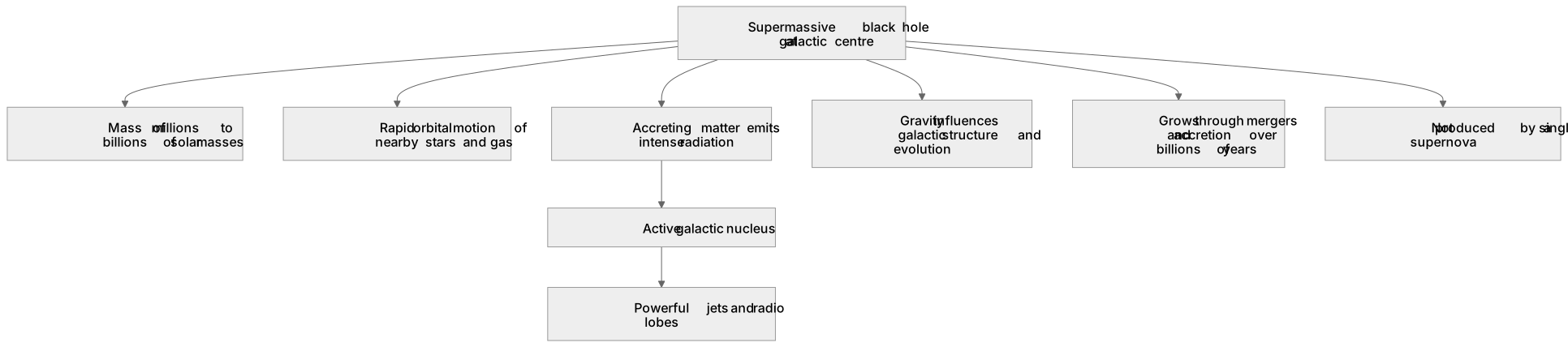
Supermassive black holes have masses of millions to billions of solar masses and reside at the centres of most large galaxies, including the Milky Way, where Sagittarius A* has a mass of about 4 million solar masses. They are inferred from the rapid orbital motion of stars and gas close to the galactic centre, from intense radiation emitted by accreting matter, and from jets and radio lobes produced by active galactic nuclei. Their event horizons are far larger than those of stellar-mass black holes, and their gravity influences galactic structure and evolution. They are not produced by a single supernova but grow through mergers and accretion over billions of years.
What earns the marks
- State that supermassive black holes have masses of millions to billions of solar masses and are found at the centres of most large galaxies.
- Describe observational evidence such as the rapid orbits of stars near the galactic centre and radiation from accreting matter in active galactic nuclei.
- Explain that accretion of matter onto a supermassive black hole can produce powerful jets and radio lobes observable across vast distances.
- Distinguish supermassive black holes from stellar-mass black holes in terms of mass, formation history and location within galaxies.
- Relate the presence of a supermassive black hole to the dynamics of the galactic centre, including the high orbital speeds of nearby stars.
Common mistakes and how to put them right
Confusing supermassive black holes with stellar-mass black holes.
Put it right by stating that supermassive black holes contain millions to billions of solar masses and lie at galactic centres.
Believing supermassive black holes form directly from a single supernova.
Put it right by explaining that they grow through accretion and mergers over long timescales.
Assuming black holes can be seen directly.
Put it right by describing indirect evidence such as stellar orbits, accretion radiation and jets.
Exam tips
- Use the Milky Way's centre, Sagittarius A*, as a concrete example when describing evidence for a supermassive black hole.
- Link observations of fast stellar orbits to the gravitational field of a compact, massive object using Kepler's laws or orbital speed arguments.
- Distinguish clearly between stellar-mass and supermassive black holes when answering comparison questions.
Try the lesson
The start of the Supernovae, neutron stars and black holes (A-level only): Supermassive black holes at the centre of galaxies. lesson, made from checked teaching notes for this specification point.
Have a go first
Where are supermassive black holes typically found?
Listen
Supermassive black holes have masses of millions to billions of solar masses and reside at the centres of most large galaxies, including the Milky Way, where Sagittarius A* has a mass of about 4 million solar masses. They are inferred from the rapid orbital motion of stars and gas close to the galactic centre, from intense radiation emitted by accreting matter, and from jets and radio lobes produced by active galactic nuclei. Their event horizons are far larger than those of stellar-mass black holes, and their gravity influences galactic structure and evolution. They are not produced by a single supernova but grow through mergers and accretion over billions of years. A strong answer earns marks for these points. State that supermassive black holes have masses of millions to billions of solar masses and are found at the centres of most large galaxies. Describe observational evidence such as the rapid orbits of stars near the galactic centre and radiation from accreting matter in active galactic nuclei. Explain that accretion of matter onto a supermassive black hole can produce powerful jets and radio lobes observable across vast distances. Distinguish supermassive black holes from stellar-mass black holes in terms of mass, formation history and location within galaxies. A common slip: Confusing supermassive black holes with stellar-mass black holes. Instead, stating that supermassive black holes contain millions to billions of solar masses and lie at galactic centres. Exam tip: Use the Milky Way's centre, Sagittarius A*, as a concrete example when describing evidence for a supermassive black hole.
See it
Key words
Say what each word means before you turn the card.
Supermassive black holes
Try answering aloud or in your head before turning the card.
Sagittarius A*
Try answering aloud or in your head before turning the card.
Accretion
Try answering aloud or in your head before turning the card.
Active galactic nuclei
Try answering aloud or in your head before turning the card.
See every definition
- Supermassive black holes
- Objects with masses of millions to billions of solar masses that reside at the centres of most large galaxies, including the Milky Way.
- Sagittarius A*
- The supermassive black hole at the centre of the Milky Way, with a mass of about 4 million solar masses.
- Accretion
- A process through which supermassive black holes grow over billions of years, alongside mergers, emitting intense radiation from accreting matter.
- Active galactic nuclei
- Sources that produce jets and radio lobes, alongside intense radiation emitted by accreting matter.
Label the diagram
Some boxes have lost their names. Pick the right name for each number.
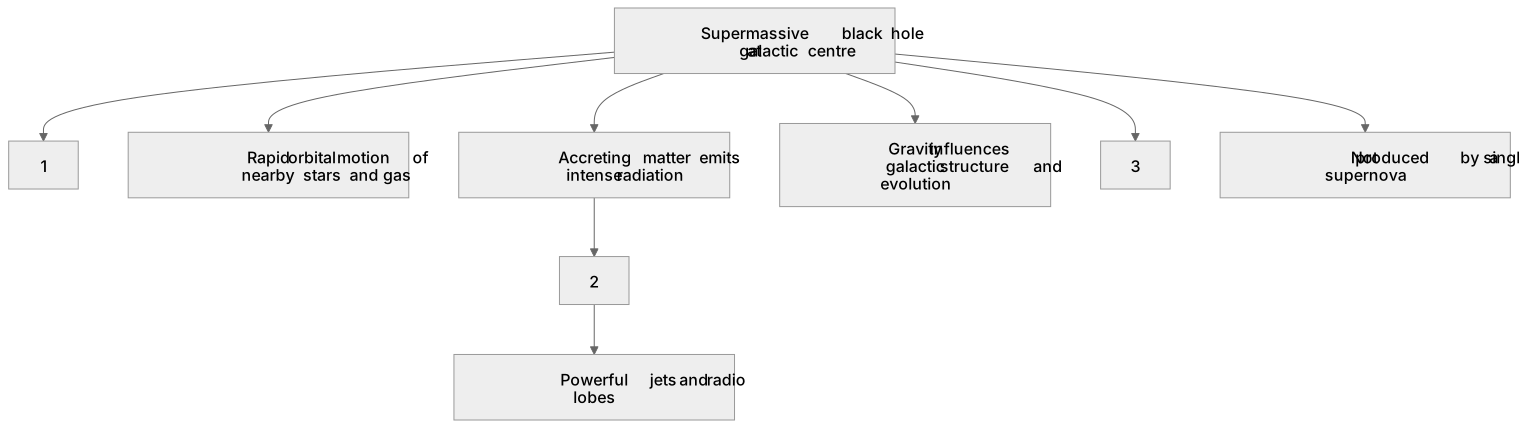
1Box 1
2Box 2
3Box 3
There is more to this lesson
The full lesson goes on to check your understanding and help you earn the marks. Create a free account to carry on, with your progress saved.
A week of Premium from your first lesson · Then the free plan continues · No card, no charge
Test your understanding of Supernovae, neutron stars and black holes (A-level only): Supermassive black holes at the centre of galaxies.
Active recall beats re-reading. Take an instant quiz now to test what you’ve learned and lock it into long-term memory.
A week of Premium from your first lesson · Then the free plan continues · No card, no charge