AQA · A-Level · Physics
Course version: 7408 · Version from Sept 2016
Students should be familiar with the light curve of typical type 1a…
Full specification wording
Supernovae, neutron stars and black holes (A-level only): Students should be familiar with the light curve of typical type 1a supernovae.
A type 1a supernova occurs when a white dwarf in a binary system accretes matter from a companion and approaches the Chandrasekhar limit, triggering runaway carbon fusion.
Checked against the AQA 7408 specification (opens in a new tab) on .
- Point 5 of 6
- 4 key terms
Study notes
From the checked teaching notes for this specification point.
The idea
A type 1a supernova occurs when a white dwarf in a binary system accretes matter from a companion and approaches the Chandrasekhar limit, triggering runaway carbon fusion. Because the exploding mass is nearly the same each time, the peak luminosity is standardised, so the light curve rises sharply over days, peaks, then falls as radioactive decay of nickel-56 and cobalt-56 powers the fading remnant. Plotting apparent magnitude against time gives a characteristic shape: a rapid rise, a broad peak, then an exponential decline with a half-life of about 77 days. Comparing the observed peak brightness with the known absolute magnitude allows distance estimation, making type 1a supernovae standard candles for cosmology.
What earns the marks
- Describe the origin of a type 1a supernova as a white dwarf accreting matter in a binary system until runaway fusion occurs near the Chandrasekhar limit.
- State that the peak luminosity is approximately standard because the exploding mass is similar in each event, making type 1a supernovae standard candles.
- Sketch or interpret a light curve showing a rapid rise to peak brightness followed by a slower decline powered by radioactive decay.
- Explain that the decline is linked to the decay of nickel-56 and cobalt-56, with a characteristic timescale of roughly 77 days.
- Use the difference between apparent and absolute magnitude, or flux and luminosity, to estimate distance to the host galaxy.
Common mistakes and how to put them right
Confusing type 1a supernovae with core-collapse supernovae.
Put it right by stating that type 1a involves a white dwarf in a binary system, not the collapse of a massive star's core.
Assuming all supernovae have identical peak brightness.
Put it right by noting that type 1a supernovae are standardisable because their trigger mass is similar, while core-collapse events vary.
Treating the light curve as a simple symmetric peak.
Put it right by describing the rapid rise and slower, exponential decline caused by radioactive decay.
Exam tips
- Practise sketching the light curve with labelled axes: time in days on the x-axis and apparent magnitude or luminosity on the y-axis, with the peak and decline clearly marked.
- When explaining standard candles, link the near-constant peak luminosity to distance measurement using the distance modulus or flux-luminosity relation.
- Use precise terms such as white dwarf, Chandrasekhar limit, runaway fusion, nickel-56 and cobalt-56 to show secure subject knowledge.
Try the lesson
The start of the Supernovae, neutron stars and black holes (A-level only): Students should be familiar with the light curve of typical type 1a supernovae. lesson, made from checked teaching notes for this specification point.
Have a go first
Which feature is characteristic of the light curve of a typical type 1a supernova?
Listen
A type 1a supernova occurs when a white dwarf in a binary system accretes matter from a companion and approaches the Chandrasekhar limit, triggering runaway carbon fusion. Because the exploding mass is nearly the same each time, the peak luminosity is standardised, so the light curve rises sharply over days, peaks, then falls as radioactive decay of nickel-56 and cobalt-56 powers the fading remnant. Plotting apparent magnitude against time gives a characteristic shape: a rapid rise, a broad peak, then an exponential decline with a half-life of about 77 days. Comparing the observed peak brightness with the known absolute magnitude allows distance estimation, making type 1a supernovae standard candles for cosmology. A strong answer earns marks for these points. Describe the origin of a type 1a supernova as a white dwarf accreting matter in a binary system until runaway fusion occurs near the Chandrasekhar limit. State that the peak luminosity is approximately standard because the exploding mass is similar in each event, making type 1a supernovae standard candles. Sketch or interpret a light curve showing a rapid rise to peak brightness followed by a slower decline powered by radioactive decay. Explain that the decline is linked to the decay of nickel-56 and cobalt-56, with a characteristic timescale of roughly 77 days. A common slip: Confusing type 1a supernovae with core-collapse supernovae. Instead, stating that type 1a involves a white dwarf in a binary system, not the collapse of a massive star's core. Exam tip: Practise sketching the light curve with labelled axes: time in days on the x-axis and apparent magnitude or luminosity on the y-axis, with the peak and decline clearly marked.
See it
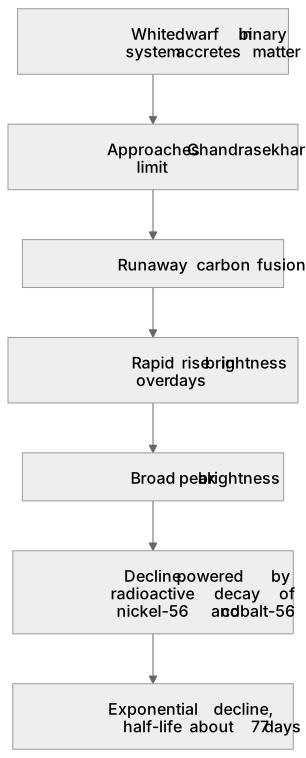
Put it in order
Put these steps in the order they happen.
- 1. Exponential decline, half-life about 77 days
- 2. Decline powered by radioactive decay of nickel-56 and cobalt-56
- 3. Runaway carbon fusion
- 4. Broad peak brightness
- 5. White dwarf in binary system accretes matter
- 6. Approaches Chandrasekhar limit
- 7. Rapid rise in brightness over days
Key words
Say what each word means before you turn the card.
Standard candles
Try answering aloud or in your head before turning the card.
Light curve
Try answering aloud or in your head before turning the card.
Chandrasekhar limit
Try answering aloud or in your head before turning the card.
Radioactive decay
Try answering aloud or in your head before turning the card.
See every definition
- Standard candles
- Type 1a supernovae have a standardised peak luminosity, so comparing observed peak brightness with known absolute magnitude allows distance estimation for cosmology.
- Light curve
- A plot of apparent magnitude against time showing a rapid rise, a broad peak, then an exponential decline with a half-life of about 77 days.
- Chandrasekhar limit
- A white dwarf in a binary system accretes matter from a companion and approaches this limit, triggering runaway carbon fusion.
- Radioactive decay
- The fading remnant is powered by the decay of nickel-56 and cobalt-56, giving a characteristic timescale of roughly 77 days.
Label the diagram
Some boxes have lost their names. Pick the right name for each number.
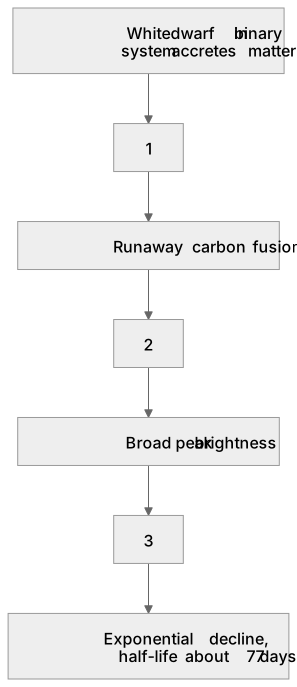
1Box 1
2Box 2
3Box 3
There is more to this lesson
The full lesson goes on to check your understanding and help you earn the marks. Create a free account to carry on, with your progress saved.
A week of Premium from your first lesson · Then the free plan continues · No card, no charge
Test your understanding of Supernovae, neutron stars and black holes (A-level only): Students should be familiar with the light curve of typical type 1a supernovae.
Active recall beats re-reading. Take an instant quiz now to test what you’ve learned and lock it into long-term memory.
A week of Premium from your first lesson · Then the free plan continues · No card, no charge