AQA · A-Level · Physics
Course version: 7408 · Version from Sept 2016
Einstein’s explanation of photoelectricity and its significance in terms…
Full specification wording
The discovery of photoelectricity (A-level only): Einstein’s explanation of photoelectricity and its significance in terms of the nature of electromagnetic radiation.
Einstein explained the photoelectric effect by proposing that electromagnetic radiation is quantised into photons of energy E = hf.
Checked against the AQA 7408 specification (opens in a new tab) on .
- Point 4 of 4
- 4 key terms
Study notes
From the checked teaching notes for this specification point.
The idea
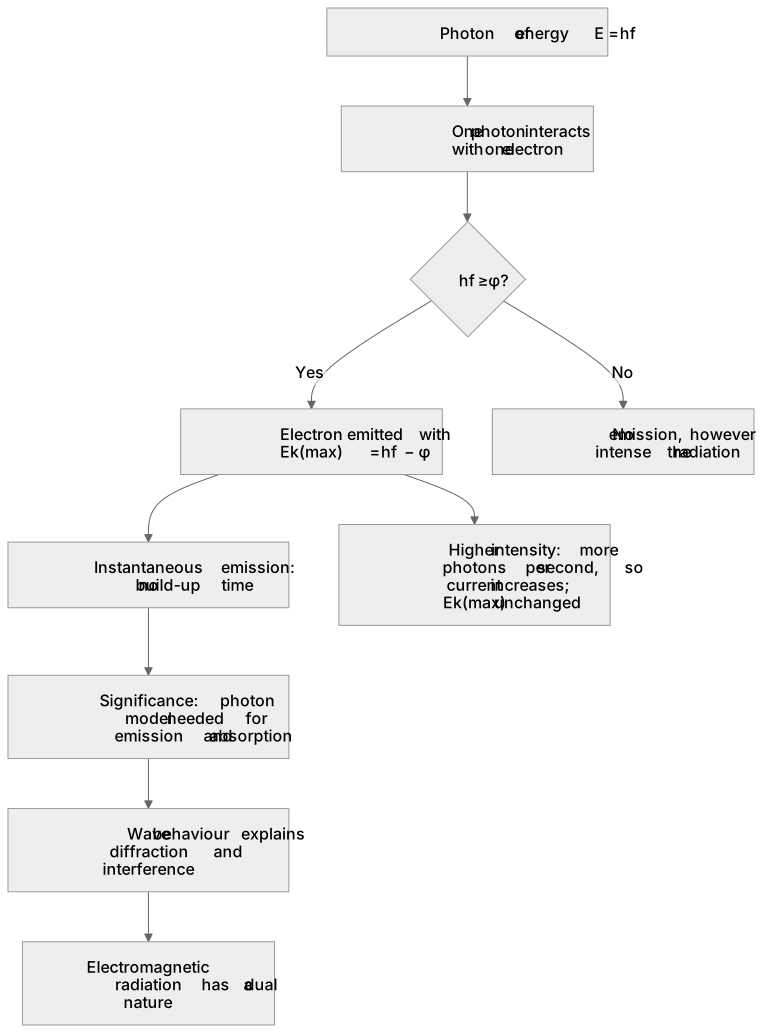
Einstein explained the photoelectric effect by proposing that electromagnetic radiation is quantised into photons of energy E = hf. A single photon can transfer all its energy to one electron; if this exceeds the work function φ, the electron escapes with maximum kinetic energy Ek(max) = hf − φ. This explains why emission is instantaneous above a threshold frequency, why intensity affects only the number of electrons per second, and why there is no time delay. It shows that light behaves as a particle in interaction, while wave behaviour such as interference remains valid. The significance is that electromagnetic radiation has a dual nature: wave and photon models are complementary, each explaining different observations.
What earns the marks
- States that electromagnetic radiation is emitted, absorbed or transferred in discrete quanta called photons, each of energy E = hf.
- Explains that one photon interacts with one electron, transferring energy hf; if hf ≥ φ the electron is emitted.
- Uses the photoelectric equation Ek(max) = hf − φ to relate maximum kinetic energy, frequency and work function.
- Explains the threshold frequency f₀ = φ/h: below f₀ no emission occurs however intense the radiation.
- Explains that increasing intensity increases the number of photons per second, so the photoelectric current increases, but maximum kinetic energy is unchanged.
- Explains instantaneous emission because a single photon can supply the required energy in one interaction, with no build-up time.
- Discusses significance: electromagnetic radiation has both wave and particle properties; the photon model is needed for emission and absorption, while wave behaviour explains diffraction and interference.
Common mistakes and how to put them right
Thinking that brighter light always gives electrons more kinetic energy.
Put it right: Intensity increases the number of photons per second, so current increases, but maximum kinetic energy depends on frequency, not intensity.
Believing that electrons accumulate energy from many photons over time.
Put it right: Emission is essentially instantaneous because one photon transfers its energy to one electron in a single interaction.
Confusing work function with threshold frequency.
Put it right: Work function φ is the minimum energy needed to remove an electron, measured in joules; threshold frequency f₀ = φ/h is the minimum frequency for emission, measured in hertz.
Using E = hf for a photon but then treating the photoelectric equation as hf = φ without subtracting φ.
Put it right: The maximum kinetic energy is the photon energy minus the work function: Ek(max) = hf − φ.
Exam tips
- When explaining the effect, explicitly link one photon to one electron and state that energy transfer is one-to-one.
- Use the equation Ek(max) = hf − φ and define each symbol, including that φ is the work function and Ek(max) is the maximum kinetic energy of emitted electrons.
- For significance questions, contrast the wave model (which cannot explain threshold frequency or instantaneous emission) with the photon model, and state that both wave and particle descriptions are needed.
- Check units: convert work function from electronvolts to joules if needed, using 1 eV = 1.60 × 10⁻¹⁹ J, and keep frequency in hertz.
Try the lesson
The start of the The discovery of photoelectricity (A-level only): Einstein’s explanation of photoelectricity and its significance in terms of the nature of electromagnetic radiation. lesson, made from checked teaching notes for this specification point.
Have a go first
In Einstein’s explanation of the photoelectric effect, which term describes the discrete packet of electromagnetic energy that interacts with a single electron?
Listen
Einstein explained the photoelectric effect by proposing that electromagnetic radiation is quantised into photons of energy E = hf. A single photon can transfer all its energy to one electron; if this exceeds the work function φ, the electron escapes with maximum kinetic energy Ek(max) = hf − φ. This explains why emission is instantaneous above a threshold frequency, why intensity affects only the number of electrons per second, and why there is no time delay. It shows that light behaves as a particle in interaction, while wave behaviour such as interference remains valid. The significance is that electromagnetic radiation has a dual nature: wave and photon models are complementary, each explaining different observations. A strong answer earns marks for these points. States that electromagnetic radiation is emitted, absorbed or transferred in discrete quanta called photons, each of energy E = hf. Explains that one photon interacts with one electron, transferring energy hf; if hf ≥ φ the electron is emitted. Uses the photoelectric equation Ek(max) = hf − φ to relate maximum kinetic energy, frequency and work function. Explains the threshold frequency f₀ = φ/h: below f₀ no emission occurs however intense the radiation. A common slip: Thinking that brighter light always gives electrons more kinetic energy. Instead, intensity increases the number of photons per second, so current increases, but maximum kinetic energy depends on frequency, not intensity. Exam tip: When explaining the effect, explicitly link one photon to one electron and state that energy transfer is one-to-one.
See it
Key words
Say what each word means before you turn the card.
Quantisation of electromagnetic radiation
Try answering aloud or in your head before turning the card.
Photon model and one-to-one interaction
Try answering aloud or in your head before turning the card.
Conservation of energy in photon–electron collisions
Try answering aloud or in your head before turning the card.
Wave–particle duality of electromagnetic radiation
Try answering aloud or in your head before turning the card.
See every definition
- Quantisation of electromagnetic radiation
- Electromagnetic radiation is emitted, absorbed or transferred in discrete quanta called photons, each of energy E = hf.
- Photon model and one-to-one interaction
- One photon interacts with one electron, transferring energy hf; if hf ≥ φ the electron is emitted.
- Conservation of energy in photon–electron collisions
- The maximum kinetic energy is the photon energy minus the work function: Ek(max) = hf − φ.
- Wave–particle duality of electromagnetic radiation
- Electromagnetic radiation has both wave and particle properties; the photon model is needed for emission and absorption, while wave behaviour explains diffraction and interference.
Label the diagram
Some boxes have lost their names. Pick the right name for each number.
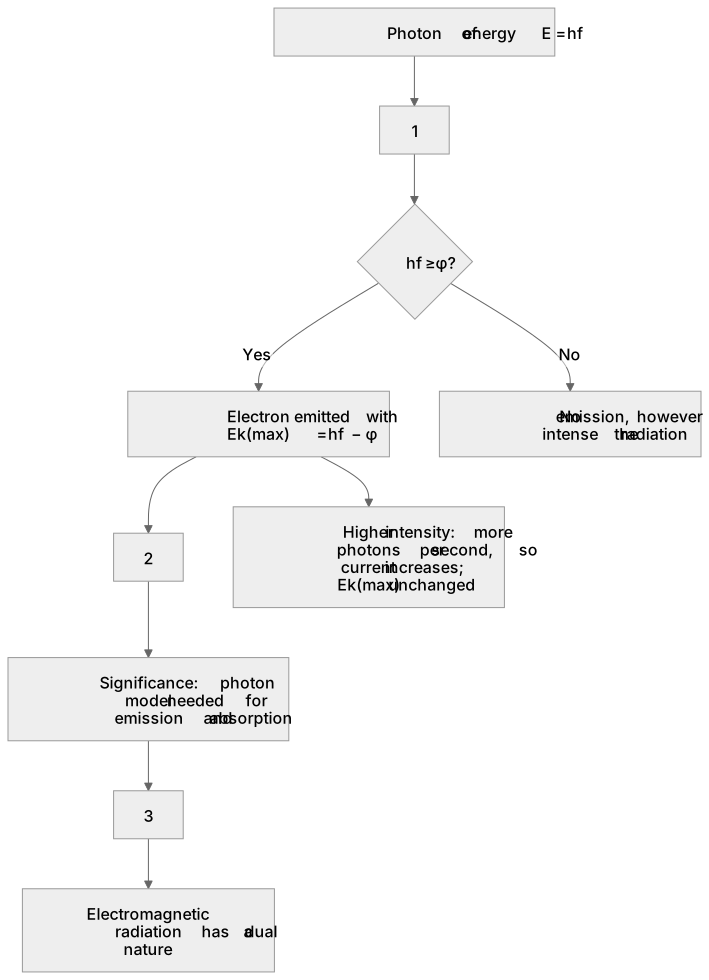
1Box 1
2Box 2
3Box 3
There is more to this lesson
The full lesson goes on to check your understanding and help you earn the marks. Create a free account to carry on, with your progress saved.
A week of Premium from your first lesson · Then the free plan continues · No card, no charge
Test your understanding of The discovery of photoelectricity (A-level only): Einstein’s explanation of photoelectricity and its significance in terms of the nature of electromagnetic radiation.
Active recall beats re-reading. Take an instant quiz now to test what you’ve learned and lock it into long-term memory.
A week of Premium from your first lesson · Then the free plan continues · No card, no charge