AQA · A-Level · Physics
Course version: 7408 · Version from Sept 2016
The failure of classical wave theory to explain observations on…
Full specification wording
The discovery of photoelectricity (A-level only): The failure of classical wave theory to explain observations on photoelectricity.
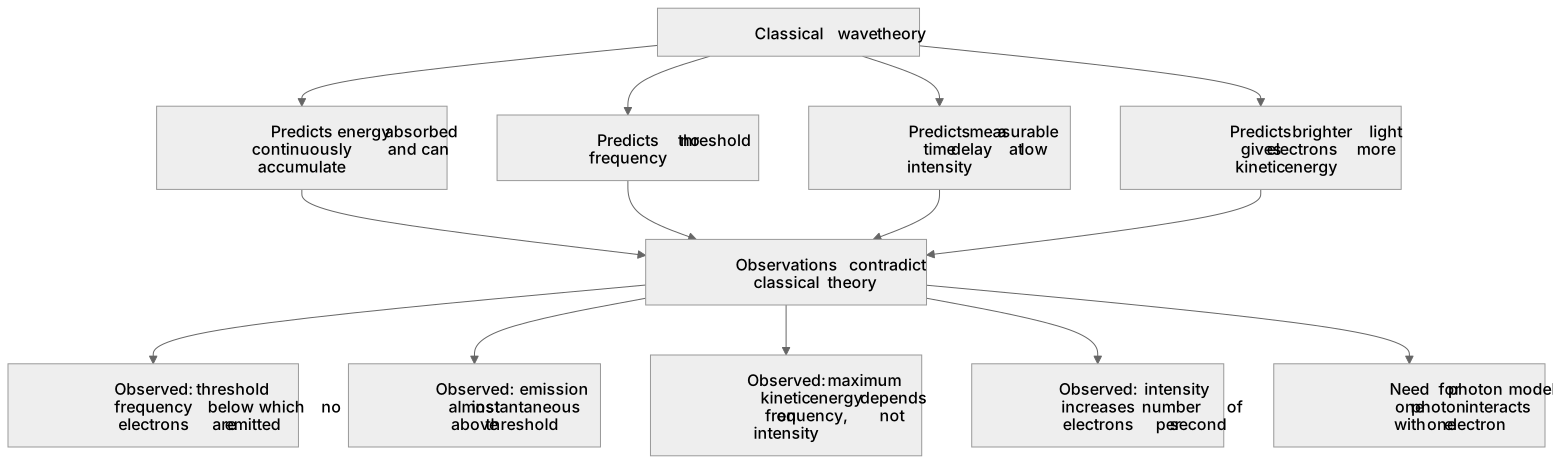
Classical wave theory predicts that light of any frequency can eject electrons from a metal, provided the light is intense enough or shines for long enough, because energy is absorbed continuously…
Checked against the AQA 7408 specification (opens in a new tab) on .
- Point 3 of 4
- 4 key terms
Study notes
From the checked teaching notes for this specification point.
The idea
Classical wave theory predicts that light of any frequency can eject electrons from a metal, provided the light is intense enough or shines for long enough, because energy is absorbed continuously and can accumulate. Observations contradict this: below a threshold frequency no electrons are emitted, however intense the light or however long it shines. Above the threshold, emission is almost instantaneous, even at low intensity, and the maximum kinetic energy of emitted electrons depends on frequency, not intensity. Classical theory also predicts that brighter light should give electrons more kinetic energy, but experiments show that intensity increases the number of electrons per second instead. Einstein’s photon model, with one photon interacting with one electron, explains these observations.
What earns the marks
- States the classical prediction that continuous wave energy can accumulate until electrons escape, regardless of frequency.
- Identifies the observation of a threshold frequency below which no photoelectrons are emitted, which classical theory cannot explain.
- Explains that emission is instantaneous above the threshold, whereas classical theory predicts a measurable time delay at low intensity.
- States that maximum kinetic energy depends on frequency, not intensity, contradicting the classical wave prediction.
- Explains that increasing intensity increases the number of photoelectrons per second, not their maximum kinetic energy.
- Links the failure of classical theory to the need for a photon or quantum model in which one photon interacts with one electron.
Common mistakes and how to put them right
Claiming that classical theory predicts a threshold frequency.
Put it right: Classical wave theory predicts no threshold, because any frequency can supply energy if intensity or time is sufficient.
Saying that brighter light gives photoelectrons more kinetic energy.
Put it right: Intensity increases the rate of emission, while frequency determines maximum kinetic energy.
Describing the time delay as always observed.
Put it right: Classical theory predicts a delay at low intensity, but experiments show emission is essentially immediate above the threshold.
Exam tips
- Structure your answer as prediction versus observation versus explanation, so each failure of classical theory is clear.
- Use the words threshold frequency, intensity and maximum kinetic energy precisely, and avoid using them interchangeably.
- Refer explicitly to the photon model when explaining why the observations support quantisation.
Try the lesson
The start of the The discovery of photoelectricity (A-level only): The failure of classical wave theory to explain observations on photoelectricity. lesson, made from checked teaching notes for this specification point.
Have a go first
Classical wave theory predicts that photoelectric emission should occur eventually for any frequency of incident light, provided the light is intense enough. Which observation contradicts this prediction?
Listen
Classical wave theory predicts that light of any frequency can eject electrons from a metal, provided the light is intense enough or shines for long enough, because energy is absorbed continuously and can accumulate. Observations contradict this: below a threshold frequency no electrons are emitted, however intense the light or however long it shines. Above the threshold, emission is almost instantaneous, even at low intensity, and the maximum kinetic energy of emitted electrons depends on frequency, not intensity. Classical theory also predicts that brighter light should give electrons more kinetic energy, but experiments show that intensity increases the number of electrons per second instead. Einstein’s photon model, with one photon interacting with one electron, explains these observations. A strong answer earns marks for these points. States the classical prediction that continuous wave energy can accumulate until electrons escape, regardless of frequency. Identifies the observation of a threshold frequency below which no photoelectrons are emitted, which classical theory cannot explain. Explains that emission is instantaneous above the threshold, whereas classical theory predicts a measurable time delay at low intensity. States that maximum kinetic energy depends on frequency, not intensity, contradicting the classical wave prediction. A common slip: Claiming that classical theory predicts a threshold frequency. Instead, classical wave theory predicts no threshold, because any frequency can supply energy if intensity or time is sufficient. Exam tip: Structure your answer as prediction versus observation versus explanation, so each failure of classical theory is clear.
See it
Key words
Say what each word means before you turn the card.
Threshold frequency
Try answering aloud or in your head before turning the card.
Intensity and photoelectric current
Try answering aloud or in your head before turning the card.
Photon model of light
Try answering aloud or in your head before turning the card.
Limitations of classical wave theory
Try answering aloud or in your head before turning the card.
See every definition
- Threshold frequency
- The frequency below which no electrons are emitted, however intense the light or however long it shines.
- Intensity and photoelectric current
- Increasing intensity increases the number of electrons per second, not their maximum kinetic energy.
- Photon model of light
- A model in which one photon interacts with one electron, explaining the observations on photoelectricity.
- Limitations of classical wave theory
- It predicts that light of any frequency can eject electrons if intense enough or shining long enough, because energy is absorbed continuously and can accumulate.
Label the diagram
Some boxes have lost their names. Pick the right name for each number.
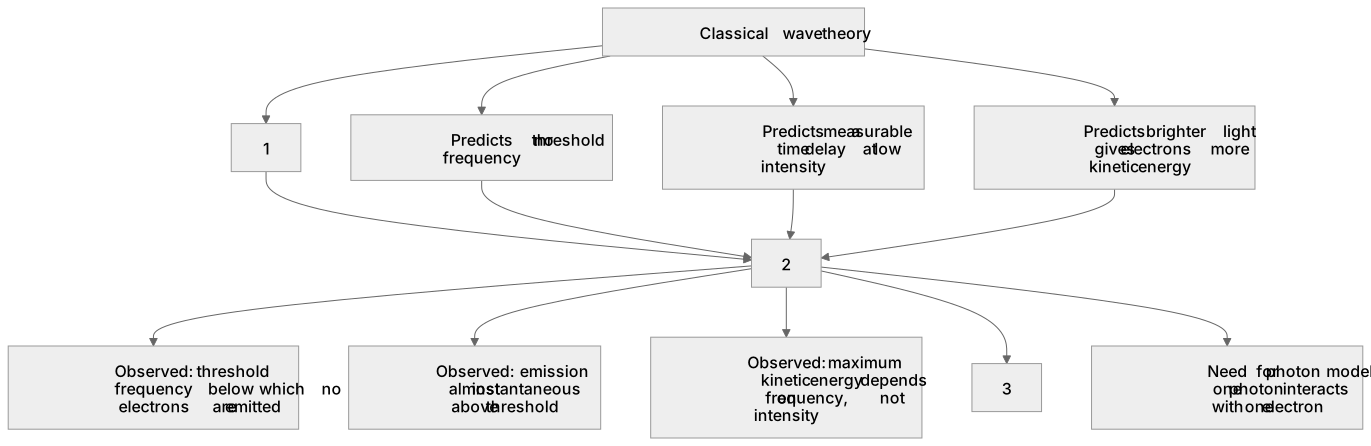
1Box 1
2Box 2
3Box 3
There is more to this lesson
The full lesson goes on to check your understanding and help you earn the marks. Create a free account to carry on, with your progress saved.
A week of Premium from your first lesson · Then the free plan continues · No card, no charge
Test your understanding of The discovery of photoelectricity (A-level only): The failure of classical wave theory to explain observations on photoelectricity.
Active recall beats re-reading. Take an instant quiz now to test what you’ve learned and lock it into long-term memory.
A week of Premium from your first lesson · Then the free plan continues · No card, no charge