AQA · A-Level · Physics
Course version: 7408 · Version from Sept 2016
Operation and characteristics of an ideal operational amplifier: power…
Full specification wording
The ideal operational amplifier (A-level only): Operation and characteristics of an ideal operational amplifier: power supply and signal connections infinite open-loop gain infinite input resistance.
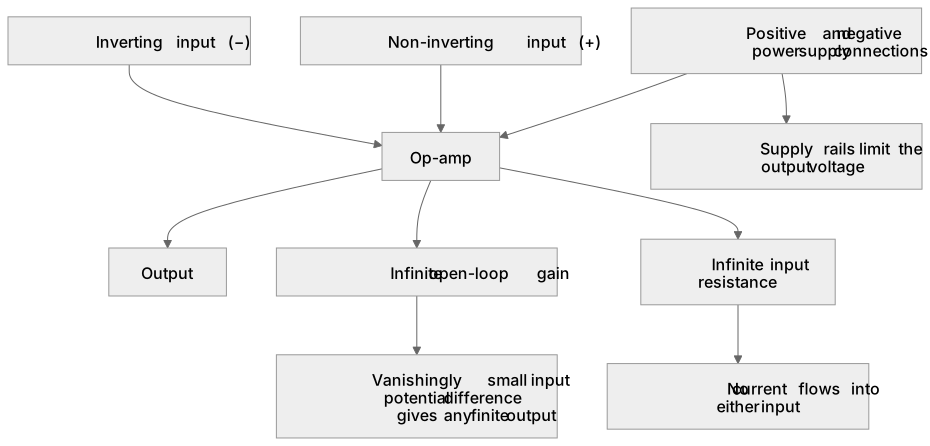
An ideal operational amplifier is a differential voltage amplifier with two inputs, an output, and power supply connections.
Checked against the AQA 7408 specification (opens in a new tab) on .
- Point 1 of 2
- 4 key terms
Study notes
From the checked teaching notes for this specification point.
The idea
An ideal operational amplifier is a differential voltage amplifier with two inputs, an output, and power supply connections. The inverting input is marked with a minus sign and the non-inverting input with a plus sign. The output voltage is proportional to the difference between the input voltages, multiplied by the open-loop gain. For an ideal op-amp the open-loop gain is infinite, so even an infinitesimal difference between the inputs would drive the output to saturation; the input resistance is also infinite, so no current flows into either input. Power supply connections provide the positive and negative rails that limit the output voltage. These ideal properties simplify circuit analysis, especially when negative feedback is applied.
What earns the marks
- Identify the inverting input, non-inverting input, output, and the positive and negative power supply connections on an op-amp symbol.
- State that the output voltage is proportional to the potential difference between the two inputs, with the proportionality constant being the open-loop gain.
- Explain that infinite open-loop gain means any finite output is produced by a vanishingly small input potential difference, so the inputs are at almost the same potential when negative feedback is used.
- Explain that infinite input resistance means no current flows into either input terminal, so the op-amp draws no input current.
- Describe the role of the power supply connections in setting the maximum positive and negative output voltages available from the op-amp.
Common mistakes and how to put them right
Assuming current flows into the op-amp inputs.
Put it right: With infinite input resistance the ideal input current is zero, so the correct statement is that no current enters the inputs.
Confusing the inverting and non-inverting inputs.
Put it right: The inverting input is marked with a minus sign and reverses the sign of the output relative to that input.
Believing the output can exceed the power supply rails.
Put it right: The output saturates at values set by the positive and negative supply voltages.
Exam tips
- Label the op-amp symbol clearly with the inverting input, non-inverting input, output, and supply rails when drawing or annotating a diagram.
- Use the ideal assumptions of infinite open-loop gain and infinite input resistance when analysing circuits with negative feedback.
- Remember that the power supply connections determine the saturation limits, so quote them when discussing output voltage limits.
Try the lesson
The start of the The ideal operational amplifier (A-level only): Operation and characteristics of an ideal operational amplifier: power supply and signal connections infinite open-loop gain infinite input resistance. lesson, made from checked teaching notes for this specification point.
Have a go first
Which pair of characteristics correctly describes the theoretical model of an ideal operational amplifier?
Listen
An ideal operational amplifier is a differential voltage amplifier with two inputs, an output, and power supply connections. The inverting input is marked with a minus sign and the non-inverting input with a plus sign. The output voltage is proportional to the difference between the input voltages, multiplied by the open-loop gain. For an ideal op-amp the open-loop gain is infinite, so even an infinitesimal difference between the inputs would drive the output to saturation; the input resistance is also infinite, so no current flows into either input. Power supply connections provide the positive and negative rails that limit the output voltage. These ideal properties simplify circuit analysis, especially when negative feedback is applied. A strong answer earns marks for these points. Identify the inverting input, non-inverting input, output, and the positive and negative power supply connections on an op-amp symbol. State that the output voltage is proportional to the potential difference between the two inputs, with the proportionality constant being the open-loop gain. Explain that infinite open-loop gain means any finite output is produced by a vanishingly small input potential difference, so the inputs are at almost the same potential when negative feedback is used. Explain that infinite input resistance means no current flows into either input terminal, so the op-amp draws no input current. Exam tip: Label the op-amp symbol clearly with the inverting input, non-inverting input, output, and supply rails when drawing or annotating a diagram.
See it
Key words
Say what each word means before you turn the card.
Differential amplification
Try answering aloud or in your head before turning the card.
Ideal op-amp assumptions
Try answering aloud or in your head before turning the card.
Input and output connections
Try answering aloud or in your head before turning the card.
Power supply rails and saturation
Try answering aloud or in your head before turning the card.
See every definition
- Differential amplification
- The output voltage is proportional to the difference between the input voltages, multiplied by the open-loop gain.
- Ideal op-amp assumptions
- The open-loop gain is infinite and the input resistance is also infinite, so no current flows into either input.
- Input and output connections
- There are two inputs, an output, and power supply connections; the inverting input is marked with a minus sign and the non-inverting input with a plus sign.
- Power supply rails and saturation
- The power supply connections provide the positive and negative rails that limit the output voltage.
Label the diagram
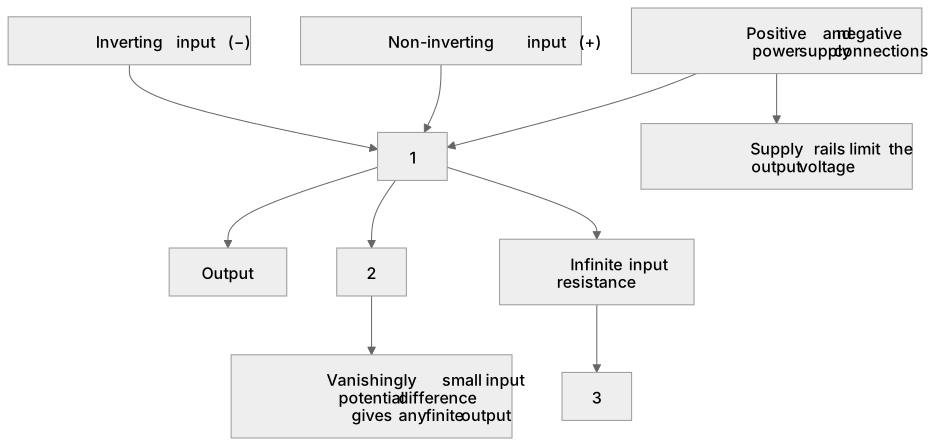
Some boxes have lost their names. Pick the right name for each number.
1Box 1
2Box 2
3Box 3
There is more to this lesson
The full lesson goes on to check your understanding and help you earn the marks. Create a free account to carry on, with your progress saved.
A week of Premium from your first lesson · Then the free plan continues · No card, no charge
Test your understanding of The ideal operational amplifier (A-level only): Operation and characteristics of an ideal operational amplifier: power supply and signal connections infinite open-loop gain infinite input resistance.
Active recall beats re-reading. Take an instant quiz now to test what you’ve learned and lock it into long-term memory.
A week of Premium from your first lesson · Then the free plan continues · No card, no charge