AQA · A-Level · Physics
Course version: 7408 · Version from Sept 2016
The operational amplifier should be treated as an important system…
Full specification wording
The ideal operational amplifier (A-level only): The operational amplifier should be treated as an important system building block.
An operational amplifier, or op-amp, is a high-gain differential voltage amplifier supplied as an integrated circuit.
Checked against the AQA 7408 specification (opens in a new tab) on .
- Point 2 of 2
- 2 key terms
Study notes
From the checked teaching notes for this specification point.
The idea
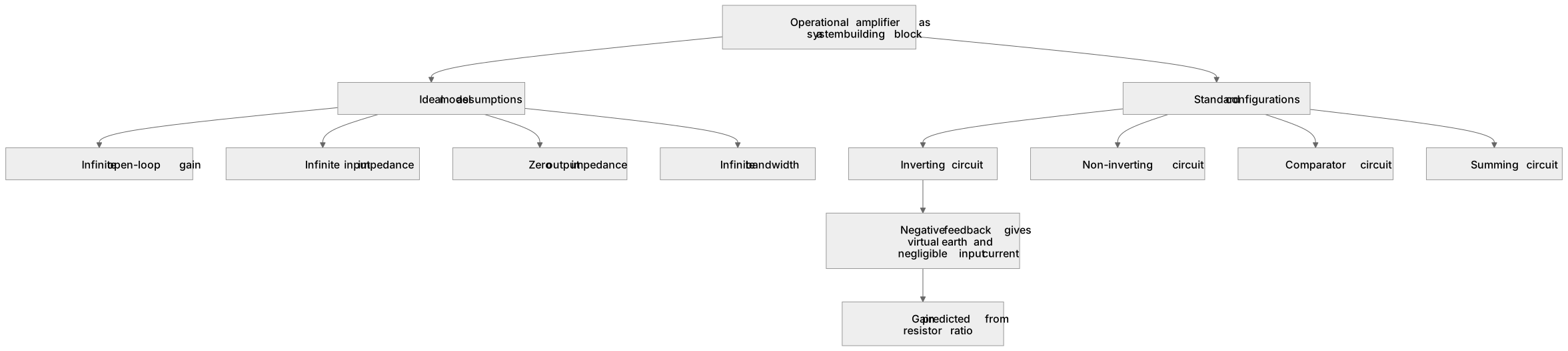
An operational amplifier, or op-amp, is a high-gain differential voltage amplifier supplied as an integrated circuit. Treating it as a system building block means you analyse circuits by connecting standard blocks rather than by examining internal transistors. The ideal model assumes infinite open-loop gain, infinite input impedance, zero output impedance and infinite bandwidth. In a circuit with negative feedback, these assumptions give two working rules: the potential difference between the inverting and non-inverting inputs is effectively zero, and negligible current enters either input. For example, in an inverting amplifier, the input resistor and feedback resistor form a potential divider because the inverting input sits at virtual earth. This lets you predict gain from resistor values and design sensor, comparator and summing circuits reliably.
What earns the marks
- States that an operational amplifier is a differential amplifier with very high open-loop voltage gain, usually supplied as an integrated circuit.
- Explains that treating it as a building block means using standard configurations such as inverting, non-inverting, comparator and summing circuits.
- Applies the ideal op-amp assumptions: infinite open-loop gain, infinite input impedance, zero output impedance and infinite bandwidth.
- Uses the virtual earth or virtual short idea for a negative-feedback circuit, so the inverting input is at approximately the same potential as the non-inverting input.
- States that negligible current flows into either input, so current through the input resistor equals current through the feedback resistor.
- Derives or uses gain relationships from resistor ratios, for example the inverting amplifier gain is the negative ratio of feedback resistance to input resistance.
- Explains that negative feedback stabilises gain and reduces distortion, making the block predictable in a larger system.
- Describes how op-amp blocks can be cascaded or combined, for example a summing amplifier feeding a filter or comparator.
Common mistakes and how to put them right
Treating the op-amp as a device that creates energy rather than as an amplifier that needs a power supply.
Put it right by stating that the output cannot exceed the supply rails and that the op-amp shapes a signal using external components.
Assuming the inputs are always at the same potential in every circuit.
Put it right by specifying that the virtual short applies only when negative feedback is present and the output is not saturated.
Using the open-loop gain directly in a negative-feedback design.
Put it right by using the external resistor ratio, because negative feedback sets the closed-loop gain.
Thinking that current flows into the input terminals in an ideal op-amp.
Put it right by applying the ideal assumption of infinite input impedance, so input current is negligible.
Exam tips
- Sketch the op-amp block with its two inputs and one output, then label the feedback path before doing any algebra.
- When deriving a gain, write the virtual-earth condition and the current-balance equation as separate lines so the examiner can follow your reasoning.
- Check whether the circuit has negative feedback; if it does not, do not use the virtual short rule.
- Give final gains as dimensionless ratios or in decibels only if the question asks for decibels, and keep resistor values in the same unit throughout.
Try the lesson
The start of the The ideal operational amplifier (A-level only): The operational amplifier should be treated as an important system building block. lesson, made from checked teaching notes for this specification point.
Have a go first
In A-level physics, an operational amplifier is best described as which type of system building block?
Listen
An operational amplifier, or op-amp, is a high-gain differential voltage amplifier supplied as an integrated circuit. Treating it as a system building block means you analyse circuits by connecting standard blocks rather than by examining internal transistors. The ideal model assumes infinite open-loop gain, infinite input impedance, zero output impedance and infinite bandwidth. In a circuit with negative feedback, these assumptions give two working rules: the potential difference between the inverting and non-inverting inputs is effectively zero, and negligible current enters either input. For example, in an inverting amplifier, the input resistor and feedback resistor form a potential divider because the inverting input sits at virtual earth. This lets you predict gain from resistor values and design sensor, comparator and summing circuits reliably. A strong answer earns marks for these points. States that an operational amplifier is a differential amplifier with very high open-loop voltage gain, usually supplied as an integrated circuit. Explains that treating it as a building block means using standard configurations such as inverting, non-inverting, comparator and summing circuits. Applies the ideal op-amp assumptions: infinite open-loop gain, infinite input impedance, zero output impedance and infinite bandwidth. Uses the virtual earth or virtual short idea for a negative-feedback circuit, so the inverting input is at approximately the same potential as the non-inverting input. A common slip: Treating the op-amp as a device that creates energy rather than as an amplifier that needs a power supply. Instead, stating that the output cannot exceed the supply rails and that the op-amp shapes a signal using external components. Exam tip: Sketch the op-amp block with its two inputs and one output, then label the feedback path before doing any algebra.
See it
Key words
Say what each word means before you turn the card.
Operational amplifier
Try answering aloud or in your head before turning the card.
Ideal model
Try answering aloud or in your head before turning the card.
See every definition
- Operational amplifier
- A high-gain differential voltage amplifier supplied as an integrated circuit, treated as an important system building block.
- Ideal model
- Assumes infinite open-loop gain, infinite input impedance, zero output impedance and infinite bandwidth.
Label the diagram
Some boxes have lost their names. Pick the right name for each number.
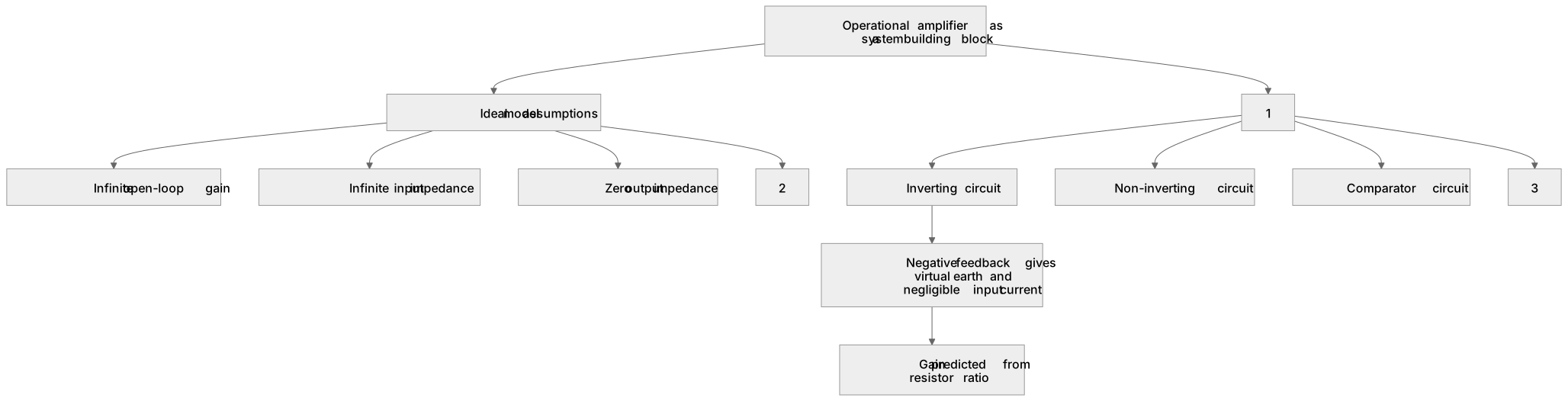
1Box 1
2Box 2
3Box 3
There is more to this lesson
The full lesson goes on to check your understanding and help you earn the marks. Create a free account to carry on, with your progress saved.
A week of Premium from your first lesson · Then the free plan continues · No card, no charge
Test your understanding of The ideal operational amplifier (A-level only): The operational amplifier should be treated as an important system building block.
Active recall beats re-reading. Take an instant quiz now to test what you’ve learned and lock it into long-term memory.
A week of Premium from your first lesson · Then the free plan continues · No card, no charge