AQA · A-Level · Physics
Course version: 7408 · Version from Sept 2016
Causes of inefficiencies in a transformer.
Full specification wording
The operation of a transformer (A-level only): Causes of inefficiencies in a transformer.
An ideal transformer transfers all input power to the output, so input power equals output power.
Checked against the AQA 7408 specification (opens in a new tab) on .
- Point 1 of 2
- 4 key terms
Study notes
From the checked teaching notes for this specification point.
The idea
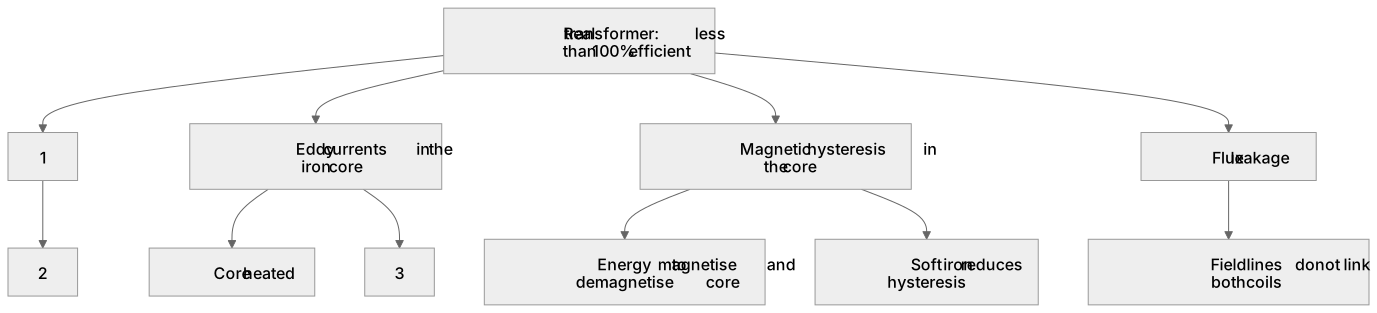
An ideal transformer transfers all input power to the output, so input power equals output power. Real transformers are less than 100% efficient because some energy is dissipated. The main causes are: resistance in the primary and secondary coils, which causes heating (I²R losses); eddy currents induced in the iron core, which circulate and heat the core; magnetic hysteresis in the core, where energy is needed to repeatedly magnetise and demagnetise the iron; and flux leakage, where some magnetic field lines do not link both coils. Efficiency is output power divided by input power, often expressed as a percentage. For example, if a transformer supplies 92 W from a 100 W input, efficiency is 92%. Laminated cores reduce eddy currents, and soft iron reduces hysteresis.
What earns the marks
- Resistance in the primary and secondary coils causes heating, often called I²R or copper losses.
- Eddy currents are induced in the core by changing magnetic flux and dissipate energy as heat.
- Hysteresis losses occur because energy is required to magnetise and demagnetise the core each cycle.
- Flux leakage occurs when some magnetic field lines from the primary do not link the secondary coil.
- Efficiency = (output power ÷ input power) × 100%, and real efficiency is always less than 100%.
- Laminated cores reduce eddy currents; soft magnetic materials reduce hysteresis losses.
Common mistakes and how to put them right
Thinking that a transformer creates energy or that output power can exceed input power.
Put it right by applying conservation of energy so output power is always less than input power in a real transformer.
Confusing eddy currents with the current in the coils.
Put it right by stating that eddy currents are induced within the core itself and cause heating.
Ignoring flux leakage and attributing all inefficiency to resistance.
Put it right by listing flux leakage as a separate cause where magnetic field lines fail to link both coils.
Exam tips
- When asked for causes, name the mechanism and state the energy transfer, for example eddy currents transfer energy by heating the core.
- Use the efficiency equation with consistent power units and give the answer as a percentage when appropriate.
- Link each cause to a practical design feature, such as laminated core for eddy currents or soft iron for hysteresis.
Try the lesson
The start of the The operation of a transformer (A-level only): Causes of inefficiencies in a transformer. lesson, made from checked teaching notes for this specification point.
Have a go first
Which process in a transformer core directly causes energy to be wasted as internal energy?
Listen
An ideal transformer transfers all input power to the output, so input power equals output power. Real transformers are less than 100% efficient because some energy is dissipated. The main causes are: resistance in the primary and secondary coils, which causes heating (I²R losses); eddy currents induced in the iron core, which circulate and heat the core; magnetic hysteresis in the core, where energy is needed to repeatedly magnetise and demagnetise the iron; and flux leakage, where some magnetic field lines do not link both coils. Efficiency is output power divided by input power, often expressed as a percentage. For example, if a transformer supplies 92 W from a 100 W input, efficiency is 92%. Laminated cores reduce eddy currents, and soft iron reduces hysteresis. A strong answer earns marks for these points. Resistance in the primary and secondary coils causes heating, often called I²R or copper losses. Eddy currents are induced in the core by changing magnetic flux and dissipate energy as heat. Hysteresis losses occur because energy is required to magnetise and demagnetise the core each cycle. Flux leakage occurs when some magnetic field lines from the primary do not link the secondary coil. A common slip: Thinking that a transformer creates energy or that output power can exceed input power. Instead, applying conservation of energy so output power is always less than input power in a real transformer. Exam tip: When asked for causes, name the mechanism and state the energy transfer, for example eddy currents transfer energy by heating the core.
See it

Key words
Say what each word means before you turn the card.
Eddy currents
Try answering aloud or in your head before turning the card.
Hysteresis
Try answering aloud or in your head before turning the card.
Flux leakage
Try answering aloud or in your head before turning the card.
Efficiency
Try answering aloud or in your head before turning the card.
See every definition
- Eddy currents
- Currents induced in the iron core by changing magnetic flux, which circulate and heat the core.
- Hysteresis
- Loss in the core where energy is needed to repeatedly magnetise and demagnetise the iron.
- Flux leakage
- Where some magnetic field lines do not link both coils.
- Efficiency
- Output power divided by input power, often expressed as a percentage.
Label the diagram
Some boxes have lost their names. Pick the right name for each number.
1Box 1
2Box 2
3Box 3
There is more to this lesson
The full lesson goes on to check your understanding and help you earn the marks. Create a free account to carry on, with your progress saved.
A week of Premium from your first lesson · Then the free plan continues · No card, no charge
Test your understanding of The operation of a transformer (A-level only): Causes of inefficiencies in a transformer.
Active recall beats re-reading. Take an instant quiz now to test what you’ve learned and lock it into long-term memory.
A week of Premium from your first lesson · Then the free plan continues · No card, no charge