AQA · A-Level · Physics
Course version: 7408 · Version from Sept 2016
Transmission of electrical power at high voltage including calculations of…
Full specification wording
The operation of a transformer (A-level only): Transmission of electrical power at high voltage including calculations of power loss in transmission lines.
Electrical power is transmitted through cables that have resistance, so some energy is dissipated as heat.
Checked against the AQA 7408 specification (opens in a new tab) on .
- Point 2 of 2
- 4 key terms
Study notes
From the checked teaching notes for this specification point.
The idea
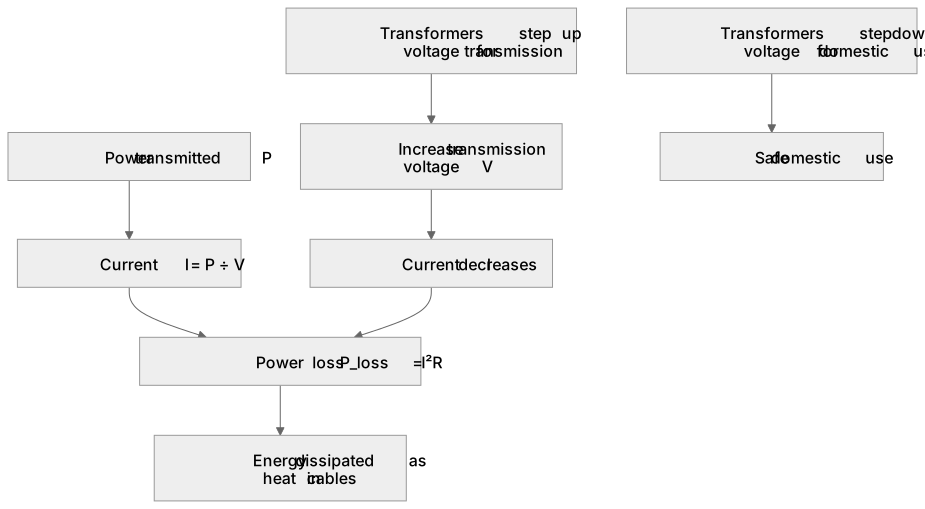
Electrical power is transmitted through cables that have resistance, so some energy is dissipated as heat. For a given power P transmitted at voltage V, the current is I = P ÷ V. The power lost in the transmission line of resistance R is P_loss = I²R. Because P_loss depends on I², increasing the transmission voltage reduces the current and greatly reduces power loss. Transformers step up voltage for transmission and step down voltage for safe domestic use.
For example: Transmitting 10 MW at 250 kV gives I = 40 A; if R = 5 Ω, P_loss = (40 A)² × 5 Ω = 8000 W. At 25 kV the current would be 400 A and the loss would be 800 kW, showing the benefit of high-voltage transmission.
What earns the marks
- Power transmitted is related to voltage and current by P = VI, so I = P ÷ V.
- Power loss in a transmission line of resistance R is P_loss = I²R.
- For a fixed transmitted power, increasing voltage decreases current and therefore decreases power loss.
- Transformers are used to step up voltage for transmission and step down voltage for distribution and domestic use.
- Calculations may require combining P = VI with P_loss = I²R to find current, resistance or lost power.
- The efficiency of transmission can be found from useful output power divided by input power, often as a percentage.
Common mistakes and how to put them right
Using P_loss = V²R instead of P_loss = I²R.
Put it right by using the current in the line and the line resistance.
Assuming that increasing voltage increases power loss.
Put it right by explaining that for fixed transmitted power, higher voltage means lower current and lower I²R loss.
Forgetting to square the current in P_loss = I²R.
Put it right by calculating the current first and then squaring it before multiplying by resistance.
Exam tips
- Write down the transmitted power and the line resistance before substituting into equations.
- Show the current calculation separately so that an error in squaring does not lose all method marks.
- State clearly that high voltage reduces current, and link this to reduced heating in the cables.
Try the lesson
The start of the The operation of a transformer (A-level only): Transmission of electrical power at high voltage including calculations of power loss in transmission lines. lesson, made from checked teaching notes for this specification point.
Have a go first
Why is electrical power transmitted through the national grid at a very high potential difference?
Listen
Electrical power is transmitted through cables that have resistance, so some energy is dissipated as heat. For a given power P transmitted at voltage V, the current is I = P ÷ V. The power lost in the transmission line of resistance R is P_loss = I²R. Because P_loss depends on I², increasing the transmission voltage reduces the current and greatly reduces power loss. Transformers step up voltage for transmission and step down voltage for safe domestic use. For example, transmitting 10 MW at 250 kV gives I = 40 A; if R = 5 Ω, P_loss = (40 A)² × 5 Ω = 8000 W. At 25 kV the current would be 400 A and the loss would be 800 kW, showing the benefit of high-voltage transmission. A strong answer earns marks for these points. Power transmitted is related to voltage and current by P = VI, so I = P ÷ V. Power loss in a transmission line of resistance R is P_loss = I²R. For a fixed transmitted power, increasing voltage decreases current and therefore decreases power loss. Transformers are used to step up voltage for transmission and step down voltage for distribution and domestic use. A common slip: Using P_loss = V²R instead of P_loss = I²R. Instead, using the current in the line and the line resistance. Exam tip: Write down the transmitted power and the line resistance before substituting into equations.
See it
Key words
Say what each word means before you turn the card.
Electrical power transmission
Try answering aloud or in your head before turning the card.
Energy dissipation in resistive cables
Try answering aloud or in your head before turning the card.
Transformer action in the national grid
Try answering aloud or in your head before turning the card.
Quantitative analysis of power loss
Try answering aloud or in your head before turning the card.
See every definition
- Electrical power transmission
- The transfer of electrical power through cables that have resistance, so some energy is dissipated as heat.
- Energy dissipation in resistive cables
- Energy is dissipated as heat in cables that have resistance when electrical power is transmitted through them.
- Transformer action in the national grid
- Transformers step up voltage for transmission and step down voltage for safe domestic use.
- Quantitative analysis of power loss
- For a given power P transmitted at voltage V, the current is I = P ÷ V, and the power lost in the transmission line of resistance R is P_loss = I²R.
Label the diagram
Some boxes have lost their names. Pick the right name for each number.
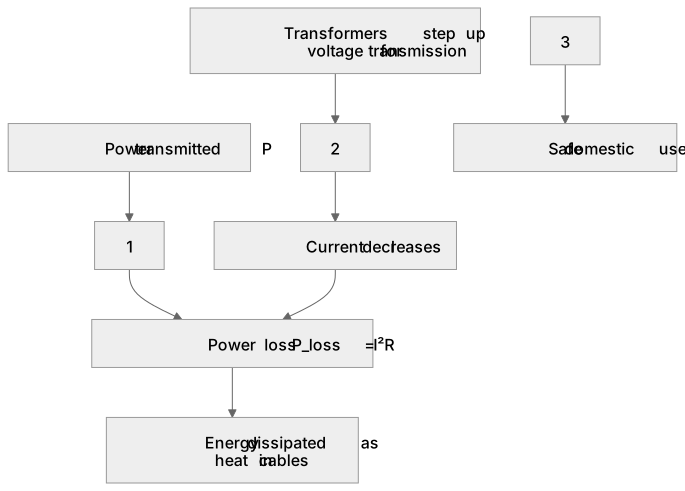
1Box 1
2Box 2
3Box 3
There is more to this lesson
The full lesson goes on to check your understanding and help you earn the marks. Create a free account to carry on, with your progress saved.
A week of Premium from your first lesson · Then the free plan continues · No card, no charge
Test your understanding of The operation of a transformer (A-level only): Transmission of electrical power at high voltage including calculations of power loss in transmission lines.
Active recall beats re-reading. Take an instant quiz now to test what you’ve learned and lock it into long-term memory.
A week of Premium from your first lesson · Then the free plan continues · No card, no charge