AQA · A-Level · Physics
Course version: 7408 · Version from Sept 2016
Calculations including continuous flow.
Full specification wording
Thermal energy transfer (A-level only): Calculations including continuous flow.
Continuous-flow calculations apply Q = mc∆θ to a moving fluid, such as water in a heating system or air through a heat exchanger.
Checked against the AQA 7408 specification (opens in a new tab) on .
- Point 6 of 7
- 3 key terms
Study notes
From the checked teaching notes for this specification point.
The idea
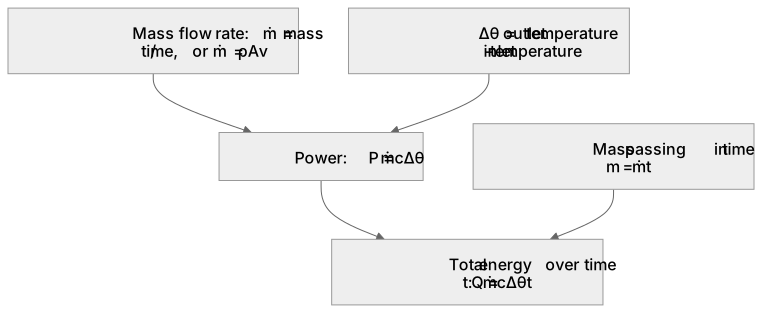
Continuous-flow calculations apply Q = mc∆θ to a moving fluid, such as water in a heating system or air through a heat exchanger. In a steady flow, the mass passing a point each second is the mass flow rate, often written as ṁ = ρAv for a fluid of density ρ through area A at speed v, or as mass per unit time from a pump. The energy transferred per second, or power, is P = ṁc∆θ, where ∆θ is the temperature rise between inlet and outlet.
For example: If 0.50 kg of water passes per second and warms by 20 K, P = 0.50 × 4200 × 20 = 4.2 × 10⁴ W. Over a time t, the total energy is Q = ṁc∆θt.
What earns the marks
- Identify the mass flow rate as mass divided by time, or as density × cross-sectional area × speed for a fluid in a pipe.
- Apply P = ṁc∆θ to find the rate of thermal energy transfer in a steady-flow system.
- Multiply power by time, Q = Pt, to find total energy transferred over a stated period.
- Use the inlet and outlet temperatures to find ∆θ, taking care that the difference is positive for heating.
- Combine the flow equation with Q = mc∆θ by recognising that m = ṁt for the mass passing in time t.
Common mistakes and how to put them right
Treating the mass flow rate as the total mass.
Put it right by multiplying by the time to obtain the mass that has flowed.
Using the outlet temperature alone as ∆θ.
Put it right by subtracting the inlet temperature from the outlet temperature.
Forgetting to convert litres per second to kilograms per second using the density of the fluid.
Put it right by multiplying volume flow rate by density.
Exam tips
- Write down the mass flow rate with its unit before using it in P = ṁc∆θ.
- Keep a clear distinction between power in watts and energy in joules, and check which one the question asks for.
- For pipe-flow questions, calculate the cross-sectional area from the diameter before finding ṁ = ρAv.
Try the lesson
The start of the Thermal energy transfer (A-level only): Calculations including continuous flow. lesson, made from checked teaching notes for this specification point.
Have a go first
A pump moves 3.0 kg of oil each minute through a pipe. The oil is heated so that its temperature rises by 25 °C. The specific heat capacity of the oil is 2 000 J kg⁻¹ K⁻¹. Calculate the rate of thermal energy transfer to the oil.
Listen
Continuous-flow calculations apply Q = mc∆θ to a moving fluid, such as water in a heating system or air through a heat exchanger. In a steady flow, the mass passing a point each second is the mass flow rate, often written as ṁ = ρAv for a fluid of density ρ through area A at speed v, or as mass per unit time from a pump. The energy transferred per second, or power, is P = ṁc∆θ, where ∆θ is the temperature rise between inlet and outlet. For example, if 0.50 kg of water passes per second and warms by 20 K, P = 0.50 × 4200 × 20 = 4.2 × 10⁴ W. Over a time t, the total energy is Q = ṁc∆θt. A strong answer earns marks for these points. Identify the mass flow rate as mass divided by time, or as density × cross-sectional area × speed for a fluid in a pipe. Apply P = ṁc∆θ to find the rate of thermal energy transfer in a steady-flow system. Multiply power by time, Q = Pt, to find total energy transferred over a stated period. Use the inlet and outlet temperatures to find ∆θ, taking care that the difference is positive for heating. A common slip: Treating the mass flow rate as the total mass. Instead, multiplying by the time to obtain the mass that has flowed. Exam tip: Write down the mass flow rate with its unit before using it in P = ṁc∆θ.
See it
Key words
Say what each word means before you turn the card.
Mass flow rate
Try answering aloud or in your head before turning the card.
Power
Try answering aloud or in your head before turning the card.
∆θ
Try answering aloud or in your head before turning the card.
See every definition
- Mass flow rate
- The mass passing a point each second, given as mass divided by time or as density × cross-sectional area × speed for a fluid in a pipe.
- Power
- The energy transferred per second, found from ṁc∆θ where ∆θ is the temperature rise between inlet and outlet.
- ∆θ
- The temperature rise between inlet and outlet, taken as positive for heating.
Label the diagram
Some boxes have lost their names. Pick the right name for each number.
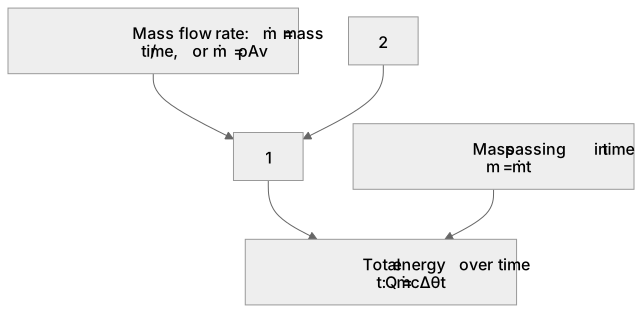
1Box 1
2Box 2
There is more to this lesson
The full lesson goes on to check your understanding and help you earn the marks. Create a free account to carry on, with your progress saved.
A week of Premium from your first lesson · Then the free plan continues · No card, no charge
Test your understanding of Thermal energy transfer (A-level only): Calculations including continuous flow.
Active recall beats re-reading. Take an instant quiz now to test what you’ve learned and lock it into long-term memory.
A week of Premium from your first lesson · Then the free plan continues · No card, no charge