AQA · A-Level · Physics
Course version: 7408 · Version from Sept 2016
For a change of state Q = ml where l is the specific latent heat.
Full specification wording
Thermal energy transfer (A-level only): For a change of state Q = ml where l is the specific latent heat.
During a change of state the temperature stays constant while energy is transferred, so specific heat capacity cannot be used.
Checked against the AQA 7408 specification (opens in a new tab) on .
- Point 7 of 7
- 4 key terms
Study notes
From the checked teaching notes for this specification point.
The idea
During a change of state the temperature stays constant while energy is transferred, so specific heat capacity cannot be used. Instead Q = ml, where Q is the energy needed to change the state of mass m and l is the specific latent heat: the energy per unit mass for that change. Melting and boiling use the latent heat of fusion and of vaporisation respectively; condensation and freezing release the same energy per unit mass. For example, melting 0.50 kg of ice needs Q = 0.50 × 3.34 × 10⁵ = 1.67 × 10⁵ J. Rearranged, l = Q ÷ m, so l has units J kg⁻¹. In a mixture problem, energy lost by cooling equals energy gained by melting, so equate mcΔθ with ml.
What earns the marks
- States that temperature remains constant during a change of state, so Q = mcΔθ cannot be applied and Q = ml is used instead.
- Defines specific latent heat as the energy required per unit mass to change the state of a substance at constant temperature.
- Applies Q = ml with consistent units, converting grams to kilograms and kJ to J before substituting.
- Distinguishes latent heat of fusion (solid to liquid) from latent heat of vaporisation (liquid to gas), and recognises that the reverse changes release the same energy per unit mass.
- Rearranges to l = Q ÷ m and identifies the unit J kg⁻¹, or uses simultaneous energy balance in mixtures.
- Interprets a heating graph: sloping sections use mcΔθ, flat sections use ml, and the longer flat section at boiling reflects the larger latent heat of vaporisation.
Common mistakes and how to put them right
Using Q = mcΔθ during melting or boiling.
Put it right by checking that the temperature is constant and switching to Q = ml.
Forgetting to convert grams to kilograms or kJ to J.
Put it right by converting all masses to kg and energies to J before substituting.
Assuming the energy supplied always equals ml in an experiment.
Put it right by accounting for energy lost to the surroundings, for example by using a lid or lagging and treating the value as a minimum.
Exam tips
- Underline the phrase change of state in the question; it signals that Q = ml is expected rather than Q = mcΔθ.
- Show the substitution with units before evaluating, so a unit slip is visible and can still earn method credit.
- When a question gives a rate in W, multiply power by time to find Q before dividing by m to obtain l.
Try the lesson
The start of the Thermal energy transfer (A-level only): For a change of state Q = ml where l is the specific latent heat. lesson, made from checked teaching notes for this specification point.
Have a go first
A mass of 0.40 kg of ice melts completely at 0 °C. The specific latent heat of fusion of ice is 3.3 × 10⁵ J kg⁻¹. Calculate the energy transferred to the ice during melting.
Listen
During a change of state the temperature stays constant while energy is transferred, so specific heat capacity cannot be used. Instead Q = ml, where Q is the energy needed to change the state of mass m and l is the specific latent heat: the energy per unit mass for that change. Melting and boiling use the latent heat of fusion and of vaporisation respectively; condensation and freezing release the same energy per unit mass. For example, melting 0.50 kg of ice needs Q = 0.50 × 3.34 × 10⁵ = 1.67 × 10⁵ J. Rearranged, l = Q ÷ m, so l has units J kg⁻¹. In a mixture problem, energy lost by cooling equals energy gained by melting, so equate mcΔθ with ml. A strong answer earns marks for these points. States that temperature remains constant during a change of state, so Q = mcΔθ cannot be applied and Q = ml is used instead. Defines specific latent heat as the energy required per unit mass to change the state of a substance at constant temperature. Applies Q = ml with consistent units, converting grams to kilograms and kJ to J before substituting. Distinguishes latent heat of fusion (solid to liquid) from latent heat of vaporisation (liquid to gas), and recognises that the reverse changes release the same energy per unit mass. A common slip: Using Q = mcΔθ during melting or boiling. Instead, checking that the temperature is constant and switching to Q = ml. Exam tip: Underline the phrase change of state in the question; it signals that Q = ml is expected rather than Q = mcΔθ.
See it
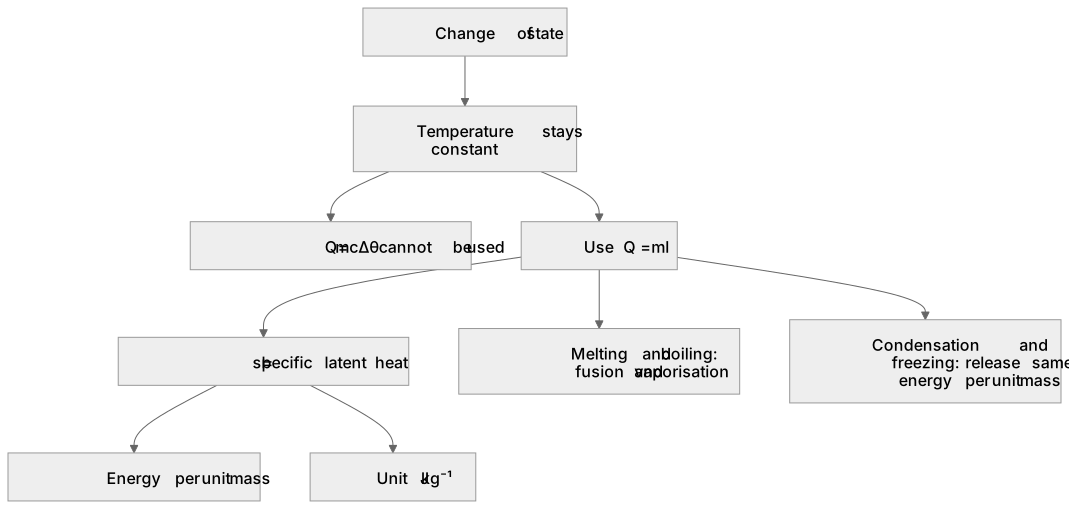
Key words
Say what each word means before you turn the card.
Specific latent heat
Try answering aloud or in your head before turning the card.
Latent heat of fusion
Try answering aloud or in your head before turning the card.
Latent heat of vaporisation
Try answering aloud or in your head before turning the card.
Q = ml
Try answering aloud or in your head before turning the card.
See every definition
- Specific latent heat
- The energy required per unit mass to change the state of a substance at constant temperature.
- Latent heat of fusion
- The latent heat used for melting, the change from solid to liquid.
- Latent heat of vaporisation
- The latent heat used for boiling, the change from liquid to gas.
- Q = ml
- The equation used instead of Q = mcΔθ during a change of state, where Q is the energy needed to change the state of mass m.
Label the diagram
Some boxes have lost their names. Pick the right name for each number.
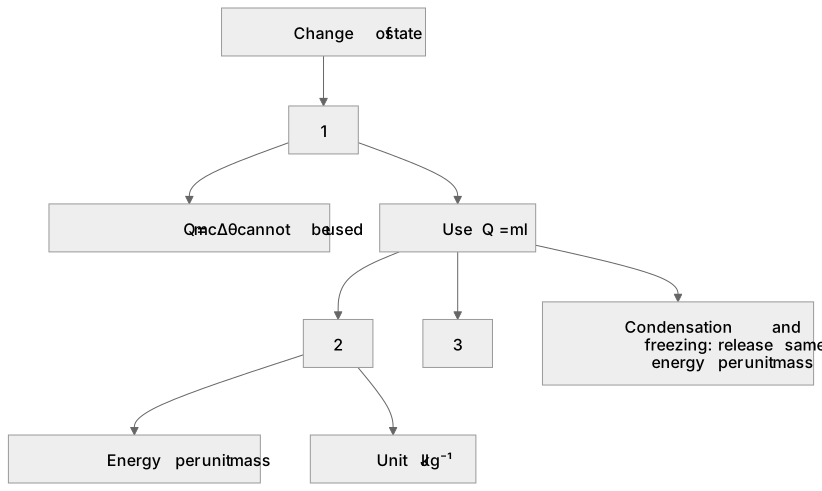
1Box 1
2Box 2
3Box 3
There is more to this lesson
The full lesson goes on to check your understanding and help you earn the marks. Create a free account to carry on, with your progress saved.
A week of Premium from your first lesson · Then the free plan continues · No card, no charge
Test your understanding of Thermal energy transfer (A-level only): For a change of state Q = ml where l is the specific latent heat.
Active recall beats re-reading. Take an instant quiz now to test what you’ve learned and lock it into long-term memory.
A week of Premium from your first lesson · Then the free plan continues · No card, no charge