AQA · A-Level · Physics
Course version: 7408 · Version from Sept 2016
Reflection and transmission characteristics of sound waves at tissue…
Full specification wording
Ultrasound imaging (A-level only): Reflection and transmission characteristics of sound waves at tissue boundaries, acoustic impedance, Z, and attenuation.
When ultrasound meets a boundary between two tissues, some energy reflects and some transmits.
Checked against the AQA 7408 specification (opens in a new tab) on .
- Point 1 of 5
- 4 key terms
Study notes
From the checked teaching notes for this specification point.
The idea
When ultrasound meets a boundary between two tissues, some energy reflects and some transmits. The fraction reflected depends on the acoustic impedance mismatch: Z = ρc, where ρ is density and c is speed of sound. The intensity reflection coefficient is (Z₂ − Z₁)²/(Z₂ + Z₁)². A large mismatch, such as soft tissue to air or bone, reflects strongly; a small mismatch, such as between soft tissues, reflects weakly. Transmission is greatest when impedances match. Attenuation is the loss of intensity with depth from absorption, scattering and reflection, and increases with frequency. A coupling gel removes the air layer at the skin, improving transmission. Pulses are used so reflected echoes can be timed to build an image.
What earns the marks
- Acoustic impedance is defined as Z = ρc, the product of tissue density and speed of sound in that tissue.
- At a boundary, the reflected and transmitted intensities depend on the difference in acoustic impedance between the two media.
- The intensity reflection coefficient is (Z₂ − Z₁)²/(Z₂ + Z₁)², giving the fraction of incident intensity reflected.
- A large impedance mismatch, such as tissue to air, reflects most of the ultrasound, while a small mismatch transmits most of it.
- Attenuation is the reduction in intensity with distance due to absorption, scattering and reflection, and it increases with ultrasound frequency.
- Coupling gel is used because it has an impedance close to that of skin, reducing reflection at the skin–air boundary.
- Pulses are used so that the time delay of each echo can be measured and related to the depth of a boundary.
Common mistakes and how to put them right
Confusing acoustic impedance with resistance or with intensity.
Put it right by defining Z as density multiplied by speed of sound.
Using the impedance values the wrong way round in the reflection coefficient.
Put it right by squaring the difference and the sum so the result is unchanged by swapping Z₁ and Z₂.
Believing all ultrasound is reflected at every boundary.
Put it right by explaining that the reflected fraction depends on the impedance mismatch.
Ignoring attenuation when comparing echoes from different depths.
Put it right by noting that deeper echoes are weaker because intensity falls with distance.
Exam tips
- Write the equation Z = ρc and the reflection coefficient before substituting values, and keep units consistent.
- Check that a calculated reflection coefficient is between 0 and 1, and interpret it as a fraction or percentage.
- Explain coupling gel in terms of impedance matching rather than simply saying it helps sound travel.
- When discussing attenuation, state that higher frequency gives better resolution but greater attenuation.
Try the lesson
The start of the Ultrasound imaging (A-level only): Reflection and transmission characteristics of sound waves at tissue boundaries, acoustic impedance, Z, and attenuation. lesson, made from checked teaching notes for this specification point.
Have a go first
Which quantity is defined as the product of the density of a tissue and the speed of sound in that tissue?
Listen
When ultrasound meets a boundary between two tissues, some energy reflects and some transmits. The fraction reflected depends on the acoustic impedance mismatch: Z = ρc, where ρ is density and c is speed of sound. The intensity reflection coefficient is (Z₂ − Z₁)²/(Z₂ + Z₁)². A large mismatch, such as soft tissue to air or bone, reflects strongly; a small mismatch, such as between soft tissues, reflects weakly. Transmission is greatest when impedances match. Attenuation is the loss of intensity with depth from absorption, scattering and reflection, and increases with frequency. A coupling gel removes the air layer at the skin, improving transmission. Pulses are used so reflected echoes can be timed to build an image. A strong answer earns marks for these points. Acoustic impedance is defined as Z = ρc, the product of tissue density and speed of sound in that tissue. At a boundary, the reflected and transmitted intensities depend on the difference in acoustic impedance between the two media. The intensity reflection coefficient is (Z₂ − Z₁)²/(Z₂ + Z₁)², giving the fraction of incident intensity reflected. A large impedance mismatch, such as tissue to air, reflects most of the ultrasound, while a small mismatch transmits most of it. A common slip: Confusing acoustic impedance with resistance or with intensity. Instead, defining Z as density multiplied by speed of sound. Exam tip: Write the equation Z = ρc and the reflection coefficient before substituting values, and keep units consistent.
See it
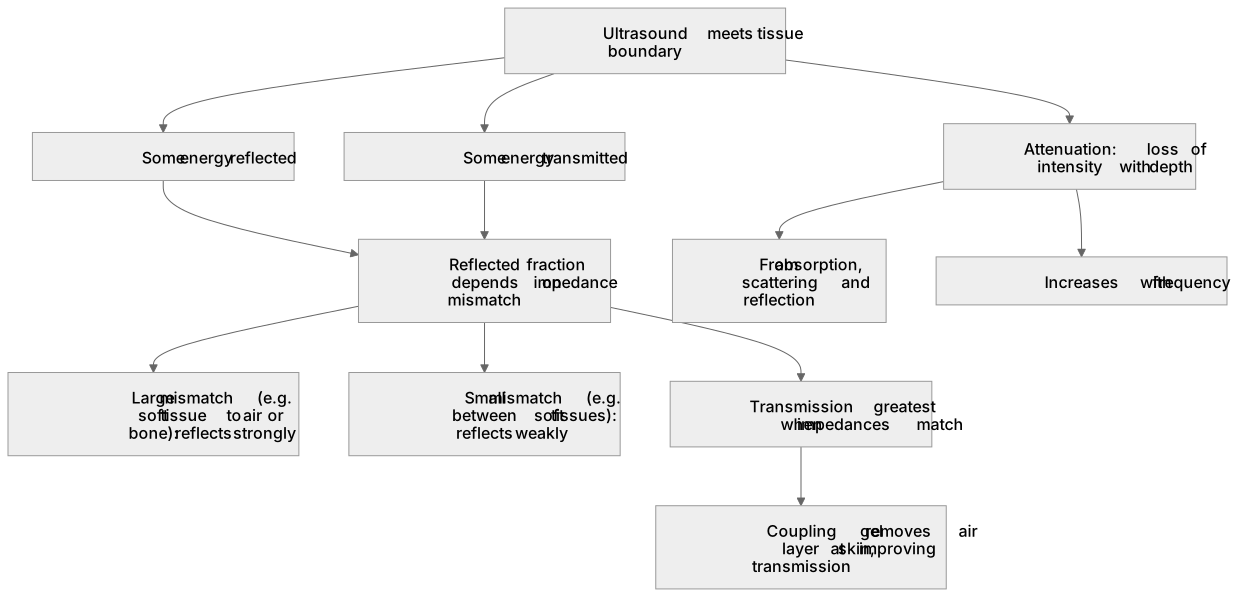
Key words
Say what each word means before you turn the card.
Acoustic impedance
Try answering aloud or in your head before turning the card.
Intensity reflection coefficient
Try answering aloud or in your head before turning the card.
Attenuation
Try answering aloud or in your head before turning the card.
Coupling gel
Try answering aloud or in your head before turning the card.
See every definition
- Acoustic impedance
- Defined as Z = ρc, the product of tissue density and the speed of sound in that tissue.
- Intensity reflection coefficient
- The fraction of incident intensity reflected, given by (Z₂ − Z₁)²/(Z₂ + Z₁)².
- Attenuation
- The loss of intensity with depth from absorption, scattering and reflection, which increases with frequency.
- Coupling gel
- Used because it has an impedance close to that of skin, reducing reflection at the skin–air boundary.
Label the diagram
Some boxes have lost their names. Pick the right name for each number.
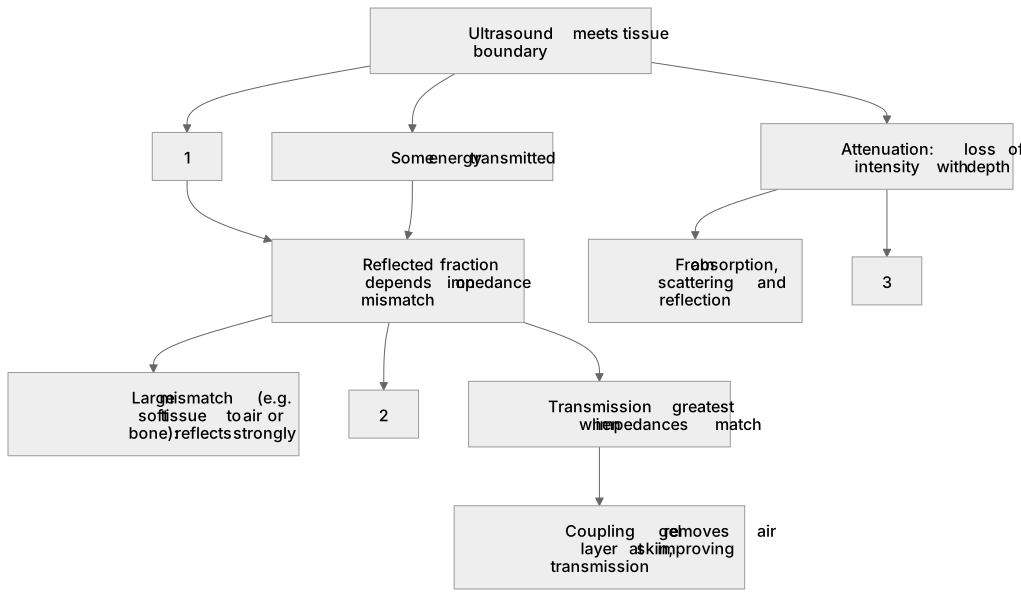
1Box 1
2Box 2
3Box 3
There is more to this lesson
The full lesson goes on to check your understanding and help you earn the marks. Create a free account to carry on, with your progress saved.
A week of Premium from your first lesson · Then the free plan continues · No card, no charge
Test your understanding of Ultrasound imaging (A-level only): Reflection and transmission characteristics of sound waves at tissue boundaries, acoustic impedance, Z, and attenuation.
Active recall beats re-reading. Take an instant quiz now to test what you’ve learned and lock it into long-term memory.
A week of Premium from your first lesson · Then the free plan continues · No card, no charge