AQA · A-Level · Physics
Course version: 7408 · Version from Sept 2016
Advantages and disadvantages of ultrasound imaging in comparison with…
Full specification wording
Ultrasound imaging (A-level only): Advantages and disadvantages of ultrasound imaging in comparison with alternatives including safety issues and resolution.
Ultrasound imaging uses high-frequency sound above 20 kHz, typically 1–15 MHz, sent as pulses into the body.
Checked against the AQA 7408 specification (opens in a new tab) on .
- Point 2 of 5
- 4 key terms
Study notes
From the checked teaching notes for this specification point.
The idea
Ultrasound imaging uses high-frequency sound above 20 kHz, typically 1–15 MHz, sent as pulses into the body. A piezoelectric transducer emits a pulse, then detects echoes from boundaries where acoustic impedance Z = ρc changes. The time delay t gives depth via d = vt/2, where v is the speed of sound in tissue, about 1540 m s⁻¹. Advantages over X-rays and CT include no ionising radiation, real-time moving images, low cost and portability. Disadvantages include poorer resolution than X-ray or MRI, strong reflection at bone and gas, and operator dependence. Resolution improves with shorter wavelength, so higher frequency gives finer detail but greater attenuation, limiting penetration. Safety issues centre on heating and cavitation at high intensity; diagnostic intensities are kept low.
What earns the marks
- Ultrasound is non-ionising, so it avoids the radiation risk associated with X-rays and CT scans, making it safer for fetuses and repeated examinations.
- Real-time imaging allows movement such as heart valves or blood flow to be observed, which static X-ray images cannot show directly.
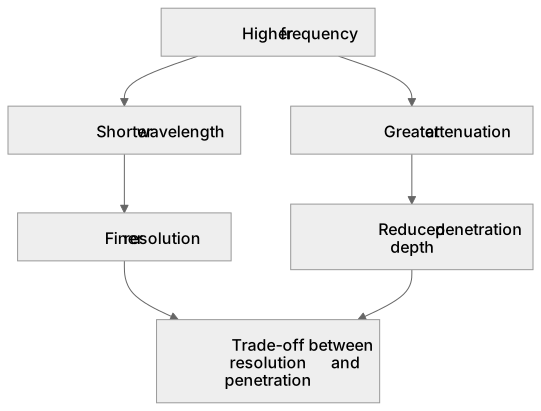
- Resolution is limited by wavelength; using a higher frequency shortens wavelength and improves resolution but increases attenuation in tissue, reducing penetration depth.
- Strong reflection occurs at boundaries with large acoustic impedance mismatch, such as soft tissue to bone or air, which can obscure structures behind them.
- Ultrasound equipment is relatively cheap, portable and widely available compared with MRI, though image quality depends heavily on operator skill.
- Safety concerns include tissue heating and cavitation from high-intensity ultrasound; diagnostic exposure is controlled by limiting intensity and scan time.
Common mistakes and how to put them right
Claiming ultrasound is completely risk-free.
Put it right by stating that diagnostic levels are kept low to minimise heating and cavitation, so risk is reduced rather than absent.
Confusing resolution with penetration.
Put it right by explaining that higher frequency improves resolution but is attenuated more, so penetration decreases.
Stating that ultrasound cannot image bone at all.
Put it right by saying bone reflects strongly, producing bright surfaces, but little sound passes through to image deeper structures.
Exam tips
- Compare ultrasound with a named alternative such as X-ray, CT or MRI, and make each advantage or disadvantage explicit rather than listing features of ultrasound alone.
- Link resolution to wavelength and frequency using v = fλ, and link penetration to attenuation, so the trade-off is clear.
- Use precise safety vocabulary such as ionising radiation, heating and cavitation, and avoid vague phrases like safer rays.
Try the lesson
The start of the Ultrasound imaging (A-level only): Advantages and disadvantages of ultrasound imaging in comparison with alternatives including safety issues and resolution. lesson, made from checked teaching notes for this specification point.
Have a go first
Which statement describes an advantage of ultrasound imaging compared with X-ray imaging?
Listen
Ultrasound imaging uses high-frequency sound above 20 kHz, typically 1–15 MHz, sent as pulses into the body. A piezoelectric transducer emits a pulse, then detects echoes from boundaries where acoustic impedance Z = ρc changes. The time delay t gives depth via d = vt/2, where v is the speed of sound in tissue, about 1540 m s⁻¹. Advantages over X-rays and CT include no ionising radiation, real-time moving images, low cost and portability. Disadvantages include poorer resolution than X-ray or MRI, strong reflection at bone and gas, and operator dependence. Resolution improves with shorter wavelength, so higher frequency gives finer detail but greater attenuation, limiting penetration. Safety issues centre on heating and cavitation at high intensity; diagnostic intensities are kept low. A strong answer earns marks for these points. Ultrasound is non-ionising, so it avoids the radiation risk associated with X-rays and CT scans, making it safer for fetuses and repeated examinations. Real-time imaging allows movement such as heart valves or blood flow to be observed, which static X-ray images cannot show directly. Resolution is limited by wavelength; using a higher frequency shortens wavelength and improves resolution but increases attenuation in tissue, reducing penetration depth. Strong reflection occurs at boundaries with large acoustic impedance mismatch, such as soft tissue to bone or air, which can obscure structures behind them. A common slip: Claiming ultrasound is completely risk-free. Instead, stating that diagnostic levels are kept low to minimise heating and cavitation, so risk is reduced rather than absent. Exam tip: Compare ultrasound with a named alternative such as X-ray, CT or MRI, and make each advantage or disadvantage explicit rather than listing features of ultrasound alone.
See it
Key words
Say what each word means before you turn the card.
Non-ionising safety
Try answering aloud or in your head before turning the card.
Resolution and wavelength
Try answering aloud or in your head before turning the card.
Attenuation and penetration
Try answering aloud or in your head before turning the card.
Comparison with X-ray, CT and MRI
Try answering aloud or in your head before turning the card.
See every definition
- Non-ionising safety
- Ultrasound avoids the radiation risk associated with X-rays and CT scans, making it safer for fetuses and repeated examinations.
- Resolution and wavelength
- Resolution is limited by wavelength; a higher frequency shortens wavelength and improves resolution but increases attenuation in tissue, reducing penetration depth.
- Attenuation and penetration
- Higher frequency gives finer detail but greater attenuation, limiting penetration; strong reflection occurs at boundaries with large acoustic impedance mismatch, such as soft tissue to bone or air.
- Comparison with X-ray, CT and MRI
- Advantages over X-rays and CT include no ionising radiation, real-time moving images, low cost and portability; disadvantages include poorer resolution than X-ray or MRI and operator dependence.
Label the diagram
Some boxes have lost their names. Pick the right name for each number.
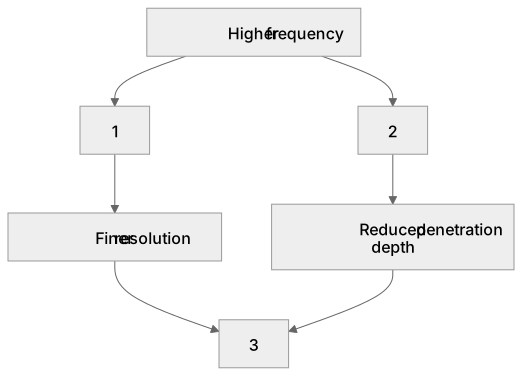
1Box 1
2Box 2
3Box 3
There is more to this lesson
The full lesson goes on to check your understanding and help you earn the marks. Create a free account to carry on, with your progress saved.
A week of Premium from your first lesson · Then the free plan continues · No card, no charge
Test your understanding of Ultrasound imaging (A-level only): Advantages and disadvantages of ultrasound imaging in comparison with alternatives including safety issues and resolution.
Active recall beats re-reading. Take an instant quiz now to test what you’ve learned and lock it into long-term memory.
A week of Premium from your first lesson · Then the free plan continues · No card, no charge