AQA · A-Level · Physics
Course version: 7408 · Version from Sept 2016
Zener diode (A-level only): Anode and cathode.
A Zener diode is a p–n junction with a heavily doped depletion region, so it can conduct safely in reverse breakdown at a well-defined Zener voltage.
Checked against the AQA 7408 specification (opens in a new tab) on .
- Point 2 of 4
- 4 key terms
Study notes
From the checked teaching notes for this specification point.
The idea
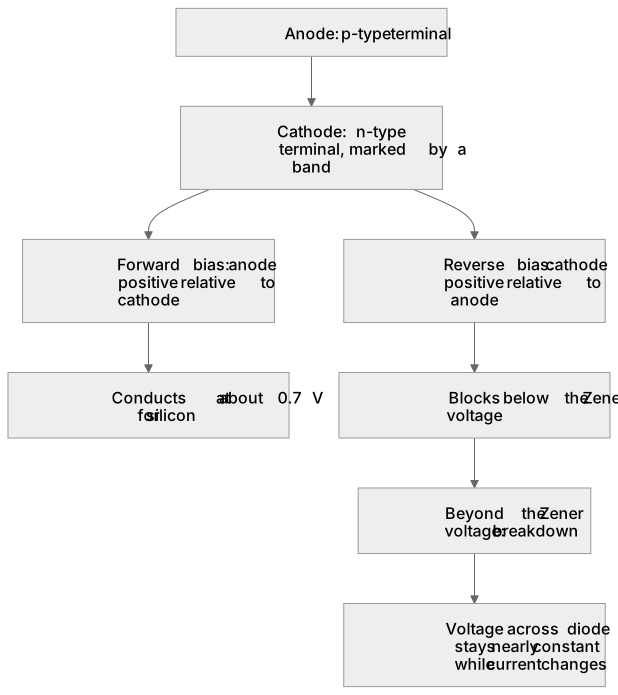
A Zener diode is a p–n junction with a heavily doped depletion region, so it can conduct safely in reverse breakdown at a well-defined Zener voltage. The anode is the p-type terminal and the cathode is the n-type terminal, marked by a band on the package. In normal forward bias the anode is positive relative to the cathode and the diode conducts at about 0.7 V for silicon. In reverse bias the cathode is positive relative to the anode; beyond the Zener voltage, breakdown occurs and the voltage across the diode stays nearly constant while current changes. For example, a 5.1 V Zener with its cathode to the positive rail and anode to 0 V maintains about 5.1 V across it when reverse current flows. Identifying anode and cathode correctly is essential for predicting conduction and for wiring the diode in a circuit.
What earns the marks
- The anode is the p-type terminal and the cathode is the n-type terminal of the Zener diode.
- The cathode is marked by a band on the diode body; conventional current flows from anode to cathode when forward biased.
- Forward bias means anode positive relative to cathode, giving conduction at about 0.7 V for a silicon Zener.
- Reverse bias means cathode positive relative to anode; the diode blocks until the reverse voltage reaches the Zener voltage.
- In reverse breakdown the voltage across the Zener remains approximately constant while the current through it changes.
- Correct identification of anode and cathode is needed to connect the Zener so that it operates in reverse breakdown for voltage regulation.
Common mistakes and how to put them right
Assuming the banded end is the anode.
Put it right: The band marks the cathode, so the banded end connects to the more positive rail in reverse-bias operation.
Thinking a Zener conducts in reverse bias at any voltage.
Put it right: It blocks below the Zener voltage and only breaks down at that value.
Confusing forward and reverse bias.
Put it right: Forward bias has anode positive relative to cathode, while reverse bias has cathode positive relative to anode.
Treating the Zener voltage as a forward voltage.
Put it right: The Zener voltage is a reverse-breakdown value, not the forward drop.
Exam tips
- Sketch the diode symbol and label anode and cathode before answering circuit questions; this reduces polarity errors.
- When explaining Zener action, state the bias condition and the approximate constant voltage across the diode in breakdown.
- Use the band marking to justify connections in circuit diagrams, and check that the cathode faces the positive supply rail for regulation.
- If asked to compare forward and reverse behaviour, give the approximate forward voltage and the named Zener voltage separately.
Try the lesson
The start of the Zener diode (A-level only): Anode and cathode. lesson, made from checked teaching notes for this specification point.
Have a go first
In a circuit diagram, a Zener diode is shown with its anode connected to the positive terminal of a battery. In which direction does the Zener diode conduct when it is forward biased?
Listen
A Zener diode is a p–n junction with a heavily doped depletion region, so it can conduct safely in reverse breakdown at a well-defined Zener voltage. The anode is the p-type terminal and the cathode is the n-type terminal, marked by a band on the package. In normal forward bias the anode is positive relative to the cathode and the diode conducts at about 0.7 V for silicon. In reverse bias the cathode is positive relative to the anode; beyond the Zener voltage, breakdown occurs and the voltage across the diode stays nearly constant while current changes. For example, a 5.1 V Zener with its cathode to the positive rail and anode to 0 V maintains about 5.1 V across it when reverse current flows. Identifying anode and cathode correctly is essential for predicting conduction and for wiring the diode in a circuit. A strong answer earns marks for these points. The anode is the p-type terminal and the cathode is the n-type terminal of the Zener diode. The cathode is marked by a band on the diode body; conventional current flows from anode to cathode when forward biased. Forward bias means anode positive relative to cathode, giving conduction at about 0.7 V for a silicon Zener. Reverse bias means cathode positive relative to anode; the diode blocks until the reverse voltage reaches the Zener voltage. Exam tip: Sketch the diode symbol and label anode and cathode before answering circuit questions; this reduces polarity errors.
See it
Key words
Say what each word means before you turn the card.
Anode
Try answering aloud or in your head before turning the card.
Cathode
Try answering aloud or in your head before turning the card.
Forward bias
Try answering aloud or in your head before turning the card.
Reverse bias
Try answering aloud or in your head before turning the card.
See every definition
- Anode
- The p-type terminal of the Zener diode, which is positive relative to the cathode in forward bias.
- Cathode
- The n-type terminal of the Zener diode, marked by a band on the package, and positive relative to the anode in reverse bias.
- Forward bias
- The condition where the anode is positive relative to the cathode, giving conduction at about 0.7 V for a silicon Zener.
- Reverse bias
- The condition where the cathode is positive relative to the anode, and the diode blocks until the reverse voltage reaches the Zener voltage.
Label the diagram
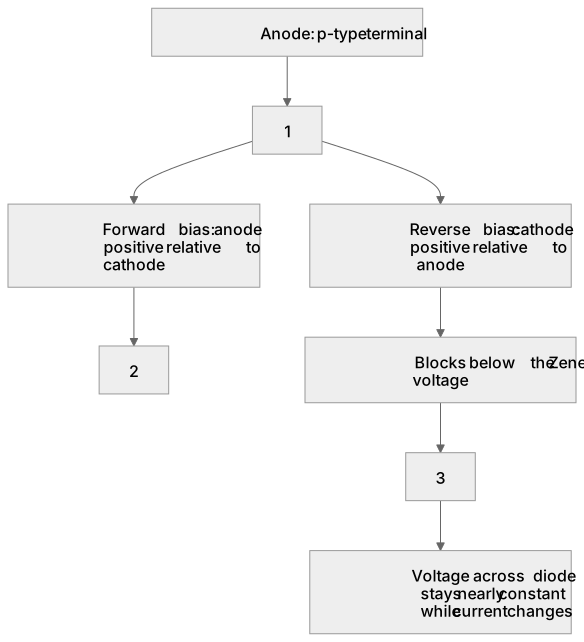
Some boxes have lost their names. Pick the right name for each number.
1Box 1
2Box 2
3Box 3
There is more to this lesson
The full lesson goes on to check your understanding and help you earn the marks. Create a free account to carry on, with your progress saved.
A week of Premium from your first lesson · Then the free plan continues · No card, no charge
Test your understanding of Zener diode (A-level only): Anode and cathode.
Active recall beats re-reading. Take an instant quiz now to test what you’ve learned and lock it into long-term memory.
A week of Premium from your first lesson · Then the free plan continues · No card, no charge