AQA · A-Level · Physics
Course version: 7408 · Version from Sept 2016
Characteristic curve showing zener breakdown voltage and typical minimum…
Full specification wording
Zener diode (A-level only): Characteristic curve showing zener breakdown voltage and typical minimum operating current.
A Zener diode is designed to operate safely in reverse breakdown, where the voltage across it stays nearly constant over a range of reverse currents.
Checked against the AQA 7408 specification (opens in a new tab) on .
- Point 1 of 4
- 4 key terms
Study notes
From the checked teaching notes for this specification point.
The idea
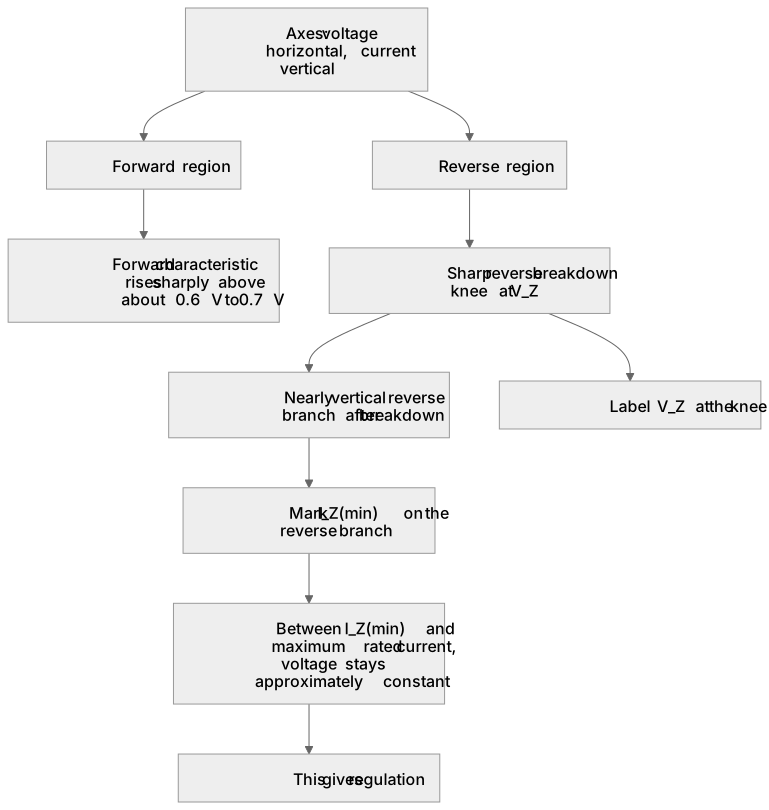
A Zener diode is designed to operate safely in reverse breakdown, where the voltage across it stays nearly constant over a range of reverse currents. Its characteristic curve plots current against voltage: forward bias behaves like an ordinary diode, while reverse bias shows a sharp knee at the Zener breakdown voltage, V_Z. Once breakdown begins, small changes in current produce almost no change in voltage, which is why the diode regulates. The curve should also mark a typical minimum operating current, I_Z(min), below which regulation is unreliable. You should read V_Z and I_Z(min) from the graph and use them when designing a voltage regulator with a series resistor.
What earns the marks
- Draws axes with voltage on the horizontal axis and current on the vertical axis, showing forward and reverse regions.
- Shows the forward characteristic rising sharply above about 0.6 V to 0.7 V for a silicon diode.
- Shows a sharp reverse breakdown knee at the Zener voltage, after which the curve is nearly vertical.
- Labels the Zener breakdown voltage, V_Z, at the knee on the reverse characteristic.
- Marks a typical minimum operating current, I_Z(min), on the reverse branch to show the lower limit for stable regulation.
- Explains that between I_Z(min) and the maximum rated current the voltage remains approximately constant, giving regulation.
Common mistakes and how to put them right
Drawing the reverse breakdown as a gradual slope rather than a sharp knee.
Put it right: Show a steep, nearly vertical reverse branch at V_Z.
Omitting the minimum operating current and implying regulation works at any reverse current.
Put it right: Mark I_Z(min) as the lower limit for reliable operation.
Labelling the breakdown voltage on the forward branch.
Put it right: Place V_Z on the reverse branch where breakdown occurs.
Exam tips
- Label both axes with quantity and unit, and mark V_Z and I_Z(min) directly on the curve.
- State that the diode is reverse biased in normal regulator operation, so the examiner sees you understand the mode of use.
- Use the near-vertical reverse branch to justify the statement that output voltage stays almost constant as current changes.
Try the lesson
The start of the Zener diode (A-level only): Characteristic curve showing zener breakdown voltage and typical minimum operating current. lesson, made from checked teaching notes for this specification point.
Have a go first
What does the zener breakdown voltage represent on the characteristic curve of a zener diode?
Listen
A Zener diode is designed to operate safely in reverse breakdown, where the voltage across it stays nearly constant over a range of reverse currents. Its characteristic curve plots current against voltage: forward bias behaves like an ordinary diode, while reverse bias shows a sharp knee at the Zener breakdown voltage, V_Z. Once breakdown begins, small changes in current produce almost no change in voltage, which is why the diode regulates. The curve should also mark a typical minimum operating current, I_Z(min), below which regulation is unreliable. You should read V_Z and I_Z(min) from the graph and use them when designing a voltage regulator with a series resistor. A strong answer earns marks for these points. Draws axes with voltage on the horizontal axis and current on the vertical axis, showing forward and reverse regions. Shows the forward characteristic rising sharply above about 0.6 V to 0.7 V for a silicon diode. Shows a sharp reverse breakdown knee at the Zener voltage, after which the curve is nearly vertical. Labels the Zener breakdown voltage, V_Z, at the knee on the reverse characteristic. A common slip: Drawing the reverse breakdown as a gradual slope rather than a sharp knee. Instead, show a steep, nearly vertical reverse branch at V_Z. Exam tip: Label both axes with quantity and unit, and mark V_Z and I_Z(min) directly on the curve.
See it
Key words
Say what each word means before you turn the card.
Zener breakdown voltage
Try answering aloud or in your head before turning the card.
Minimum operating current
Try answering aloud or in your head before turning the card.
Zener diode
Try answering aloud or in your head before turning the card.
Regulation
Try answering aloud or in your head before turning the card.
See every definition
- Zener breakdown voltage
- The voltage, labelled V_Z, at the sharp knee on the reverse characteristic where reverse breakdown begins.
- Minimum operating current
- A typical current, labelled I_Z(min), marked on the reverse branch as the lower limit below which regulation is unreliable.
- Zener diode
- A diode designed to operate safely in reverse breakdown, where the voltage across it stays nearly constant over a range of reverse currents.
- Regulation
- What happens once breakdown begins, because small changes in current produce almost no change in voltage.
Label the diagram
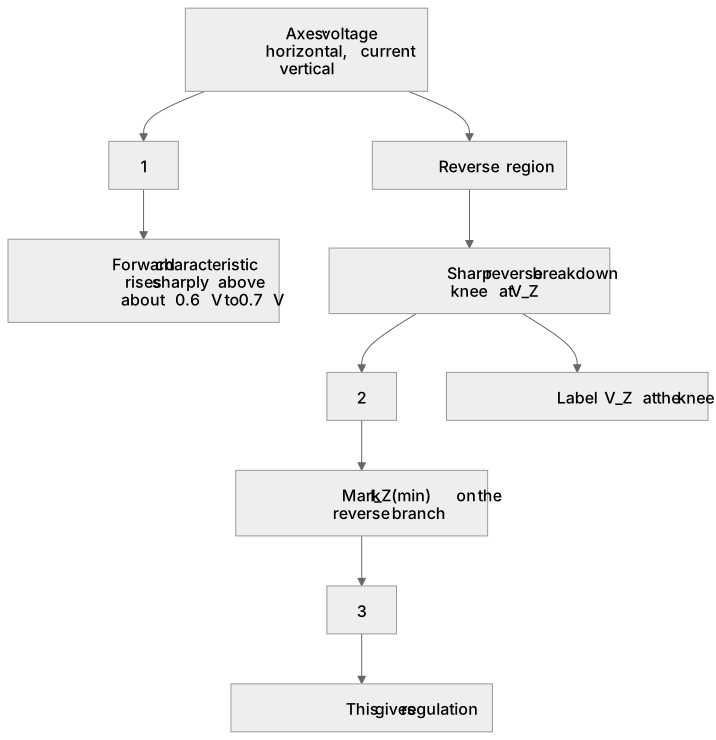
Some boxes have lost their names. Pick the right name for each number.
1Box 1
2Box 2
3Box 3
There is more to this lesson
The full lesson goes on to check your understanding and help you earn the marks. Create a free account to carry on, with your progress saved.
A week of Premium from your first lesson · Then the free plan continues · No card, no charge
Test your understanding of Zener diode (A-level only): Characteristic curve showing zener breakdown voltage and typical minimum operating current.
Active recall beats re-reading. Take an instant quiz now to test what you’ve learned and lock it into long-term memory.
A week of Premium from your first lesson · Then the free plan continues · No card, no charge