AQA · GCSE · Physics
Course version: 8463 · Version from Sept 2016
Acceleration: acceleration = change in velocity / time taken
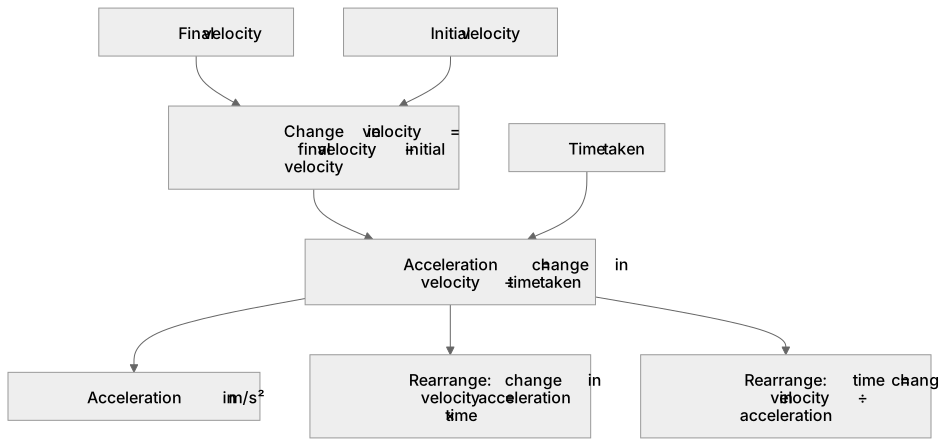
This equation defines average acceleration as the change in velocity divided by the time taken.
Checked against the AQA 8463 specification (opens in a new tab) on .
- Point 10 of 23
- 3 key terms
Study notes
From the checked teaching notes for this specification point.
The idea
This equation defines average acceleration as the change in velocity divided by the time taken. In symbols, a = Δv / t, where Δv is final velocity minus initial velocity. For example, a car accelerates from 8 m/s to 20 m/s in 4 s: Δv = 20 m/s − 8 m/s = 12 m/s, so a = 12 m/s ÷ 4 s = 3 m/s². The equation applies to motion in a straight line when acceleration is average or uniform. If velocity is measured in m/s and time in s, acceleration is in m/s². A negative value shows deceleration or acceleration opposite to the chosen positive direction. Rearranging gives Δv = a × t and t = Δv ÷ a, which are useful when the question supplies different quantities.
What earns the marks
- Identify the change in velocity as final velocity minus initial velocity, including direction signs.
- Substitute the change in velocity and time into acceleration = change in velocity ÷ time taken.
- Rearrange the equation to find change in velocity or time when required.
- Give acceleration in m/s² and ensure velocity and time units are consistent.
- Explain that the result is an average acceleration over the time interval.
Common mistakes and how to put them right
Dividing time by change in velocity.
Put it right by dividing change in velocity by time.
Using initial velocity minus final velocity.
Put it right by using final velocity minus initial velocity.
Mixing units such as km/h with seconds without converting.
Put it right by converting all velocities to m/s first.
Exam tips
- Show the rearrangement clearly if you need to find time or change in velocity.
- Include the unit m/s² in your final answer and check the sign makes physical sense.
- For graph questions, link the equation to the gradient of a velocity–time graph.
Try the lesson
The start of the Acceleration: acceleration = change in velocity / time taken lesson, made from checked teaching notes for this specification point.
Have a go first
A car increases its velocity from 12 m/s to 20 m/s over a period of 4 s. Using the equation acceleration = change in velocity / time taken, calculate the car's acceleration.
Listen
This equation defines average acceleration as the change in velocity divided by the time taken. In symbols, a = Δv / t, where Δv is final velocity minus initial velocity. For example, a car accelerates from 8 m/s to 20 m/s in 4 s: Δv = 20 m/s − 8 m/s = 12 m/s, so a = 12 m/s ÷ 4 s = 3 m/s². The equation applies to motion in a straight line when acceleration is average or uniform. If velocity is measured in m/s and time in s, acceleration is in m/s². A negative value shows deceleration or acceleration opposite to the chosen positive direction. Rearranging gives Δv = a × t and t = Δv ÷ a, which are useful when the question supplies different quantities. A strong answer earns marks for these points. Identify the change in velocity as final velocity minus initial velocity, including direction signs. Substitute the change in velocity and time into acceleration = change in velocity ÷ time taken. Rearrange the equation to find change in velocity or time when required. Give acceleration in m/s² and ensure velocity and time units are consistent. A common slip: Dividing time by change in velocity. Instead, dividing change in velocity by time. Exam tip: Show the rearrangement clearly if you need to find time or change in velocity.
See it
Key words
Say what each word means before you turn the card.
Equation linking acceleration, velocity change and time
Try answering aloud or in your head before turning the card.
Rearranging equations
Try answering aloud or in your head before turning the card.
Velocity–time graph gradients
Try answering aloud or in your head before turning the card.
See every definition
- Equation linking acceleration, velocity change and time
- Acceleration equals change in velocity divided by time taken, giving average acceleration over the time interval.
- Rearranging equations
- Rearranging gives change in velocity = acceleration × time and time = change in velocity ÷ acceleration, useful when the question supplies different quantities.
- Velocity–time graph gradients
- For graph questions, the equation is linked to the gradient of a velocity–time graph.
Label the diagram
Some boxes have lost their names. Pick the right name for each number.
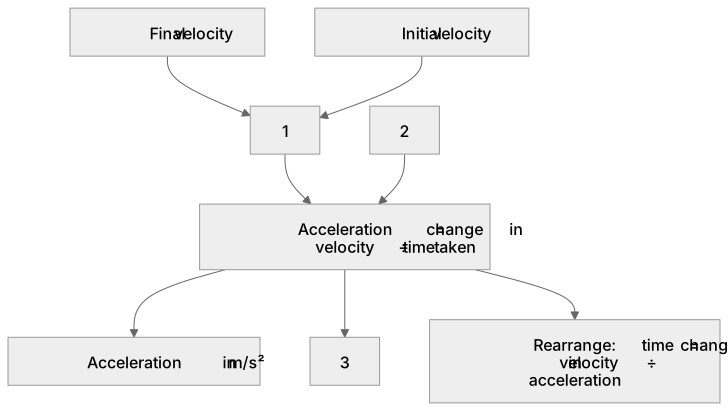
1Box 1
2Box 2
3Box 3
There is more to this lesson
The full lesson goes on to check your understanding and help you earn the marks. Create a free account to carry on, with your progress saved.
A week of Premium from your first lesson · Then the free plan continues · No card, no charge
Test your understanding of Acceleration: acceleration = change in velocity / time taken
Active recall beats re-reading. Take an instant quiz now to test what you’ve learned and lock it into long-term memory.
A week of Premium from your first lesson · Then the free plan continues · No card, no charge