AQA · GCSE · Physics
Course version: 8463 · Version from Sept 2016
(Physics only) Students should be able to: draw and interpret…
Full specification wording
Acceleration: (Physics only) Students should be able to: draw and interpret velocity–time graphs for objects that reach terminal velocity interpret the changing motion in terms of the forces acting.
Marks here come from pairing each part of the graph with a force diagram.
Checked against the AQA 8463 specification (opens in a new tab) on .
- Point 23 of 23
Study notes
From the checked teaching notes for this specification point.
The idea
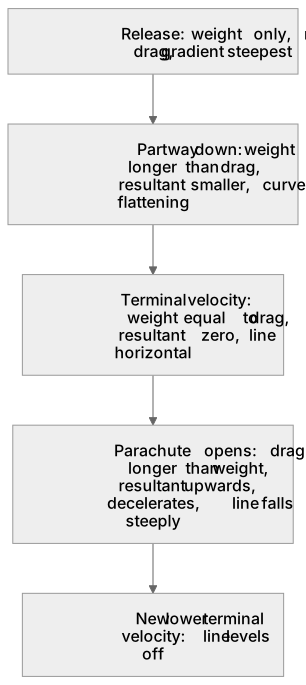
Marks here come from pairing each part of the graph with a force diagram. At release there is one arrow down for the weight and nothing upwards, so the gradient is at its steepest. Part way down there is a long weight arrow and a shorter drag arrow, so the resultant is smaller and the curve is flattening. At terminal velocity the arrows are equal in length, the resultant is zero and the line is horizontal. When a parachute opens the drag arrow suddenly becomes longer than the weight, the resultant points upwards, the skydiver decelerates and the line falls steeply before levelling off at a new and lower terminal velocity. Draw the curve smoothly, with no corners except at the moment the parachute opens, and label both terminal velocities.
What earns the marks
- A curve of decreasing gradient reaching a horizontal line at the terminal velocity.
- The weight being greater than the drag while the object accelerates.
- The weight equal to the drag, and a zero resultant, along the horizontal section.
- The drag greater than the weight after a parachute opens, so the velocity falls to a new lower terminal velocity.
Common mistakes and how to put them right
Drawing the line returning to zero velocity after the parachute opens.
Saying the skydiver moves upwards because the resultant force is upwards.
Drawing equal force arrows during the accelerating stage.
Showing a sharp corner where the curve should flatten gradually.
Exam tips
- Annotate the graph with force arrows, because examiners credit the link between the two.
- After a parachute opens the speed falls but never below the new terminal velocity, so the line levels off rather than reaching zero.
Try the lesson
The start of the Acceleration: (Physics only) Students should be able to: draw and interpret velocity–time graphs for objects that reach terminal velocity interpret the changing motion in terms of the forces acting. lesson, made from checked teaching notes for this specification point.
Have a go first
A skydiver jumps from a plane. On a velocity–time graph, the line rises steeply, then curves until it becomes horizontal. What does the horizontal section show about the skydiver's motion?
Listen
Marks here come from pairing each part of the graph with a force diagram. At release there is one arrow down for the weight and nothing upwards, so the gradient is at its steepest. Part way down there is a long weight arrow and a shorter drag arrow, so the resultant is smaller and the curve is flattening. At terminal velocity the arrows are equal in length, the resultant is zero and the line is horizontal. When a parachute opens the drag arrow suddenly becomes longer than the weight, the resultant points upwards, the skydiver decelerates and the line falls steeply before levelling off at a new and lower terminal velocity. Draw the curve smoothly, with no corners except at the moment the parachute opens, and label both terminal velocities. A strong answer earns marks for these points. a curve of decreasing gradient reaching a horizontal line at the terminal velocity. the weight being greater than the drag while the object accelerates. the weight equal to the drag, and a zero resultant, along the horizontal section. the drag greater than the weight after a parachute opens, so the velocity falls to a new lower terminal velocity. Exam tip: Annotate the graph with force arrows, because examiners credit the link between the two.
See it
Put it in order
Put these steps in the order they happen.
- 1. Part way down: weight longer than drag, resultant smaller, curve flattening
- 2. Terminal velocity: weight equal to drag, resultant zero, line horizontal
- 3. Release: weight only, no drag, gradient steepest
- 4. New lower terminal velocity: line levels off
- 5. Parachute opens: drag longer than weight, resultant upwards, decelerates, line falls steeply
Label the diagram
Some boxes have lost their names. Pick the right name for each number.
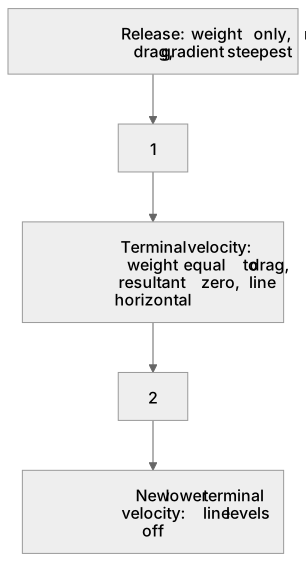
1Box 1
2Box 2
There is more to this lesson
The full lesson goes on to check your understanding and help you earn the marks. Create a free account to carry on, with your progress saved.
A week of Premium from your first lesson · Then the free plan continues · No card, no charge
Test your understanding of Acceleration: (Physics only) Students should be able to: draw and interpret velocity–time graphs for objects that reach terminal velocity interpret the changing motion in terms of the forces acting.
Active recall beats re-reading. Take an instant quiz now to test what you’ve learned and lock it into long-term memory.
A week of Premium from your first lesson · Then the free plan continues · No card, no charge