AQA · GCSE · Physics
Course version: 8463 · Version from Sept 2016
Students should be able to estimate the magnitude of everyday accelerations.
Full specification wording
Acceleration: Students should be able to estimate the magnitude of everyday accelerations.
Estimating means choosing sensible numbers and dividing.
Checked against the AQA 8463 specification (opens in a new tab) on .
- Point 15 of 23
- 3 key terms
Study notes
From the checked teaching notes for this specification point.
The idea
Estimating means choosing sensible numbers and dividing. A family car pulling away might reach 13 m/s in about 8 s, giving roughly 1.6 m/s²; a sports car reaching 27 m/s in 5 s manages about 5 m/s². A sprinter leaving the blocks achieves something near 5 m/s² briefly. A commuter train accelerates gently, at well under 1 m/s². Anything dropped near the Earth's surface accelerates at about 10 m/s² while air resistance is small, and that value is the natural yardstick, because an acceleration much larger than it is violent and a passenger lift is designed for around 1 m/s² so that people stay comfortable. State the two values you assumed and show the division, because examiners reward a reasoned estimate rather than a remembered number.
What earns the marks
- A sensible estimate of the change in velocity for the situation.
- A sensible estimate of the time taken.
- The substitution into acceleration = change in velocity divided by time.
- An answer of a realistic order of magnitude, with its unit.
Common mistakes and how to put them right
Estimating a car's acceleration as tens of metres per second squared.
Giving an estimate without showing the values assumed.
Using a top speed in miles per hour without converting it.
Confusing the acceleration with the final velocity reached.
Exam tips
- Write down the two assumptions before dividing, because they carry marks.
- Compare your answer with free fall at about 10 m/s² as a reality check.
Try the lesson
The start of the Acceleration: Students should be able to estimate the magnitude of everyday accelerations. lesson, made from checked teaching notes for this specification point.
Have a go first
Which of these is a reasonable estimate for the acceleration of a car pulling away from traffic lights?
Listen
Estimating means choosing sensible numbers and dividing. A family car pulling away might reach 13 m/s in about 8 s, giving roughly 1.6 m/s²; a sports car reaching 27 m/s in 5 s manages about 5 m/s². A sprinter leaving the blocks achieves something near 5 m/s² briefly. A commuter train accelerates gently, at well under 1 m/s². Anything dropped near the Earth's surface accelerates at about 10 m/s² while air resistance is small, and that value is the natural yardstick, because an acceleration much larger than it is violent and a passenger lift is designed for around 1 m/s² so that people stay comfortable. State the two values you assumed and show the division, because examiners reward a reasoned estimate rather than a remembered number. A strong answer earns marks for these points. a sensible estimate of the change in velocity for the situation. a sensible estimate of the time taken. the substitution into acceleration = change in velocity divided by time. an answer of a realistic order of magnitude, with its unit. Exam tip: Write down the two assumptions before dividing, because they carry marks.
See it
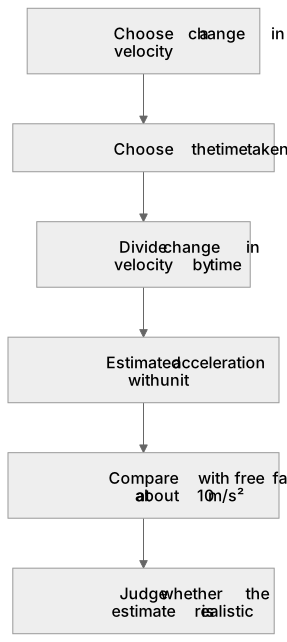
Put it in order
Put these steps in the order they happen.
- 1. Divide change in velocity by time
- 2. Choose the time taken
- 3. Choose a change in velocity
- 4. Judge whether the estimate is realistic
- 5. Compare with free fall at about 10 m/s²
- 6. Estimated acceleration with unit
Key words
Say what each word means before you turn the card.
estimation
Try answering aloud or in your head before turning the card.
everyday accelerations
Try answering aloud or in your head before turning the card.
free fall as a yardstick
Try answering aloud or in your head before turning the card.
See every definition
- estimation
- Choosing sensible numbers and dividing, stating the two values you assumed and showing the division.
- everyday accelerations
- The magnitude of accelerations for situations such as a family car pulling away, a sports car, a sprinter, a commuter train or a passenger lift.
- free fall as a yardstick
- Anything dropped near the Earth's surface accelerates at about 10 m/s² while air resistance is small, and that value is the natural yardstick for comparison.
Label the diagram
Some boxes have lost their names. Pick the right name for each number.
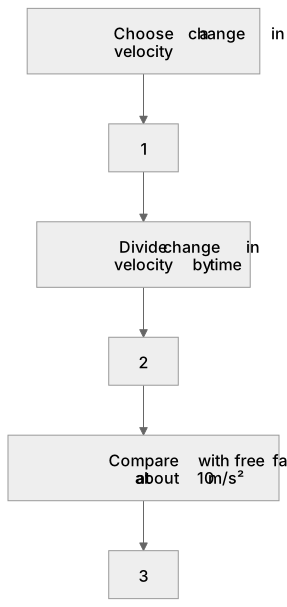
1Box 1
2Box 2
3Box 3
There is more to this lesson
The full lesson goes on to check your understanding and help you earn the marks. Create a free account to carry on, with your progress saved.
A week of Premium from your first lesson · Then the free plan continues · No card, no charge
Test your understanding of Acceleration: Students should be able to estimate the magnitude of everyday accelerations.
Active recall beats re-reading. Take an instant quiz now to test what you’ve learned and lock it into long-term memory.
A week of Premium from your first lesson · Then the free plan continues · No card, no charge