AQA · GCSE · Physics
Course version: 8463 · Version from Sept 2016
Acceleration: time, t, in seconds, s
Time, t, is the duration over which a change in velocity occurs.
Checked against the AQA 8463 specification (opens in a new tab) on .
- Point 13 of 23
Study notes
From the checked teaching notes for this specification point.
The idea
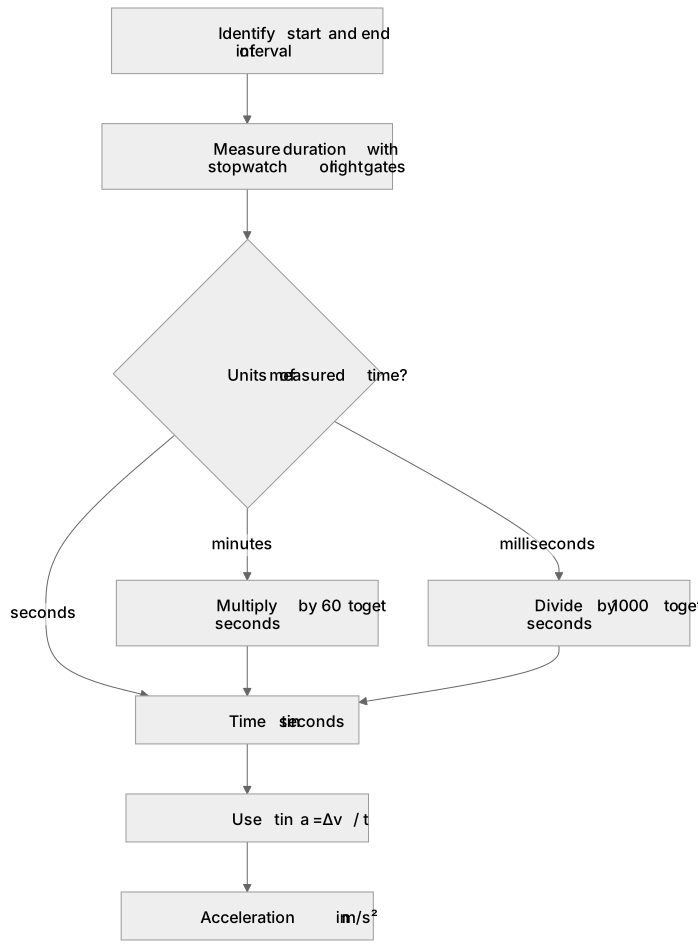
Time, t, is the duration over which a change in velocity occurs. In acceleration calculations, t must be measured in seconds (s). If a stopwatch records 2 minutes 30 seconds, convert to 150 s before using the equation. The symbol t represents this time interval, not a clock reading. For example, a car accelerating from rest to 20 m/s in 5 s has t = 5 s. If the same change takes 0.5 minutes, t = 30 s. Always identify the start and end of the interval, then express the duration in seconds. This ensures the acceleration unit m/s² is consistent. When timing, start the stopwatch at the initial velocity and stop at the final velocity. If using light gates, the time interval is between the two gates. Record raw times and convert units carefully, remembering 1 minute = 60 s and 1 ms = 0.001 s.
What earns the marks
- Time t is the duration of the velocity change, measured in seconds (s).
- Convert minutes to seconds by multiplying by 60; convert milliseconds to seconds by dividing by 1000.
- Use the time interval between the initial and final velocity measurements, not a cumulative clock reading.
- In the equation a = Δv / t, t must be in seconds to give acceleration in m/s².
- When timing manually, use a stopwatch and repeat readings to reduce random error.
Common mistakes and how to put them right
Using minutes directly in the equation instead of converting to seconds.
Put it right by multiplying minutes by 60.
Confusing time t with speed or distance.
Put it right by identifying t as the duration of the velocity change.
Recording the stopwatch reading at the end only, rather than the time interval.
Put it right by subtracting the start time from the end time.
Exam tips
- Always write the unit s after a time value in calculations and final answers.
- If a time is given in minutes or milliseconds, convert to seconds before substituting into any equation.
- Check that the time interval matches the change in velocity you are using; for example, use the time between two velocity readings.
Try the lesson
The start of the Acceleration: time, t, in seconds, s lesson, made from checked teaching notes for this specification point.
Have a go first
What is the standard unit for time, t, used in the equation for acceleration?
Listen
Time, t, is the duration over which a change in velocity occurs. In acceleration calculations, t must be measured in seconds (s). If a stopwatch records 2 minutes 30 seconds, convert to 150 s before using the equation. The symbol t represents this time interval, not a clock reading. For example, a car accelerating from rest to 20 m/s in 5 s has t = 5 s. If the same change takes 0.5 minutes, t = 30 s. Always identify the start and end of the interval, then express the duration in seconds. This ensures the acceleration unit m/s² is consistent. When timing, start the stopwatch at the initial velocity and stop at the final velocity. If using light gates, the time interval is between the two gates. Record raw times and convert units carefully, remembering 1 minute = 60 s and 1 ms = 0.001 s. A strong answer earns marks for these points. Time t is the duration of the velocity change, measured in seconds (s). Convert minutes to seconds by multiplying by 60; convert milliseconds to seconds by dividing by 1000. Use the time interval between the initial and final velocity measurements, not a cumulative clock reading. In the equation a = Δv / t, t must be in seconds to give acceleration in m/s². A common slip: Using minutes directly in the equation instead of converting to seconds. Instead, multiplying minutes by 60. Exam tip: Always write the unit s after a time value in calculations and final answers.
See it
Label the diagram
Some boxes have lost their names. Pick the right name for each number.
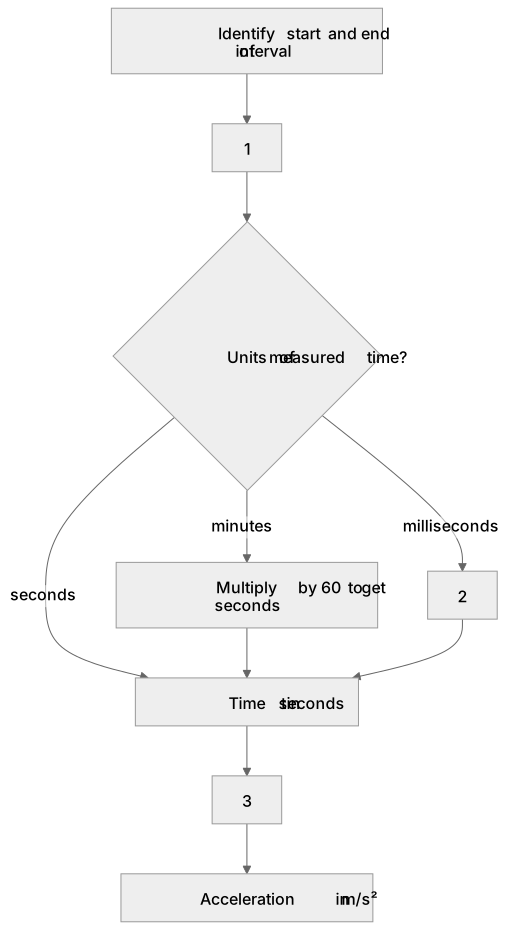
1Box 1
2Box 2
3Box 3
There is more to this lesson
The full lesson goes on to check your understanding and help you earn the marks. Create a free account to carry on, with your progress saved.
A week of Premium from your first lesson · Then the free plan continues · No card, no charge
Test your understanding of Acceleration: time, t, in seconds, s
Active recall beats re-reading. Take an instant quiz now to test what you’ve learned and lock it into long-term memory.
A week of Premium from your first lesson · Then the free plan continues · No card, no charge