AQA · GCSE · Physics
Course version: 8463 · Version from Sept 2016
So atmospheric pressure decreases with an increase in height.
Full specification wording
Atmospheric pressure: So atmospheric pressure decreases with an increase in height.
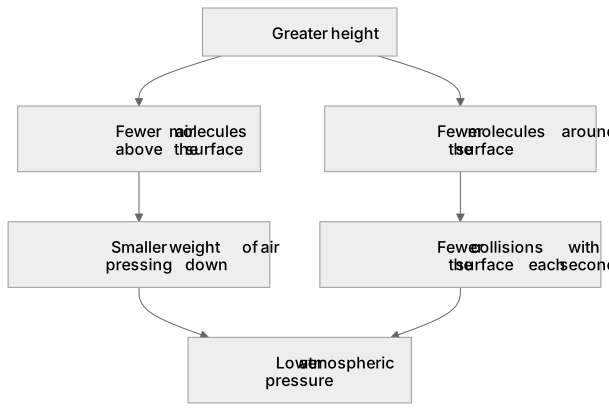
Fewer molecules above a surface means a smaller weight of air pressing down, and fewer molecules around it means fewer collisions each second.
Checked against the AQA 8463 specification (opens in a new tab) on .
- Point 5 of 6
- 3 key terms
Study notes
From the checked teaching notes for this specification point.
The idea
Fewer molecules above a surface means a smaller weight of air pressing down, and fewer molecules around it means fewer collisions each second. Therefore, atmospheric pressure falls as height rises. For example, pressure at sea level is about 100 kPa, but at an airliner's cruising altitude, it drops to near 20 kPa. This is why cabins are pressurised to around 70 kPa. Each window experiences a resultant outward force calculated by multiplying the pressure difference by its area (e.g., 4 kN for an 810 cm² window). The decrease is non-linear: pressure roughly halves for every 5.5 km climbed, resulting in a curved graph. Altimeters utilise this relationship by measuring atmospheric pressure and converting it into an altitude reading.
What earns the marks
- State that there are fewer air molecules above a surface at a greater height.
- Explain that this results in a smaller weight of air acting on the surface.
- Identify that fewer molecules lead to fewer collisions with the surface each second.
- Conclude that atmospheric pressure is therefore lower at greater altitudes.
Common mistakes and how to put them right
Stating only that there is 'less air', without linking this to weight or collision frequency.
Failing to convert kilopascals into pascals before using pressure values in calculations.
Assuming the graph of pressure against altitude is a straight line, rather than a curve.
Exam tips
- Extract the pressure value from the graph and write it down before starting any calculation.
- Always check units; expect to convert kilopascals to pascals and square centimetres to square metres.
Try the lesson
The start of the Atmospheric pressure: So atmospheric pressure decreases with an increase in height. lesson, made from checked teaching notes for this specification point.
Have a go first
A weather balloon rises from sea level to a much greater height. What happens to the atmospheric pressure acting on the balloon as its height increases?
Listen
Fewer molecules above a surface means a smaller weight of air pressing down, and fewer molecules around it means fewer collisions each second. Therefore, atmospheric pressure falls as height rises. For example, pressure at sea level is about 100 kPa, but at an airliner's cruising altitude, it drops to near 20 kPa. This is why cabins are pressurised to around 70 kPa. Each window experiences a resultant outward force calculated by multiplying the pressure difference by its area (e.g., 4 kN for an 810 cm² window). The decrease is non-linear: pressure roughly halves for every 5.5 km climbed, resulting in a curved graph. Altimeters utilise this relationship by measuring atmospheric pressure and converting it into an altitude reading. A strong answer earns marks for these points. State that there are fewer air molecules above a surface at a greater height. Explain that this results in a smaller weight of air acting on the surface. Identify that fewer molecules lead to fewer collisions with the surface each second. Conclude that atmospheric pressure is therefore lower at greater altitudes. Exam tip: Extract the pressure value from the graph and write it down before starting any calculation.
See it
Key words
Say what each word means before you turn the card.
pressure falls with height
Try answering aloud or in your head before turning the card.
weight of air
Try answering aloud or in your head before turning the card.
collision frequency
Try answering aloud or in your head before turning the card.
See every definition
- pressure falls with height
- Atmospheric pressure decreases with an increase in height because there are fewer molecules above a surface and fewer collisions each second.
- weight of air
- Fewer molecules above a surface at a greater height means a smaller weight of air pressing down on it.
- collision frequency
- Fewer molecules around a surface at a greater height means fewer collisions with it each second.
Label the diagram
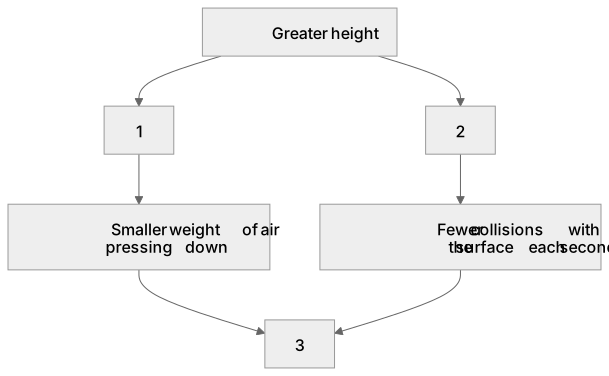
Some boxes have lost their names. Pick the right name for each number.
1Box 1
2Box 2
3Box 3
There is more to this lesson
The full lesson goes on to check your understanding and help you earn the marks. Create a free account to carry on, with your progress saved.
A week of Premium from your first lesson · Then the free plan continues · No card, no charge
Test your understanding of Atmospheric pressure: So atmospheric pressure decreases with an increase in height.
Active recall beats re-reading. Take an instant quiz now to test what you’ve learned and lock it into long-term memory.
A week of Premium from your first lesson · Then the free plan continues · No card, no charge