AQA · GCSE · Physics
Course version: 8463 · Version from Sept 2016
The number of air molecules (and so the weight of air) above a surface…
Full specification wording
Atmospheric pressure: The number of air molecules (and so the weight of air) above a surface decreases as the height of the surface above ground level increases.
Picture a column of air standing on a surface and reaching to the top of the atmosphere.
Checked against the AQA 8463 specification (opens in a new tab) on .
- Point 3 of 6
- 4 key terms
Study notes
From the checked teaching notes for this specification point.
The idea
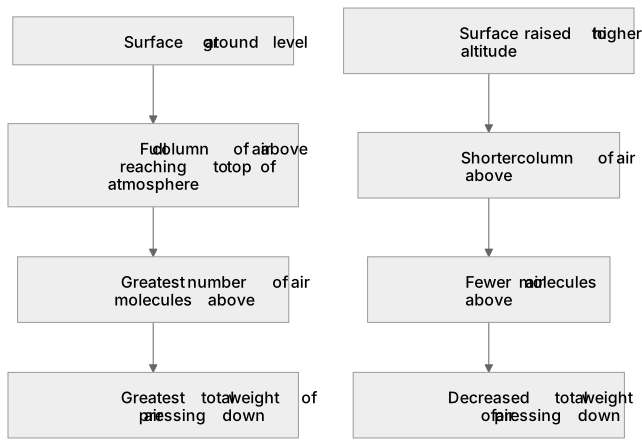
Picture a column of air standing on a surface and reaching to the top of the atmosphere. Every molecule in this column has weight, pressing down on the surface. As the surface is raised to a higher altitude, the column of air above it becomes shorter. Consequently, this shorter column contains fewer air molecules. Because there are fewer molecules above the surface, the total weight of the air pressing down decreases. For example, at the summit of Mount Snowdon, a significant portion of the atmosphere is below you, leaving fewer molecules above to exert a downward force. On the ground, you stand at the bottom of the entire column, where the number of molecules above you—and therefore the weight of the air—is at its greatest.
What earns the marks
- State that a column of air above a surface has weight due to the mass of the air molecules.
- Identify that as the height of a surface above ground level increases, the column of air above it becomes shorter.
- Explain that a shorter column means there are fewer air molecules above the surface.
- Conclude that fewer molecules result in a decreased total weight of air acting on the surface.
Common mistakes and how to put them right
Reversing cause and effect by stating that lower weight causes fewer molecules.
Put it right: The reduced number of molecules at altitude is the cause of the decreased weight of air.
Assuming the column above a high surface is identical to the one above a low surface, only shorter.
Put it right: The air is also less dense at higher altitudes, further reducing the number of molecules.
Confusing the weight of the air above with the weight of the object on the surface.
Put it right: Atmospheric pressure depends only on the weight of the air column above the surface.
Exam tips
- Use the phrase 'fewer molecules' rather than 'less air' when explaining the decrease in the weight of air with height.
- Always explicitly link the decrease in the number of air molecules above a surface directly to the reduced weight of air acting on that surface.
Try the lesson
The start of the Atmospheric pressure: The number of air molecules (and so the weight of air) above a surface decreases as the height of the surface above ground level increases. lesson, made from checked teaching notes for this specification point.
Have a go first
A weather balloon rises from ground level to a much greater height. What happens to the number of air molecules above the balloon as its height increases?
Listen
Picture a column of air standing on a surface and reaching to the top of the atmosphere. Every molecule in this column has weight, pressing down on the surface. As the surface is raised to a higher altitude, the column of air above it becomes shorter. Consequently, this shorter column contains fewer air molecules. Because there are fewer molecules above the surface, the total weight of the air pressing down decreases. For example, at the summit of Mount Snowdon, a significant portion of the atmosphere is below you, leaving fewer molecules above to exert a downward force. On the ground, you stand at the bottom of the entire column, where the number of molecules above you—and therefore the weight of the air—is at its greatest. A strong answer earns marks for these points. State that a column of air above a surface has weight due to the mass of the air molecules. Identify that as the height of a surface above ground level increases, the column of air above it becomes shorter. Explain that a shorter column means there are fewer air molecules above the surface. Conclude that fewer molecules result in a decreased total weight of air acting on the surface. A common slip: Reversing cause and effect by stating that lower weight causes fewer molecules. Instead, the reduced number of molecules at altitude is the cause of the decreased weight of air. Exam tip: Use the phrase 'fewer molecules' rather than 'less air' when explaining the decrease in the weight of air with height.
See it
Key words
Say what each word means before you turn the card.
column of air
Try answering aloud or in your head before turning the card.
weight of air
Try answering aloud or in your head before turning the card.
molecule number
Try answering aloud or in your head before turning the card.
altitude
Try answering aloud or in your head before turning the card.
See every definition
- column of air
- A body of air standing on a surface and reaching to the top of the atmosphere, every molecule in it having weight and pressing down on the surface.
- weight of air
- The total downward force from the air molecules above a surface, which decreases as the height of the surface above ground level increases.
- molecule number
- The count of air molecules above a surface, which decreases as the height of the surface above ground level increases.
- altitude
- The height of a surface above ground level; as it increases, the column of air above the surface becomes shorter and contains fewer air molecules.
Label the diagram
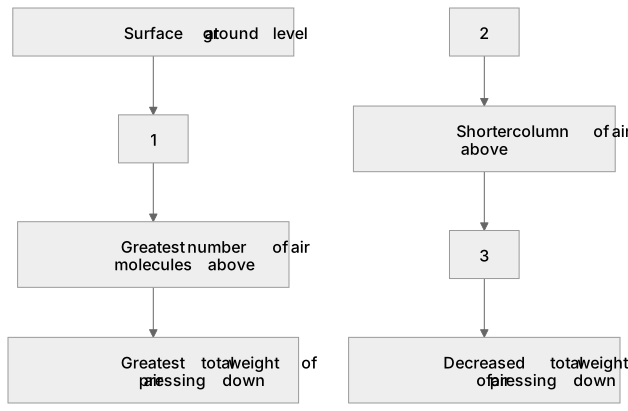
Some boxes have lost their names. Pick the right name for each number.
1Box 1
2Box 2
3Box 3
There is more to this lesson
The full lesson goes on to check your understanding and help you earn the marks. Create a free account to carry on, with your progress saved.
A week of Premium from your first lesson · Then the free plan continues · No card, no charge
Test your understanding of Atmospheric pressure: The number of air molecules (and so the weight of air) above a surface decreases as the height of the surface above ground level increases.
Active recall beats re-reading. Take an instant quiz now to test what you’ve learned and lock it into long-term memory.
A week of Premium from your first lesson · Then the free plan continues · No card, no charge