AQA · GCSE · Physics
Course version: 8463 · Version from Sept 2016
Background radiation is around us all of the time. It comes from: natural…
Full specification wording
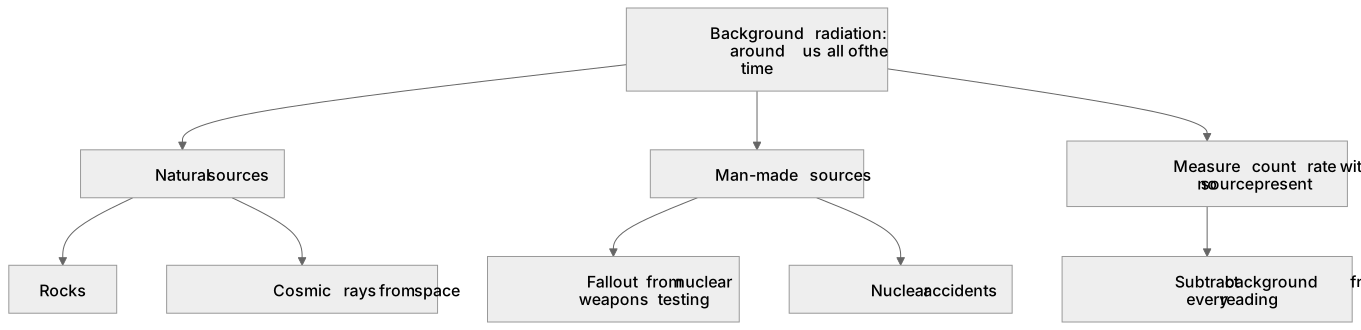
Background radiation: Background radiation is around us all of the time. It comes from: natural sources such as rocks and cosmic rays from space man-made sources such as the fallout from nuclear weapons testing and nuclear accidents.
Background radiation is the low level of ionising radiation present everywhere, all the time.
Checked against the AQA 8463 specification (opens in a new tab) on .
- Point 1 of 3
- 3 key terms
Study notes
From the checked teaching notes for this specification point.
The idea
Background radiation is the low level of ionising radiation present everywhere, all the time. Most of it is natural. Radon gas seeps out of rocks, especially granite, and is breathed in; cosmic rays arrive from space and are partly absorbed by the atmosphere; there are naturally radioactive isotopes in soil, building materials, food and drink, and in our own bodies. A smaller share is man-made, chiefly fallout from nuclear weapons testing and from nuclear accidents, plus medical procedures and waste from the nuclear industry. Because it never switches off, every experiment with a source has to start by measuring the count rate with no source present and subtracting that background from every reading.
What earns the marks
- Background radiation being present all the time, from many sources around us.
- Two named natural sources, such as radon from rocks, cosmic rays from space, or food and drink.
- A named man-made source, such as fallout from nuclear weapons testing or from a nuclear accident.
- Measuring the count rate with no source present and subtracting it from each reading.
Common mistakes and how to put them right
Listing only man-made sources and treating background radiation as pollution.
Giving 'the Sun' as a source rather than cosmic rays from space.
Claiming radon comes from nuclear power stations rather than from rocks.
Forgetting the background correction, so the count rate appears not to fall to the expected level.
Saying background radiation is zero indoors.
Exam tips
- Check whether the question asks for natural or man-made sources, because a correct example from the wrong category scores nothing.
- In range experiments, quote the background count rate as the level the readings fall back to; examiners look for that phrase.
- Give a specific source, such as radon from granite, rather than a category like 'the environment'.
Try the lesson
The start of the Background radiation: Background radiation is around us all of the time. It comes from: natural sources such as rocks and cosmic rays from space man-made sources such as the fallout from nuclear weapons testing and nuclear accidents. lesson, made from checked teaching notes for this specification point.
Have a go first
Which of these is a natural source of background radiation?
Listen
Background radiation is the low level of ionising radiation present everywhere, all the time. Most of it is natural. Radon gas seeps out of rocks, especially granite, and is breathed in; cosmic rays arrive from space and are partly absorbed by the atmosphere; there are naturally radioactive isotopes in soil, building materials, food and drink, and in our own bodies. A smaller share is man-made, chiefly fallout from nuclear weapons testing and from nuclear accidents, plus medical procedures and waste from the nuclear industry. Because it never switches off, every experiment with a source has to start by measuring the count rate with no source present and subtracting that background from every reading. A strong answer earns marks for these points. background radiation being present all the time, from many sources around us. two named natural sources, such as radon from rocks, cosmic rays from space, or food and drink. a named man-made source, such as fallout from nuclear weapons testing or from a nuclear accident. measuring the count rate with no source present and subtracting it from each reading. Exam tip: Check whether the question asks for natural or man-made sources, because a correct example from the wrong category scores nothing.
See it
Key words
Say what each word means before you turn the card.
natural sources
Try answering aloud or in your head before turning the card.
man-made sources
Try answering aloud or in your head before turning the card.
background correction
Try answering aloud or in your head before turning the card.
See every definition
- natural sources
- Sources such as rocks and cosmic rays from space that contribute to background radiation.
- man-made sources
- Sources such as the fallout from nuclear weapons testing and nuclear accidents that contribute to background radiation.
- background correction
- Measuring the count rate with no source present and subtracting that background from every reading.
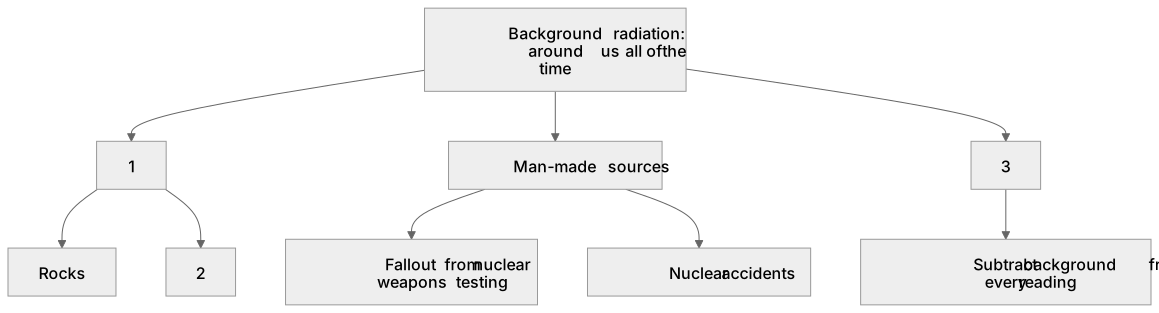
Label the diagram
Some boxes have lost their names. Pick the right name for each number.
1Box 1
2Box 2
3Box 3
There is more to this lesson
The full lesson goes on to check your understanding and help you earn the marks. Create a free account to carry on, with your progress saved.
A week of Premium from your first lesson · Then the free plan continues · No card, no charge
Test your understanding of Background radiation: Background radiation is around us all of the time. It comes from: natural sources such as rocks and cosmic rays from space man-made sources such as the fallout from nuclear weapons testing and nuclear accidents.
Active recall beats re-reading. Take an instant quiz now to test what you’ve learned and lock it into long-term memory.
A week of Premium from your first lesson · Then the free plan continues · No card, no charge