AQA · GCSE · Physics
Course version: 8463 · Version from Sept 2016
Radiation dose is measured in sieverts (Sv) 1000 millisieverts (mSv) = 1…
Full specification wording
Background radiation: Radiation dose is measured in sieverts (Sv) 1000 millisieverts (mSv) = 1 sievert (Sv) Students will not need to recall the unit of radiation dose.
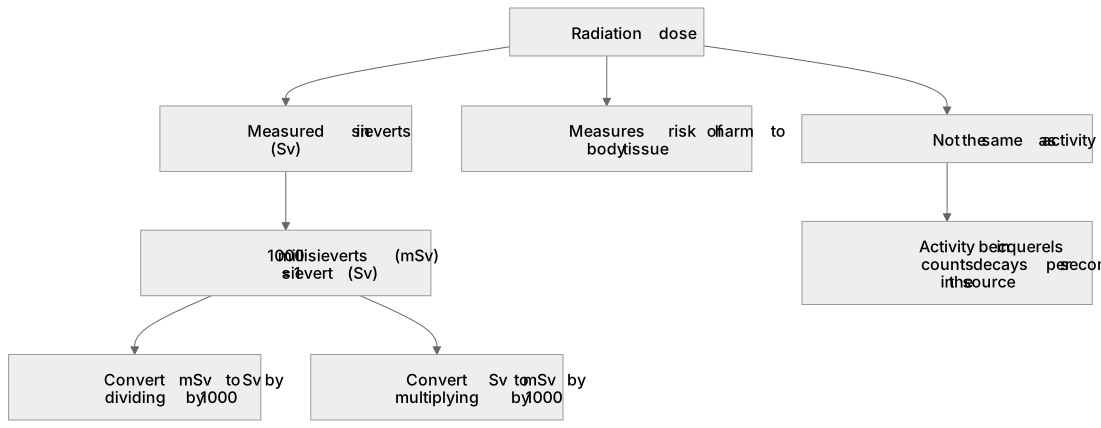
Radiation dose measures the risk of harm to body tissue from being exposed to radiation, taking account of both the amount of radiation absorbed and how damaging that type is.
Checked against the AQA 8463 specification (opens in a new tab) on .
- Point 3 of 3
- 4 key terms
Study notes
From the checked teaching notes for this specification point.
The idea
Radiation dose measures the risk of harm to body tissue from being exposed to radiation, taking account of both the amount of radiation absorbed and how damaging that type is. It is measured in sieverts, symbol Sv, and because a sievert is a large dose most everyday figures appear in millisieverts, with 1000 mSv = 1 Sv. So a typical UK annual background dose of about 2.7 mSv is 0.0027 Sv. Dose is not the same as activity: activity in becquerels counts decays per second in the source, while dose describes what the exposed person actually receives.
What earns the marks
- Radiation dose being measured in sieverts, with 1000 millisieverts equal to 1 sievert.
- A correct conversion, such as 2.7 mSv written as 0.0027 Sv.
- Recognising that dose measures the risk of harm to tissue rather than the number of decays per second.
- A comparison made using the figures given in the question rather than recalled values.
Common mistakes and how to put them right
Quoting a dose in becquerels, which is the unit of activity.
Multiplying by 1000 when converting millisieverts to sieverts instead of dividing.
Treating a large dose and a large activity as necessarily the same thing.
Comparing a dose in mSv with one in Sv without converting first.
Exam tips
- Convert every value to the same unit before you compare doses, and write the converted values down.
- Watch for the prefix; mSv and Sv differ by a factor of one thousand and the numbers look deceptively similar.
- Quote the dose figures from the stem in your conclusion so the examiner can see the comparison you made.
Try the lesson
The start of the Background radiation: Radiation dose is measured in sieverts (Sv) 1000 millisieverts (mSv) = 1 sievert (Sv) Students will not need to recall the unit of radiation dose. lesson, made from checked teaching notes for this specification point.
Have a go first
A patient receives a radiation dose of 2000 mSv. What is this dose in sieverts?
Listen
Radiation dose measures the risk of harm to body tissue from being exposed to radiation, taking account of both the amount of radiation absorbed and how damaging that type is. It is measured in sieverts, symbol Sv, and because a sievert is a large dose most everyday figures appear in millisieverts, with 1000 mSv = 1 Sv. So a typical UK annual background dose of about 2.7 mSv is 0.0027 Sv. Dose is not the same as activity: activity in becquerels counts decays per second in the source, while dose describes what the exposed person actually receives. A strong answer earns marks for these points. radiation dose being measured in sieverts, with 1000 millisieverts equal to 1 sievert. a correct conversion, such as 2.7 mSv written as 0.0027 Sv. recognising that dose measures the risk of harm to tissue rather than the number of decays per second. a comparison made using the figures given in the question rather than recalled values. Exam tip: Convert every value to the same unit before you compare doses, and write the converted values down.
See it
Key words
Say what each word means before you turn the card.
sievert and millisievert
Try answering aloud or in your head before turning the card.
unit conversion
Try answering aloud or in your head before turning the card.
dose versus activity
Try answering aloud or in your head before turning the card.
risk to tissue
Try answering aloud or in your head before turning the card.
See every definition
- sievert and millisievert
- Radiation dose is measured in sieverts (Sv), and 1000 millisieverts (mSv) = 1 sievert (Sv).
- unit conversion
- Changing a dose between millisieverts and sieverts, where 1000 mSv = 1 Sv, so 2.7 mSv is 0.0027 Sv.
- dose versus activity
- Dose describes the risk of harm to body tissue from being exposed to radiation, while activity counts decays per second in the source.
- risk to tissue
- Radiation dose measures the risk of harm to body tissue from being exposed to radiation, taking account of the amount absorbed and how damaging that type is.
Label the diagram
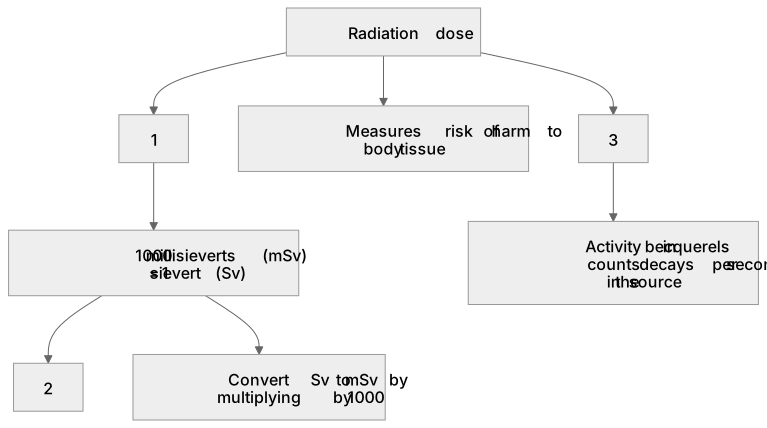
Some boxes have lost their names. Pick the right name for each number.
1Box 1
2Box 2
3Box 3
There is more to this lesson
The full lesson goes on to check your understanding and help you earn the marks. Create a free account to carry on, with your progress saved.
A week of Premium from your first lesson · Then the free plan continues · No card, no charge
Test your understanding of Background radiation: Radiation dose is measured in sieverts (Sv) 1000 millisieverts (mSv) = 1 sievert (Sv) Students will not need to recall the unit of radiation dose.
Active recall beats re-reading. Take an instant quiz now to test what you’ve learned and lock it into long-term memory.
A week of Premium from your first lesson · Then the free plan continues · No card, no charge