AQA · GCSE · Physics
Course version: 8463 · Version from Sept 2016
Students should be able to calculate the amount of energy associated with…
Full specification wording
Changes in energy: Students should be able to calculate the amount of energy associated with a moving object, a stretched spring and an object raised above ground level.
Three equations cover this content.
Checked against the AQA 8463 specification (opens in a new tab) on .
- Point 1 of 2
- 3 key terms
Study notes
From the checked teaching notes for this specification point.
The idea
Three equations cover this content. The kinetic store of a moving object is Eₖ = ½ m v², so doubling the speed quadruples the energy; a 0.020 kg aeroplane at 6.0 m/s stores 0.36 J. The elastic potential store of a spring is Eₑ = ½ k e², with e the extension in metres, not the total length; a spring of constant 50 N/m stretched 0.12 m stores 0.36 J. The gravitational potential store is Eₚ = m g h with g = 9.8 N/kg. Questions usually chain them: energy stored in the spring becomes the kinetic store of the launched object, so set ½ k e² equal to ½ m v² and solve for v. Watch the squares all the way through, because both the extension and the speed are squared, so halving the extension quarters the energy stored in the spring.
What earns the marks
- A correct substitution into ½ k e² using the extension rather than the length.
- Equating the elastic store to the kinetic store when the object is released.
- A correct rearrangement to make the speed the subject.
- The final value with the unit, for example 6.0 m/s.
Common mistakes and how to put them right
Squaring only part of the expression, so calculating ½ × m × v instead of ½ × m × v².
Putting the natural length of the spring into the equation in place of the extension.
Forgetting to convert kJ to J, which throws the spring constant out by a factor of 1000.
Exam tips
- Always write down the formula you are using before substituting numbers, such as Eₖ = ½ m v², to ensure you pick up the first mark even if your calculation goes wrong.
- Carry an unrounded intermediate energy into the second stage, then round only the final speed.
Try the lesson
The start of the Changes in energy: Students should be able to calculate the amount of energy associated with a moving object, a stretched spring and an object raised above ground level. lesson, made from checked teaching notes for this specification point.
Have a go first
A cyclist and bicycle have a combined mass of 80 kg and are moving at a speed of 5 m/s. Calculate the kinetic energy of the cyclist and bicycle.
Listen
Three equations cover this content. The kinetic store of a moving object is Eₖ = ½ m v², so doubling the speed quadruples the energy; a 0.020 kg aeroplane at 6.0 m/s stores 0.36 J. The elastic potential store of a spring is Eₑ = ½ k e², with e the extension in metres, not the total length; a spring of constant 50 N/m stretched 0.12 m stores 0.36 J. The gravitational potential store is Eₚ = m g h with g = 9.8 N/kg. Questions usually chain them: energy stored in the spring becomes the kinetic store of the launched object, so set ½ k e² equal to ½ m v² and solve for v. Watch the squares all the way through, because both the extension and the speed are squared, so halving the extension quarters the energy stored in the spring. A strong answer earns marks for these points. a correct substitution into ½ k e² using the extension rather than the length. equating the elastic store to the kinetic store when the object is released. a correct rearrangement to make the speed the subject. the final value with the unit, for example 6.0 m/s. Exam tip: Always write down the formula you are using before substituting numbers, such as Eₖ = ½ m v², to ensure you pick up the first mark even if your calculation goes wrong.
See it
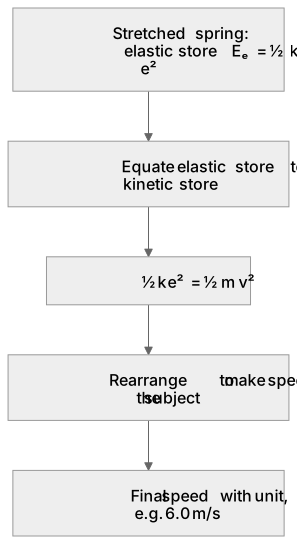
Put it in order
Put these steps in the order they happen.
- 1. Equate elastic store to kinetic store
- 2. ½ k e² = ½ m v²
- 3. Stretched spring: elastic store Eₑ = ½ k e²
- 4. Final speed with unit, e.g. 6.0 m/s
- 5. Rearrange to make speed the subject
Key words
Say what each word means before you turn the card.
kinetic store
Try answering aloud or in your head before turning the card.
elastic potential store
Try answering aloud or in your head before turning the card.
gravitational potential store
Try answering aloud or in your head before turning the card.
See every definition
- kinetic store
- The energy associated with a moving object, calculated as Eₖ = ½ m v², so doubling the speed quadruples the energy.
- elastic potential store
- The energy stored in a stretched spring, calculated as Eₑ = ½ k e², with e the extension in metres, not the total length.
- gravitational potential store
- The energy associated with an object raised above ground level, calculated as Eₚ = m g h with g = 9.8 N/kg.
Label the diagram
Some boxes have lost their names. Pick the right name for each number.
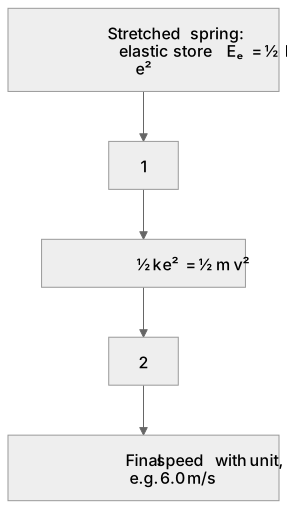
1Box 1
2Box 2
There is more to this lesson
The full lesson goes on to check your understanding and help you earn the marks. Create a free account to carry on, with your progress saved.
A week of Premium from your first lesson · Then the free plan continues · No card, no charge
Test your understanding of Changes in energy: Students should be able to calculate the amount of energy associated with a moving object, a stretched spring and an object raised above ground level.
Active recall beats re-reading. Take an instant quiz now to test what you’ve learned and lock it into long-term memory.
A week of Premium from your first lesson · Then the free plan continues · No card, no charge