AQA · GCSE · Physics
Course version: 8463 · Version from Sept 2016
Energy f or a change o f state = mass × speci f ic latent heat E = m L…
Full specification wording
Changes of state and specific latent heat: energy f or a change o f state = mass × speci f ic latent heat E = m L energy, E, in joules, J mass, m, in kilograms, kg specific latent heat, L, in joules per kilogram, J/kg Specific latent heat of fusion – change of state from solid to liquid Specific latent heat of vaporisation – change of state from liquid to vapour Students should be able to interpret heating and cooling graphs that include changes of state.
E = m L has no temperature term, as temperature is constant during a change of state.
Checked against the AQA 8463 specification (opens in a new tab) on .
- Point 3 of 4
- 3 key terms
Study notes
From the checked teaching notes for this specification point.
The idea
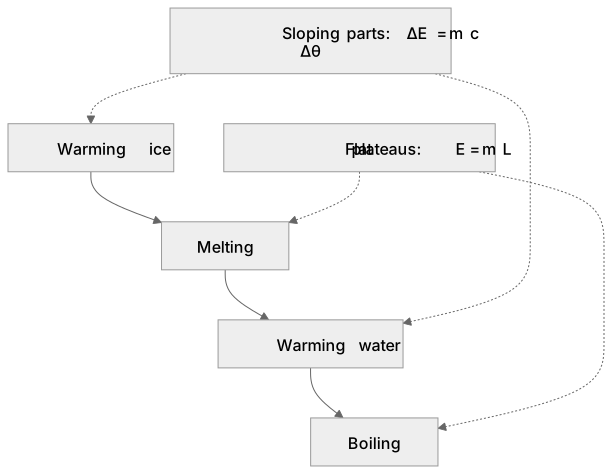
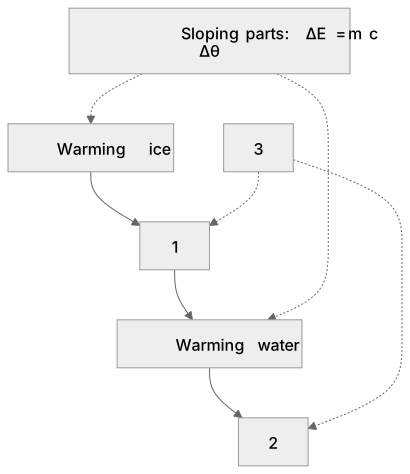
E = m L has no temperature term, as temperature is constant during a change of state. Boiling 0.25 kg of water needs E = 0.25 × 2 260 000 = 565 000 J. On heating and cooling graphs, sloping parts belong to ΔE = m c Δθ and flat plateaus belong to E = m L. Heating ice at -10 °C to steam at 100 °C involves four stages: warming ice, melting, warming water, and boiling. Cooling graphs show the reverse, with plateaus for condensing and freezing. Two standard practical errors exist. If thermal energy escapes to the surroundings, less energy reaches the water, making the calculated L too high. If water evaporates before boiling, the measured mass change is too large for the energy supplied, making L too low.
What earns the marks
- Choosing E = m L for a change of state and ΔE = m c Δθ for a temperature change.
- Correct substitution with the mass that actually changed state, in kilograms.
- The answer in joules.
- Stating that thermal energy transferred to the surroundings makes the experimental value of L too high.
- Stating that water evaporating before boiling makes the measured mass change too large, so the value of L is too low.
Common mistakes and how to put them right
Multiplying by a temperature change in E = m L, which has no temperature term.
Reading the melting point from a sloping section of the graph instead of the plateau.
Using the total mass of the sample when only part of it changed state.
Adding the two stages of a graph question together but using c for both, or L for both.
Exam tips
- Label each section of a heating or cooling graph with the equation you will use before you calculate anything.
- When asked about an error, say whether the value of L is too high or too low, and give the reason in the same sentence.
- Check the mass: it is the mass that changed state, often a mass loss read from a balance, not the starting mass.
Try the lesson
The start of the Changes of state and specific latent heat: energy f or a change o f state = mass × speci f ic latent heat E = m L energy, E, in joules, J mass, m, in kilograms, kg specific latent heat, L, in joules per kilogram, J/kg Specific latent heat of fusion – change of state from solid to liquid Specific latent heat of vaporisation – change of state from liquid to vapour Students should be able to interpret heating and cooling graphs that include changes of state. lesson, made from checked teaching notes for this specification point.
Have a go first
A block of ice has a mass of 0.50 kg. The specific latent heat of fusion of ice is 334000 J/kg. Calculate the energy needed to melt the ice at 0 °C.
Listen
E = m L has no temperature term, as temperature is constant during a change of state. Boiling 0.25 kg of water needs E = 0.25 × 2 260 000 = 565 000 J. On heating and cooling graphs, sloping parts belong to ΔE = m c Δθ and flat plateaus belong to E = m L. Heating ice at -10 °C to steam at 100 °C involves four stages: warming ice, melting, warming water, and boiling. Cooling graphs show the reverse, with plateaus for condensing and freezing. Two standard practical errors exist. If thermal energy escapes to the surroundings, less energy reaches the water, making the calculated L too high. If water evaporates before boiling, the measured mass change is too large for the energy supplied, making L too low. A strong answer earns marks for these points. choosing E = m L for a change of state and ΔE = m c Δθ for a temperature change. correct substitution with the mass that actually changed state, in kilograms. the answer in joules. stating that thermal energy transferred to the surroundings makes the experimental value of L too high. Exam tip: Label each section of a heating or cooling graph with the equation you will use before you calculate anything.
See it
Key words
Say what each word means before you turn the card.
E = m L
Try answering aloud or in your head before turning the card.
heating and cooling graphs
Try answering aloud or in your head before turning the card.
practical error analysis
Try answering aloud or in your head before turning the card.
See every definition
- E = m L
- The equation for the energy for a change of state, where energy is in joules, mass in kilograms and specific latent heat in joules per kilogram.
- heating and cooling graphs
- Graphs that include changes of state, in which sloping parts belong to ΔE = m c Δθ and flat plateaus belong to E = m L.
- practical error analysis
- Explaining how energy lost to the surroundings makes the calculated L too high, and how water evaporating before boiling makes L too low.
Label the diagram
Some boxes have lost their names. Pick the right name for each number.
1Box 1
2Box 2
3Box 3
There is more to this lesson
The full lesson goes on to check your understanding and help you earn the marks. Create a free account to carry on, with your progress saved.
A week of Premium from your first lesson · Then the free plan continues · No card, no charge
Test your understanding of Changes of state and specific latent heat: energy f or a change o f state = mass × speci f ic latent heat E = m L energy, E, in joules, J mass, m, in kilograms, kg specific latent heat, L, in joules per kilogram, J/kg Specific latent heat of fusion – change of state from solid to liquid Specific latent heat of vaporisation – change of state from liquid to vapour Students should be able to interpret heating and cooling graphs that include changes of state.
Active recall beats re-reading. Take an instant quiz now to test what you’ve learned and lock it into long-term memory.
A week of Premium from your first lesson · Then the free plan continues · No card, no charge