AQA · GCSE · Physics
Course version: 8463 · Version from Sept 2016
Students should be able to use the concept of momentum as a model to:…
Full specification wording
Conservation of momentum: Students should be able to use the concept of momentum as a model to: describe and explain examples of momentum in an event, such as a collision (physics only) complete calculations involving an event, such as the collision of two objects.
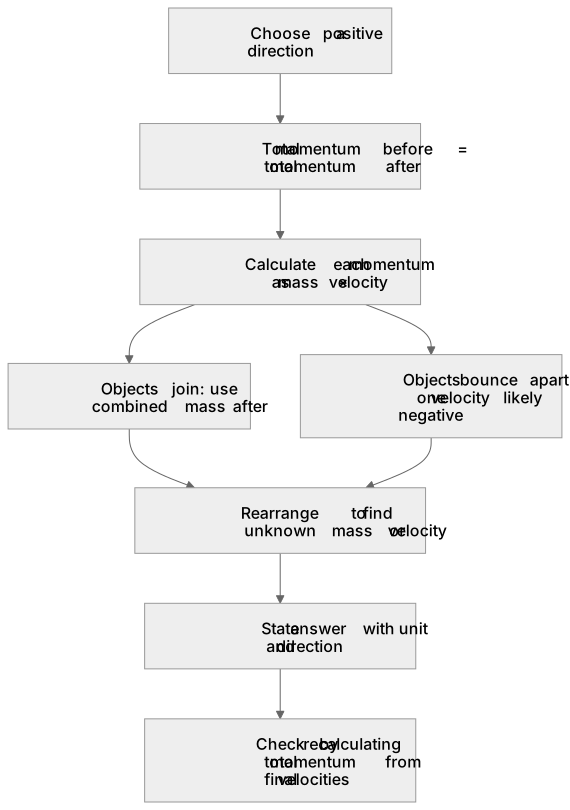
Using momentum as a model means writing total momentum before = total momentum after and filling in each term as mass × velocity.
Checked against the AQA 8463 specification (opens in a new tab) on .
- Point 3 of 3
- 4 key terms
Study notes
From the checked teaching notes for this specification point.
The idea
Using momentum as a model means writing total momentum before = total momentum after and filling in each term as mass × velocity. Choose a positive direction first. In a collision where objects join, the after side uses the combined mass. Where they bounce apart, one velocity is likely to be negative. A worked example: a 0.5 kg ball travelling at 4 m/s to the right hits a stationary 1.5 kg ball and stops dead. The total before is 0.5 × 4 = 2 kg m/s, so the second ball must carry 2 kg m/s afterwards, giving 2 ÷ 1.5 = 1.3 m/s to the right. Always finish by stating the direction as well as the number. If an object starts at rest its momentum is zero, but its mass still counts on the other side of the equation once it has been set moving. Check your work by recalculating the total momentum from your final velocities.
What earns the marks
- Stating or using total momentum before = total momentum after.
- Calculating each momentum as mass × velocity with consistent directions.
- A correct rearrangement to find the unknown mass or velocity.
- The answer with its unit and its direction stated.
Common mistakes and how to put them right
Using the mass of only one object after two have joined together.
Ignoring the sign of a velocity that points the opposite way.
Rounding an intermediate momentum so the final velocity is outside the allowed range.
Quoting a bare speed when the question asked for a velocity, which needs a direction.
Exam tips
- Set out a before and after table with mass and velocity for every object.
- Keep full accuracy in the working and round only the final answer.
- If an answer comes out negative, say what that means: the object moves the opposite way.
Try the lesson
The start of the Conservation of momentum: Students should be able to use the concept of momentum as a model to: describe and explain examples of momentum in an event, such as a collision (physics only) complete calculations involving an event, such as the collision of two objects. lesson, made from checked teaching notes for this specification point.
Have a go first
A 2 kg trolley moving at 3 m/s collides head-on with a stationary 4 kg trolley, and the two trolleys stick together. What is the total momentum of the two trolleys just after the collision?
Listen
Using momentum as a model means writing total momentum before = total momentum after and filling in each term as mass × velocity. Choose a positive direction first. In a collision where objects join, the after side uses the combined mass. Where they bounce apart, one velocity is likely to be negative. A worked example: a 0.5 kg ball travelling at 4 m/s to the right hits a stationary 1.5 kg ball and stops dead. The total before is 0.5 × 4 = 2 kg m/s, so the second ball must carry 2 kg m/s afterwards, giving 2 ÷ 1.5 = 1.3 m/s to the right. Always finish by stating the direction as well as the number. If an object starts at rest its momentum is zero, but its mass still counts on the other side of the equation once it has been set moving. Check your work by recalculating the total momentum from your final velocities. A strong answer earns marks for these points. stating or using total momentum before = total momentum after. calculating each momentum as mass × velocity with consistent directions. a correct rearrangement to find the unknown mass or velocity. the answer with its unit and its direction stated. Exam tip: Set out a before and after table with mass and velocity for every object.
See it
Key words
Say what each word means before you turn the card.
collisions
Try answering aloud or in your head before turning the card.
momentum calculations
Try answering aloud or in your head before turning the card.
combined mass
Try answering aloud or in your head before turning the card.
direction and sign
Try answering aloud or in your head before turning the card.
See every definition
- collisions
- Events in which objects interact, and momentum can be described and explained using the concept of momentum as a model.
- momentum calculations
- Calculations involving an event such as the collision of two objects, using total momentum before = total momentum after with each momentum as mass × velocity.
- combined mass
- The mass used on the after side of the equation in a collision where objects join together.
- direction and sign
- Choosing a positive direction first, so that where objects bounce apart one velocity is likely to be negative and the answer states the direction as well as the number.
Label the diagram
Some boxes have lost their names. Pick the right name for each number.
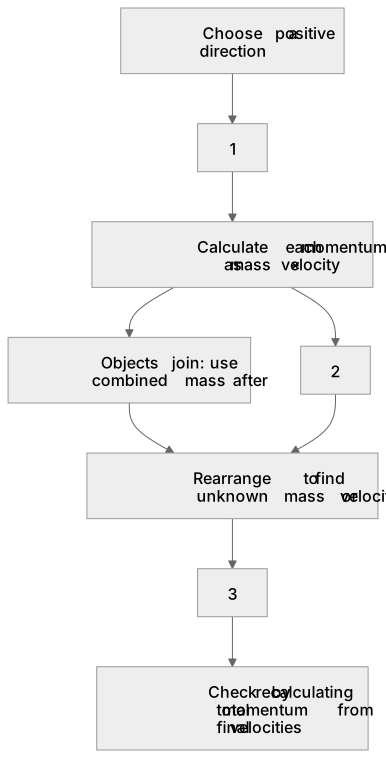
1Box 1
2Box 2
3Box 3
There is more to this lesson
The full lesson goes on to check your understanding and help you earn the marks. Create a free account to carry on, with your progress saved.
A week of Premium from your first lesson · Then the free plan continues · No card, no charge
Test your understanding of Conservation of momentum: Students should be able to use the concept of momentum as a model to: describe and explain examples of momentum in an event, such as a collision (physics only) complete calculations involving an event, such as the collision of two objects.
Active recall beats re-reading. Take an instant quiz now to test what you’ve learned and lock it into long-term memory.
A week of Premium from your first lesson · Then the free plan continues · No card, no charge